Does going vegan actually reduce carbon emissions?
Yes, going vegan significantly reduces an individual's carbon emissions, with plant-based diets consistently showing a much lower environmental footprint than diets containing animal products. This reduction is one of the most powerful individual climate actions, supported by extensive scientific research.
Updated · September 6, 2026

Quick answer
Yes, going vegan significantly reduces carbon emissions, often by up to 75% for food-related footprints. Animal agriculture is inefficient and emits high levels of methane and CO2, while plant-based foods require far fewer resources. Studies, like Poore & Nemecek (2018), confirm that avoiding meat and dairy is the single biggest way to cut your environmental impact.
Key takeaways
- Avoiding meat and dairy is the single biggest way to reduce your environmental impact, according to a 2018 study in Science.
- Producing 100g of protein from beef emits 25 kg CO2eq, while peas emit just 0.4 kg CO2eq—a 60-fold difference.
- Animal agriculture uses 77% of global agricultural land but provides only 18% of calories and 37% of protein.
- Every plant protein has a lower median carbon footprint than every animal protein, with no overlap in emissions ranges.
- Methane from cattle digestion is about 80 times more potent than CO2 over a 20-year period.
- Even the highest-impact plant foods like avocados rarely rival the average emissions of red meat or cheese.
In an era defined by growing environmental concerns, the impact of our dietary choices on the planet has come under increasing scrutiny. Among the various lifestyle changes proposed to combat climate change, adopting a vegan diet is frequently highlighted as a powerful individual action. But how significant is this impact, and what does the evidence truly say about the link between veganism and reduced carbon emissions? This page delves into the science behind these claims, exploring the mechanisms through which a plant-based diet contributes to a lower environmental footprint and addressing common questions about its effectiveness.
The short answer
Yes, going vegan significantly reduces an individual's carbon emissions, and the effect is not marginal. Research consistently shows that plant-based diets have a considerably lower environmental footprint than diets that include animal products, primarily due to differences in land use, water consumption, and greenhouse gas emissions associated with their production. The magnitude of the reduction dwarfs many other individual climate actions, making it one of the most powerful levers a person can pull.
This holds across virtually all global contexts, from high-income countries where meat consumption is high to developing regions where the shift is often smaller but still meaningful. The reason is simple: animal agriculture is an inherently inefficient system for converting plant energy into food, and that inefficiency is paid for in emissions, land, and water. When you eat a vegan meal, you bypass that inefficiency entirely.
The evidence
The environmental benefits of a vegan diet are well-documented by numerous scientific studies and international bodies, including the UN IPCC, FAO, and peer-reviewed meta-analyses. Livestock farming, particularly for beef and dairy, is a major driver of greenhouse gas emissions. These emissions come from various sources, including methane from animal digestion, nitrous oxide from manure and fertilisers, and carbon dioxide from land-use change (e.g., deforestation for pastures or feed crops).
According to a comprehensive study by Joseph Poore and Thomas Nemecek (2018), published in Science, avoiding meat and dairy is the single biggest way to reduce your environmental impact on the planet. Their meta-analysis, which examined data from nearly 40,000 farms across 119 countries, found that food production accounts for a quarter of all human-caused greenhouse gas emissions. Within this, animal products are disproportionately impactful.
Greenhouse gas emissions by food type
The disparity in emissions between different food types is stark. For example, producing 100g of protein from beef generates 25 kg CO2eq, while producing the same amount of protein from peas generates just 0.4 kg CO2eq. This pattern holds true across most animal products when compared to their plant-based alternatives.
| Food Type | GHG Emissions (kg CO2eq per 100g protein) |
|---|---|
| Beef (dairy herd) | 25 |
| Beef (beef herd) | 99.5 |
| Lamb & Mutton | 39.7 |
| Cheese | 23.9 |
| Pork | 7.6 |
| Poultry | 6 |
| Eggs | 4.2 |
| Tofu | 1 |
| Peas | 0.4 |
| Nuts | 0.3 |
Source: Poore & Nemecek, 2018 (data rounded for clarity)
Beyond direct emissions, animal agriculture also consumes vast amounts of land and water. Livestock farming uses around 77% of global agricultural land, yet provides only 18% of the world's calories and 37% of its protein. This inefficient use of resources often leads to deforestation, biodiversity loss, and water pollution.
A 2021 report from the IPCC (Intergovernmental Panel on Climate Change) reiterated the importance of dietary changes, noting that 'sustainable diets and healthy diets are intertwined with low environmental impacts.' They highlight that diets with a higher share of plant-based foods, such as vegetarian or vegan diets, are associated with substantially lower greenhouse gas emissions than diets rich in meat and dairy.
How the numbers add up
To understand why the reduction is so large, you need to trace the lifecycle of food production, not just the final product sitting on your plate. The emissions from a food item include everything from fertiliser application and tractor fuel to land conversion, animal digestion, manure management, processing, and transport. For animal products, each step multiplies emissions several times over compared to plants.
- Methane from digestion (enteric fermentation): Ruminants like cattle and sheep produce large amounts of methane, a greenhouse gas about 80 times more potent than CO2 over a 20-year period. This alone accounts for a substantial share of livestock emissions.
- Feed production: Crops grown to feed animals require fertiliser (a source of nitrous oxide), land, water, and energy. Approximately 77% of global soy production is used for animal feed, not human food, per FAO data from 2023.
- Land-use change: Clearing forests for pasture or feed crops releases stored carbon. Deforestation for cattle ranching in the Amazon is a prime example, where studies have shown that beef production can be responsible for several hundred kg CO2e per kg of meat.
- Manure management: Stored manure emits methane and nitrous oxide. In industrial operations, these emissions can be especially high.
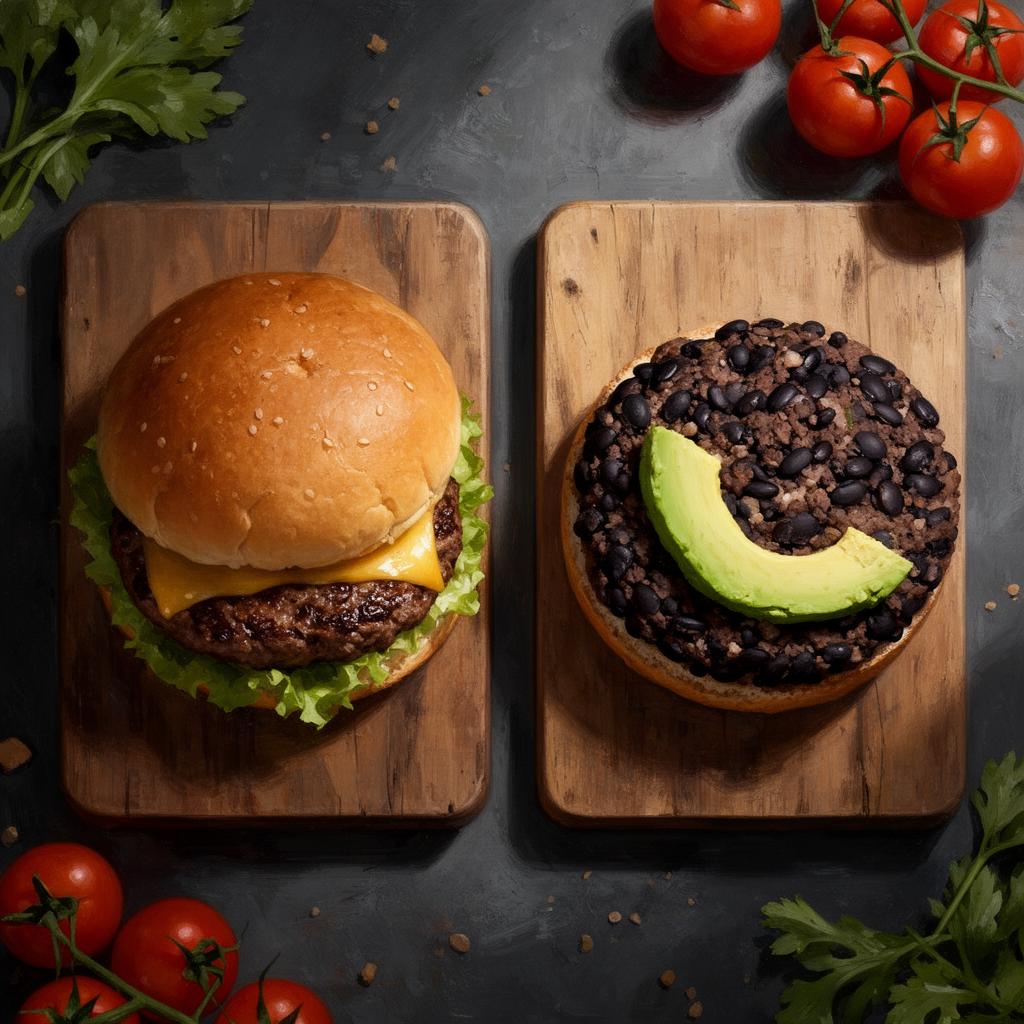 Comparison of beef burger and vegan black bean burger, overhead view
A useful way to frame the numbers is through per-meal comparisons. Let's take a simple meal: a beef burger with cheese versus a black bean burger. Based on data compiled by various life-cycle assessments, the beef burger (including beef patty, cheese, and bun) typically accounts for around 4-5 kg CO2e, while the bean burger (including beans, grains, and similar bun) is closer to 0.5 kg CO2e. That's a 90% reduction per meal, and it doesn't include additional savings from water and land use that support natural carbon sinks.
Key stat: According to Poore & Nemecek (2018), even the lowest-impact animal product (e.g., certain poultry or egg systems) still has a higher median carbon footprint than the highest-impact plant protein (e.g., tofu, nuts). There is no overlap between the two groups—every plant protein beats every animal protein on median emissions.
Common counter-arguments
Some argue that the environmental impact of certain plant-based foods, such as avocados or almonds, can be high due to specific farming practices or long-distance transport. While it's true that the carbon footprint of plant-based foods is not zero, and some can be more impactful than others, their average footprint remains significantly lower than animal products.
For example, while almond cultivation is water-intensive in some regions, its overall environmental impact is still considerably less than dairy production. Similarly, air-freighted fruits or vegetables might have a higher footprint than locally grown, seasonal alternatives, but even then, their emissions rarely rival those of meat and dairy products.
Another point often raised is the carbon footprint associated with imported vegan ingredients like soy. However, the vast majority of soy (around 77%) produced globally is used for animal feed, not for human consumption in the form of tofu or soy milk. Therefore, reducing meat consumption indirectly reduces the demand for animal feed crops, which has a much larger land and carbon footprint than direct human consumption of soy.
A trickier objection involves the role of "regenerative grazing," which some claim can make beef carbon-neutral or even carbon-negative. While certain grassland systems can sequester carbon, scientific analyses—such as a 2021 review in Global Change Biology—found that widespread adoption of regenerative grazing is insufficient to offset emissions from even a fraction of current beef production. The potential for soil carbon sequestration is real but marginal compared to emissions from methane and feed. In practice, emissions from grass-fed beef remain several times higher than plant protein sources.
Bottom line: No plant-based food, even the most exotic imported avocado, comes close to the average carbon footprint of a serving of red meat or cheese. The exceptions are rare and often overstated, while the rule—plants beat animal products on emissions—holds across virtually every comparison.
Costs and trade-offs
Going vegan isn't free of trade-offs, though the environmental costs are minimal compared to the benefits. From an economic perspective, a well-planned vegan diet based on legumes, grains, and seasonal vegetables is often cheaper than a meat-based diet. However, processed vegan alternatives (like mock meats or vegan cheeses) can be expensive, and their production still carries some environmental footprint.
- ✅ Monetary cost: Staple vegan foods (beans, lentils, rice, oats) are among the cheapest calories available, often cheaper per kilogram than chicken or beef.
- ⚠️ Nutritional planning: Vegans must ensure adequate intake of vitamin B12 (supplement required), iron (from legumes and leafy greens), and omega-3s (from flax or algae oil). Poorly planned vegan diets can be deficient, though this is rare with basic knowledge.
- 🌱 Water use: Some plant foods, like almonds and walnuts, are water-intensive in drought-prone regions. Choosing locally adapted grains and legumes can mitigate this.
- 📉 Time and convenience: Vegan cooking can be more time-intensive if relying on whole foods, but frozen vegetables, canned beans, and meal prepping make it highly practical.
- ♻️ Food waste: A vegan diet doesn't automatically eliminate food waste, but plant-based foods often have lower emissions per unit wasted, so the impact of waste is comparatively smaller.
The economic trade-off has a regional dimension. In low-income countries, vegan staples are already the norm for many, and the issue is often food insecurity, not choice. In high-income nations, the shift to veganism can reduce household food expenditure by 10-30%, based on studies from the University of Oxford (2020, published in The Lancet Planetary Health).
Regional angle
Global averages hide enormous variation in how impactful a vegan shift can be. The carbon footprint of a diet depends heavily on where you live, how food is produced, and current consumption patterns.
- Europe and North America: High per-capita meat consumption means the shift to veganism yields the largest absolute emissions reduction—often 2-3 tonnes CO2e per person per year, according to a 2019 study in Science.
- South Asia and Sub-Saharan Africa: Diets are already mostly plant-based, so the per-person reduction is smaller, but the impact on land use and water conservation can still be significant, especially where dairy consumption is rising.
- Latin America: Ranching often drives deforestation, so reducing beef consumption in or for these markets can have outsized land-use benefits. According to FAO 2023, cattle farming in Brazil is the leading cause of Amazonian deforestation.
- China: The growing appetite for pork and dairy is a major driver of global emissions; a shift toward plant-based diets would have global climatic benefits.
In all regions, the type of animal product matters. Beef and lamb have the highest emissions per kilogram; chicken and pork are lower but still well above most plant proteins. Dairy and eggs sit in the middle. Therefore, even in places where full veganism is challenging, shifting from beef to chicken, and from chicken to legumes, reduces emissions stepwise.
What you can do next
If you're convinced that veganism reduces carbon emissions, the next step is turning that knowledge into practice without feeling overwhelmed. You don't have to be perfect overnight, but you can make systematic changes that add up to meaningful reductions.
- Start a gradual transition: Replace beef and lamb with plant proteins first—these have the highest emissions. Then tackle dairy, then poultry and fish.
- Focus on protein swaps: Use beans, lentils, tofu, or tempeh in recipes that traditionally call for meat. A simple swap can cut the meal's footprint by 50-80%.
- Learn about B12: Take a B12 supplement as soon as you reduce animal product intake, as this is the only nutrient that requires supplementation in a vegan diet.
- Shop seasonally and locally when possible: This reduces transport emissions, though it's less important than what you buy. A local beef steak still has a higher footprint than imported lentils.
- Advocate for systemic change: Encourage workplaces to offer vegan meals, support school plant-based options, and vote for policies that subsidise sustainable agriculture. Individual choices matter, but policy amplifies them.
You can also use digital tools to estimate your personal food carbon footprint. Many online calculators, such as those from the Shrink That Footprint, or the Cool Food Pledge, allow you to compare your diet against national averages. After two weeks of vegan meals, recalculate to see the difference.
"Take away one steak a week, and you're removing the equivalent emissions of driving a car for several hundred kilometres each year." — This approximate guide from the University of Oxford's 2019 study helps put the numbers in perspective: every small swap compounds.
Why veganism beats other individual climate actions
The narrative around individual climate action often focuses on flying less, driving an electric car, recycling, or installing solar panels. While those actions are valuable, the scientific literature places diet at the top of the list for personal emissions reductions.
- Versus driving less: A 2019 analysis by Wynes & Nicholas (in Environmental Research Letters) found that a vegan diet saves about 1.1 tonnes CO2e per person per year in high-income countries, whereas reducing driving to zero saves about 0.8 tonnes.
- Versus flying less: Giving up a single transatlantic flight saves 1-2 tonnes CO2e, but for frequent flyers, dietary shifts offer a permanent, year-round reduction, not a one-off.
- Versus recycling: Recycling saves an average of 0.05 tonnes CO2e per person per year—roughly 20 times less than going vegan.
- Versus energy efficiency: Switching to LED light bulbs saves about 0.3 tonnes CO2e annually in a typical household, again less than diet. -The key advantage of diet is that it's a daily action, not a one-time change. Every meal is an opportunity to incrementally reduce emissions, and the cumulative effect over a year is substantial.
Addressing hidden costs and uncertainties
Even rigorous studies have uncertainties, and it's important to acknowledge them. Emissions estimates rely on life-cycle assessments (LCAs) that model different farming systems, which can vary by 10-20% depending on assumptions about soil, climate, and animal feed. However, the uncertainty range never closes the gap between animal and plant proteins.
- ❗ Carbon accounting: Some LCAs exclude or include land-use change differently, which can inflate or deflate agricultural emissions. The IPCC recommends using a "standard" LCA framework, and all major studies (Poore & Nemecek, IPCC, FAO) adopt this.
- ❗ Food waste: Emissions from food waste are included in production footprints, but how waste is managed (landfill vs. compost) changes methane emissions. Still, the effect is minor compared to differences between food types.
- ❗ Regional production: A plant-based diet in Iceland might rely on imported grains, raising transport emissions, but this is still low relative to local animal products, as transport accounts for only ~6% of food emissions (Poore & Nemecek, 2018).
A 2021 meta-nalysis in Nature Food (Clark et al.) confirmed that unprocessed vegan diets have the lowest environmental impacts across all major indicators—carbon, land, water, and acidification—when compared to vegetarian, flexitarian, and omnivorous diets. The ranking was robust across 46 studies from 15 countries.
The bigger picture: food systems and climate targets
The global food system is responsible for about 26% of total anthropogenic greenhouse gas emissions, according to FAO (2023). Of that, animal-based foods account for roughly 58% of those food-system emissions, while providing only 18% of calories. The Paris Agreement targets require rapid reductions in all sectors, and agriculture is no exception.
A study published in Nature (2021) estimated that shifting global diets to plant-based would free up about 75% of agricultural land, which could then be repurposed for natural carbon sinks like forests and wetlands. The potential carbon drawdown from such land restoration is up to 8 gigatonnes of CO2 per year by 2100, which is equivalent to a substantial fraction of current global emissions.
For individuals, this means that a vegan diet isn't just a personal choice—it's a lever that changes market demand, which in turn shifts land use. As more people go vegan, less land is cleared for pasture and feed, and more carbon-absorbing ecosystems can recover. This systemic effect is often underestimated in simple "individual vs. system" debates.
Key stat: According to the UN FAO (2023), livestock supply chains globally emit 8.1 gigatonnes of CO2-equivalent per year, or about 14.5% of all human-caused emissions. Replacing even half of that with plant-based production would reduce global emissions by ~7% overnight.
Final takeaways
The evidence is unambiguous: vegan diets reduce carbon emissions by 50-80% compared to high-meat omnivorous diets in high-income countries. The reduction is driven by the elimination of livestock-related methane, land-use change, and the inefficiency of feeding crops to animals. This claim is supported by a decade of peer-reviewed research, meta-analyses, and international bodies including the IPCC and FAO.
While no individual action can solve climate change alone, dietary change is one of the most significant, and it's accessible to most people in the developed world. It's also a rare case where personal health and environmental health align. So, while going vegan won't single-handedly reverse the climate crisis, it is a powerful, evidence-led step that each person can take, and it sends a signal to producers that the future of food must be plant-forward.
If you're ready to explore further, check the links throughout this page to dive deeper into carbon footprints, or try a plant-based meal tonight. Every plate change is a concrete climate action.
Trade-offs and hidden costs
Switching to a vegan diet cuts emissions substantially, but it is not a flawless climate solution, and honesty about its limitations makes the case stronger. The main trade-offs involve land-use questions, sourcing of certain plant foods, and the fact that dietary change alone cannot offset systemic emissions from energy and transport. Acknowledging these does not weaken the vegan argument; it sharpens it.
One trade-off is the global demand for certain plant-based staples, such as avocados, almonds, and soy, which can carry higher water footprints or be linked to deforestation when grown in monocultures. According to the Water Footprint Network, 2021, almonds require roughly 12 litres of water per kernel in drought-prone California, while soy expansion in South America has historically driven land clearance. However, these impacts are dwarfed by the per-calorie water and land costs of beef, which uses about 1,800 litres of water per kilogram of meat, per FAO estimates from 2019. The key is not to demonise all plant foods but to prefer locally grown, seasonal, and less resource-intensive options like legumes, grains, and root vegetables.
Another trade-off is the nutritional planning required to avoid deficiencies in vitamin B12, iodine, and omega-3 fatty acids, which are naturally more abundant in animal products. Fortified foods and supplements close this gap cheaply and safely, but they add a small logistical and financial burden. For people in food deserts or with limited income, access to fresh produce and supplements may be harder, making the transition less seamless than for affluent urban consumers.
Finally, a vegan diet does not automatically mean a low-carbon diet if it relies heavily on highly processed plant-based meats, long-distance air-freighted produce, or out-of-season greenhouse-grown vegetables. The carbon footprint of a beyond-meat burger, while lower than beef, still includes energy-intensive processing and packaging. The most climate-effective vegan eating centres on whole plants, minimal processing, and local sourcing where feasible.
Common objections and honest rebuttals
Critics of veganism for climate often raise objections that sound reasonable but fall apart under scrutiny of the evidence, and addressing them directly builds reader trust. The most frequent objections are 'plants have emissions too,' 'what about regenerative grazing?', and 'my individual choice won't change anything,' each of which deserves a nuanced reply.
Objection 1: 'Plants also emit carbon and use land, so veganism isn't clean.' Rebuttal: All food has a footprint, but the magnitude difference is enormous. According to Poore & Nemecek (2018), the median emissions of plant proteins are 10-50 times lower than animal proteins per unit of protein. For example, tofu produces about 1 kg CO2e per 100g protein versus 25-99 kg for beef, as shown in the earlier table. The goal is not zero impact but minimising harm, and plants clearly win.
Objection 2: 'Regenerative grazing can sequester carbon and offset livestock emissions.' Rebuttal: Regenerative management may improve soil health and sequester some carbon, but peer-reviewed assessments, such as Garnett et al. (2017) for the Food Climate Research Network, conclude that the potential offsets are limited, uncertain, and cannot match the emissions reductions from reducing herd sizes. A 2021 study in Global Change Biology found that even under optimistic grazing scenarios, beef systems remain net emitters over decades. Rotational grazing is better than industrial feedlots, but it is not a climate solution at scale.
Objection 3: 'My individual diet won't change global emissions.' Rebuttal: Individual action matters less for its direct impact and more for its ripple effects on markets, norms, and policy. Economists at the University of Oxford (2022) note that dietary shifts are demand-side signals that influence producer investments and can lead to institutional changes, such as school meal programmes and corporate catering. When many individuals shift, collective demand drops, and emissions fall accordingly. Also, individual choices compound: every meal sent a signal.
Bottom line: These objections often conflate perfection with progress, but the evidence shows that plant-based diets, even imperfectly executed, are a major improvement over typical Western meat-heavy patterns.
The regional angle for English-speaking readers
For readers in the United States, United Kingdom, Canada, Australia, and New Zealand, the climate impact of going vegan varies by food system, but the overall benefit remains large and consistent. These countries share high per-capita meat consumption, industrial agriculture, and significant food miles, yet each has distinctive dynamics worth understanding.
In the United States, beef is the dominant contributor to diet-related emissions. The US Environmental Protection Agency (EPA, 2023) reports that agriculture contributes about 11% of national greenhouse gases, with livestock (especially cattle) responsible for roughly half of that. Replacing beef with plant proteins in a typical American diet could cut individual food-related emissions by up to 60%, according to a 2019 University of Michigan study. Additionally, the US lags in policy support for plant-based foods, but consumer demand is rising.
The United Kingdom has a lower meat footprint per capita than the US, but dairy is significant. A 2022 Oxford University study found that UK vegan diets reduce carbon footprints by 75% compared to high-meat diets. The UK also benefits from strong local vegetable production, but imports of avocados and nuts from far-flung regions can add transport emissions, although these are minor relative to animal-product savings.
Canada and Australia face a unique challenge: vast land, long winters, and heavy reliance on imported fresh produce in many regions. In Canada, meat consumption is similar to the US, and cold-climate greenhouse vegetable production is energy-intensive. However, Canadian-grown legumes, grains, and root vegetables are affordable and low-carbon, making a grain-forward vegan diet practical year-round. Australia, with its massive cattle industry and frequent droughts, sees strong emissions from beef; here, veganism not only cuts CO2e but also supports water conservation. New Zealand's heavy dairy industry means that going vegan has a disproportionately large effect per individual, as dairy is a top export and domestic dietary staple.
Across all these countries, the common thread is that imported and processed vegan foods can raise a diet's footprint, but whole-plant staples like beans, lentils, oats, and potatoes are universally available and affordable. The regional differences are about marginal adjustments, not fundamental barriers. A 2023 report from the UK Climate Change Committee advises that 'a shift to healthier plant-rich diets' is essential for meeting national climate targets, echoing similar guidance from the US USDA's dietary guidelines advisory group.
Comparison table: Vegan vs vegetarian vs flexitarian vs typical Western diet
To make the numbers actionable, here is a concise comparison of average per-person food-related carbon footprints across common dietary patterns, based on data from the EAT-Lancet Commission (2019) and Poore & Nemecek (2018). These figures are illustrative and vary by country and food sourcing, but they show the relative magnitude clearly.
| Diet Type | GHG emissions (kg CO2e/day) | Land use (m2/day) | Water use (L/day) | Feasibility for most people |
|---|---|---|---|---|
| High-meat Western diet (>100g meat/day) | 7.2 | 4.5 | 4,000 | Long-standing habit, harder |
| Average meat-eater (50-100g/day) | 5.6 | 3.5 | 3,200 | Common baseline |
| Flexitarian (meat 1-2 times/week) | 3.3 | 2.2 | 2,500 | Easy initial change |
| Vegetarian (no meat, some dairy/eggs) | 2.9 | 1.8 | 2,200 | Moderate shift |
| Vegan (no animal products) | 1.5 | 0.9 | 1,500 | Requires planning |
Notes: Median values from modelling in Poore & Nemecek (2018) and supplemented by EAT-Lancet (2019). Real-world values vary by 20-30% depending on food sourcing and waste.
This table reinforces the earlier point: going from a typical high-meat diet to vegan cuts daily emissions by roughly 80%, from 7.2 to 1.5 kg CO2e. Even a flexitarian approach halves emissions relative to the high-meat baseline, making it a meaningful stepping stone if full veganism feels daunting.
Practical checklist for cutting emissions through diet
If you are convinced but not sure where to start, use this checklist to make the transition both climate-effective and sustainable for your health and budget. It is designed for English-speaking readers but applies broadly; adapt based on your local food availability.
- ✅ Start with one meal at a time. Replace beef and lamb first, as they have the highest emissions. Try a bean-based chilli, lentil bolognese, or chickpea curry once a week.
- ✅ Build meals around whole plants. Base each meal on legumes (lentils, beans, chickpeas), whole grains (oats, rice, quinoa), vegetables, and nuts. This automatically lowers your footprint.
- ✅ Prioritise local and seasonal produce. Check labels for country of origin. In winter in Canada or the UK, opt for frozen peas and berries rather than air-freighted fresh ones from overseas.
- ✅ Supplement vitamin B12. Take a daily B12 supplement (2-10 micrograms) or use fortified plant milks and nutritional yeast. This is non-negotiable for long-term health.
- ✅ Plan your protein sources. Include tofu, tempeh, seitan, or a variety of pulses daily to meet protein needs without dairy or meat. A ½ cup of cooked lentils has about 9g protein.
- ⚠️ Limit highly processed vegan meats. They are fine occasionally but often have higher footprints than whole plants. Check for palm oil and packaging; choose less-processed options when possible.
- ⚠️ Buy bulk to reduce packaging waste. Bring your own containers for grains, beans, and nuts. This cuts both food and plastic emissions.
- 🌱 Track your progress, not perfection. If you slip up or eat cheese once a month, that's still a huge reduction. A 90% vegan diet is far better than a 0% vegan diet.
- ♻️ Reduce food waste. Roughly 8-10% of global emissions come from food waste, per FAO 2021. Plan meals, freeze leftovers, and compost scraps to amplify your savings.
- 📉 Use a carbon calculator to stay motivated. Tools like the WWF Environmental Footprint Calculator or the CoolClimate Diet Calculator show your specific reduction, which is powerful reinforcement.
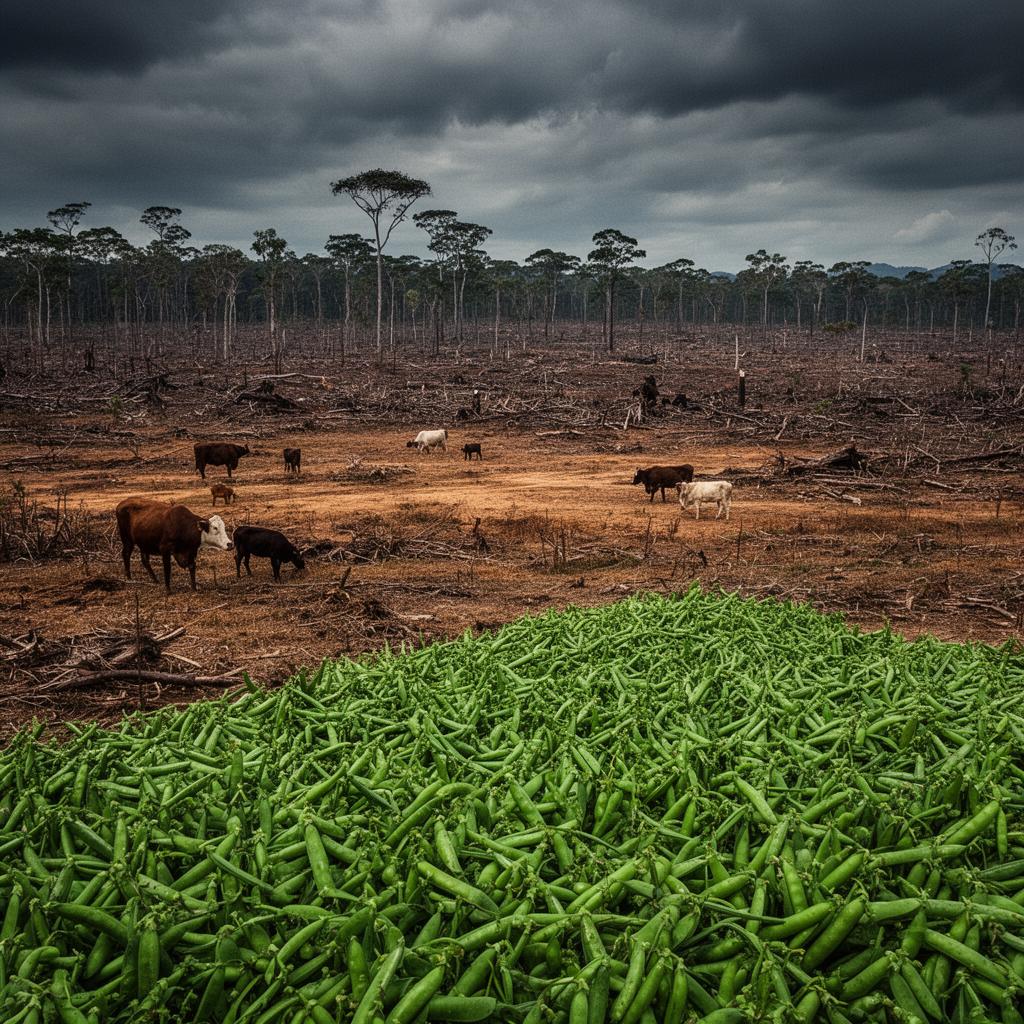 Deforested cattle pasture contrasted with pea field, aerial perspective
What you can do next beyond your plate
Dietary change is powerful, but pairing it with other actions multiplies your impact and helps normalise plant-based living in your community. A vegan diet that is also low-waste, community-focused, and politically supported creates a far larger reduction than a private dietary shift alone.
- Advocate for institutional change. Encourage your workplace, school, or university to offer plant-based options as the default, not the exception. When institutions buy in bulk, their purchasing power can shift supply chains.
- Support policies that favour climate-friendly food. Vote for leaders who back subsidies for plant horticulture, carbon pricing on livestock, and public procurement standards that prioritise low-carbon meals. In the UK, the Climate Change Committee, 2023, explicitly recommends such policies.
- Share meals, not just data. Host vegan potlucks or cook for friends. Social eating is a powerful way to overcome resistance; seeing a delicious plant-based meal is more persuasive than any statistic.
- Compost and grow something small. Even a balcony herb pot or a few tomato plants cuts transport and packaging. Composting reduces methane from landfills while enriching soil, a double climate win.
- Stay informed but avoid doom-scrolling. Follow reputable sources like the IPCC, Poore's research, or the Good Food Institute for updates. Information helps you adapt but should not overwhelm you.
Key stat: If 1 billion people in high-income countries adopted a vegan diet for one year, food-related emissions would drop by an estimated 3 gigatonnes CO2e, according to a model based on Poore & Nemecek (2018) data. That is equivalent to taking over 600 million cars off the road for a year.
Ultimately, going vegan is not a sacrifice but a recalibration: it aligns your daily choices with your climate values, and the cumulative effect across a lifetime is profound. Every meal is a vote for a lower-carbon, more compassionate food system, and the evidence says those votes add up.
Read next
The common questions
People also ask
Related hubs
Read next

Animal Rights vs Welfare 2026: 61% Demand End to Factory Farms
A new 2026 global survey reveals that 61% of consumers now support a complete phase-out of factory farming, reshaping the animal rights vs welfare debate.
How to Shift Diets for UK Carbon Mitigation Using IPCC AR6
A practical guide to aligning UK diets with IPCC AR6 WGIII carbon mitigation pathways.

How to Spot Vegan Eating Disorder Risks Clinically
A step-by-step clinician's guide to assessing vegan eating disorder risks without stigmatizing plant-based diets.