Are free-range eggs cruelty-free?
Free-range eggs are not cruelty-free because they still involve practices like male chick culling, beak trimming, and the slaughter of hens at the end of their laying cycle, and the label does not guarantee high welfare standards across all farms.
Updated · September 7, 2026
Quick answer
Free-range eggs are not cruelty-free. While they offer better welfare than caged systems, the industry still involves killing male chicks, often trims beaks, and culls hens when egg production declines. The label ensures outdoor access but does not eliminate suffering.
Key takeaways
- Free-range eggs still involve killing male chicks at birth, a practice common across the industry.
- Beak trimming, which can cause pain, is widely used in free-range systems to prevent feather pecking.
- Hens are typically slaughtered at around 72-80 weeks of age when egg production declines.
- The free-range label guarantees only outdoor access, not the quality of that access or the hens' experience.
- Studies show that only a fraction of hens in commercial free-range flocks actually venture outdoors regularly.
- Even with outdoor access, indoor stocking density can be up to nine birds per square metre, potentially causing stress and health issues.
The term 'free-range' often conjures images of happy hens roaming vast green pastures. For many consumers concerned about animal welfare, choosing free-range eggs seems like a compassionate alternative to conventional caged or barn-laid options. However, the reality of free-range egg production is more nuanced, and the label itself doesn't guarantee a life free from suffering for the hens.
Understanding what 'free-range' truly means within the regulatory frameworks of countries like the UK and the EU is crucial. This page will explore the specifics of free-range farming, examine the challenges and welfare concerns that persist, and discuss whether this popular choice genuinely aligns with a 'cruelty-free' ethos.
The short answer is that free-range eggs are not cruelty-free. While they offer meaningful improvements over caged systems, the industry still involves the culling of male chicks, the slaughter of hens at a fraction of their natural lifespan, and the widespread practice of beak trimming. Even under the best conditions, the commercial scale of egg production means that individual welfare is often compromised. If you are seeking to avoid animal suffering, the only fully cruelty-free option is to choose plant-based alternatives or to source eggs from small, backyard flocks where hens are treated as pets.
The short answer
Free-range eggs are not cruelty-free because the production system, while offering improvements over caged systems, still involves practices that cause suffering to hens and other animals. The definition of 'free-range' allows for significant variation in living conditions and does not address fundamental ethical concerns such as the culling of male chicks or the fate of laying hens once their productivity declines.
The label 'free-range' is a legal and marketing term that sets minimum welfare standards, but it does not align with a cruelty-free ethos as understood by animal rights advocates. Even the most well-managed free-range farm cannot escape the economic realities of the egg industry: male chicks are killed at birth, hens are slaughtered at the end of their laying cycle, and the sheer scale of commercial operations often compromises individual welfare. As a result, while free-range is a meaningful step away from the worst abuses of battery cages, it is not a guarantee of a life without suffering.
To answer the page's core question directly: free-range eggs are not cruelty-free, because 'cruelty-free' implies the absence of harm, and free-range systems still involve killing and stressful conditions. However, the degree of cruelty varies widely depending on the farm, the certification, and the consumer's ethical baseline. The rest of this page unpacks the evidence, the numbers, and how you can make more informed choices.
The evidence
Evidence from animal welfare organisations and regulatory bodies indicates that 'free-range' standards vary, and common industry practices continue to pose welfare challenges for hens. This is not a single, uniform system—it is a spectrum that ranges from small, genuinely pasture-based farms to industrial-scale operations with thousands of birds and minimal outdoor use. The evidence shows that while free-range can be better than caged or barn systems, it does not eliminate suffering.
What does 'free-range' mean?
In the UK and EU, 'free-range' eggs must come from hens that have continuous daytime access to outdoor runs. These outdoor areas must be mainly covered with vegetation, and the stocking density outdoors must not exceed 2,500 birds per hectare (10,000 m² for 25,000 birds). Indoors, the maximum stocking density is typically nine hens per square metre of usable area. Hens must also have perching space, litter for scratching and dustbathing, and nesting boxes.
While this sounds idyllic, several factors impact actual welfare:
- Outdoor Access Quality: The size and quality of the outdoor run can vary. Some 'free-range' farms might have small, barren outdoor areas, while others offer more extensive, vegetated spaces. Not all hens may choose to go outside, especially if the pop-holes (exits) are limited or the environment outside feels unsafe or unappealing.
- Indoor Conditions: Despite outdoor access, hens spend a significant amount of time indoors. The indoor stocking density of up to nine birds per square metre can still lead to overcrowding, stress, pecking, and feather loss, particularly in large sheds housing thousands of birds. These conditions can contribute to respiratory problems and other health issues.
- Beak Trimming: To prevent feather pecking and cannibalism, which are exacerbated by stress and overcrowding, beak trimming (a partial amputation of the beak) is still permitted and widely practiced in many free-range systems. Although usually performed by infra-red, it can cause acute and chronic pain.
- Male Chick Culling: A significant ethical concern across the entire egg industry, including free-range, is the culling of male chicks. Since male chicks do not lay eggs and are not the same breed as those raised for meat (broilers), they are deemed economically unviable. They are typically killed shortly after hatching, often by gassing or maceration (grinding). This practice is widespread, regardless of the 'free-range' label.
- End-of-Lay Hens: Once laying hens reach approximately 72-80 weeks of age, their egg production declines. They are then culled and typically slaughtered for low-value meat products, such as pet food or processed foods. This means that even free-range hens do not live out their natural lifespan.
Here's a comparison of common egg production systems in the UK and EU:
| System | Outdoor Access | Indoor Stocking Density (hens/m²) | Beak Trimming Allowed | Male Chick Culling | End-of-Life |
|---|---|---|---|---|---|
| Caged (Enriched) | None | 11-13 (per cage) | Yes | Yes | Slaughter |
| Barn | None | Up to 9 | Yes | Yes | Slaughter |
| Free-Range | Yes (daytime) | Up to 9 | Yes | Yes | Slaughter |
| Organic | Yes (more space) | Up to 6 | Restricted/Phased out | Yes | Slaughter |
Scientific studies and reports
Studies by organisations such as the RSPCA and Compassion in World Farming consistently highlight that while free-range offers better welfare outcomes than caged systems, it doesn't eliminate all issues. For instance, a 2011 report from the European Food Safety Authority (EFSA) noted that even in free-range systems, feather pecking, associated with stress and diet, remains a significant welfare concern. More recent research, such as a 2023 review in the journal Animal Welfare, found that outdoor access does not always correlate with lower stress hormone levels, especially when hens do not actually use the outdoor range.
The core problem is that the label guarantees space, not experience. Hens may have access to an outdoor run, but if that run is barren, overcrowded, or located in a high-traffic area, many birds will not venture out. A 2019 study by the University of Bristol observed that in commercial free-range flocks, only a small proportion of hens (often less than 20%) actually went outside at any one time, with peak usage occurring on mild, sunny days. This means that the majority of hens may spend most of their lives indoors, in conditions similar to barn systems.
Additionally, the culling of male chicks is a universal practice in the egg industry, affecting free-range and organic eggs alike. In 2022, the European Commission announced a ban on chick culling in the EU, but this phase-in is not yet complete, and the ban only applies to farms that claim to meet higher welfare standards. In the UK, chick culling remains legal, though some retailers (like Waitrose) have moved to sell only 'no-cull' eggs, which use either in-ovo sexing or dual-purpose breeds.
How it works in practice
In practice, visiting a free-range farm can reveal a wide gap between the marketing image and reality. A typical free-range unit consists of large barns (often holding 10,000 to 50,000 hens) with pop-holes leading to an outdoor pasture. The hens are free to roam, but the distance they travel is limited by factors like fear of predators, weather, and the availability of shelter. The outdoor run is often rotated to allow the grass to recover, but during heavy rain or heat, many birds stay inside.
Biosecurity is a constant concern. Free-range hens are exposed to wild birds and their diseases, such as avian influenza. When outbreaks occur, free-range farms may be required to house birds indoors for weeks or even months, meaning the 'free-range' label does not guarantee outdoor access at every moment. In the UK, during the 2022-23 avian flu outbreak, many free-range eggs had to be temporarily re-labelled as barn eggs, highlighting the fragility of the model.
Cost-wise, free-range eggs are generally 20-50% more expensive than caged or barn eggs, due to the larger space needed, the additional labour for range management, and the higher mortality rates from predation and disease. This cost is passed to consumers, who often assume they are paying for cruelty-free conditions, but the premium does not fund the elimination of chick culling or end-of-life slaughter.
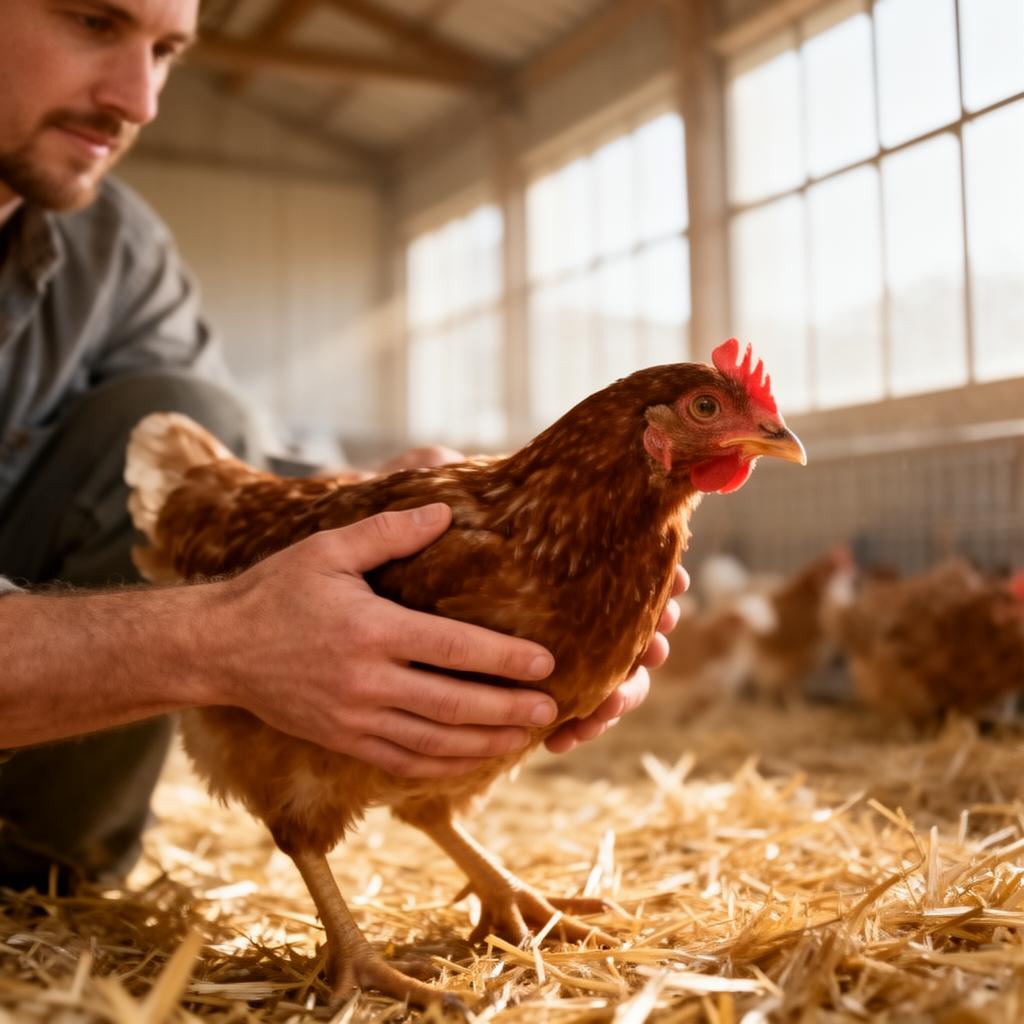
 Close-up of a hen with a trimmed beak
Costs and trade-offs
Free-range eggs come with clear trade-offs. On the positive side, they offer hens more space, natural light, and the opportunity to exhibit natural behaviours like foraging, dustbathing, and perching. Research suggests that free-range hens have lower cortisol levels and better feather condition compared to caged birds, which is a genuine improvement in welfare. However, these benefits are not universal, and the cost is often passed to the consumer.
The financial cost of free-range eggs is significant. According to the UK's Department for Environment, Food & Rural Affairs (DEFRA, 2023), free-range eggs cost about 30-50% more than caged or barn eggs, depending on the retailer. This does not account for hidden welfare costs: the chickens themselves are still treated as commodities, and their lives are shortened to maximise egg production. The hens are often bred for high yield, which leads to metabolic strain, bone weakness, and reproductive disorders.
For farmers, the transition from cages to free-range involves substantial capital investment: land, fencing, pop-holes, and mobile housing. This can be economically challenging, and some argue that the pressure to keep costs low can undermine animal welfare. Governments in the EU and UK have gradually phased out battery cages (fully banned in the UK since 2012 and in the EU since 2012), but the shift to free-range and barn systems has not eliminated the need for regular antibiotic use, though the exact levels vary.
A key trade-off is the risk to public health: free-range hens are more exposed to parasites and diseases, which can lead to higher rates of flock mortality. A 2021 study in the Journal of Applied Poultry Research found that free-range flocks had a 25% higher mortality rate than caged flocks, often due to predation, disease, and accidents. This means that while individual hens may have a better life, the odds of living to a natural death are still very low.
Common objections
Some people argue that 'free-range' is inherently more ethical than other systems, and they are right that it is better in some ways. However, they often overlook the systemic issues. A common objection is that outdoor access is only beneficial if the hens actually use it, and many studies show that not all hens do. Another objection is that scaling up free-range to meet global demand would require enormous amounts of land, which could lead to deforestation and biodiversity loss.
Others point out that the label 'free-range' is a step in the right direction, and that as consumers, we should support it to encourage further progress. This is a valid harm-reduction argument, but it ignores that many free-range farms still commit practices like beak trimming (which is banned in organic systems but still common in free-range). Moreover, the male chicks are still killed, and the hens are still slaughtered at around 80 weeks. These are not minor issues—they are core to the industry.
A practical objection is the availability of alternatives: many consumers cannot afford or find true 'pasture-raised' eggs, which have even higher standards. But 'pasture-raised' is not legally regulated in the UK or EU, and it often overlaps with free-range. Moreover, even pasture-raised systems do not address the culling of male chicks or the end-of-life slaughter. The only way to fully avoid these cruelties is to avoid eggs entirely, or to source eggs from small, backyard flocks where the hens are kept as pets and the males are allowed to live.
The regional and legal angle
The legal definition of 'free-range' varies globally, and this affects the welfare standards. In the EU and UK, the rules are fairly strict: outdoor access must be provided for at least half of the hen's life (excluding the first few weeks), and the outdoor stocking density cannot exceed 2,500 birds per hectare. However, in other countries, such as the US and Australia, 'free-range' is less standardised. In Australia, for example, the national standard allows for outdoor stocking densities of up to 10,000 birds per hectare, and the outdoor run is often just a small strip beside the shed.
In the EU, the 1999 EU Directive on the welfare of laying hens (1999/74/EC) banned conventional battery cages and set out the standards for barn and free-range systems. This has been a significant improvement, but the directive allows for beak trimming in all non-organic systems. In the UK, the RSPCA's 'Assured' scheme has stricter standards, but it is not legally binding. Meanwhile, the UK's post-Brexit trade deals may allow imports of eggs from countries with lower welfare standards, which could undercut domestic free-range producers.
Looking ahead, the EU has banned male chick culling from 2022 in that member states that have implemented it (like Germany and France), but the UK has not yet done so. This means that buying UK free-range eggs still involves the death of male chicks, unless you seek out specifically labelled 'no-cull' eggs from a handful of producers who use in-ovo sexing technology. The technology is improving, but it is not yet mainstream, and it adds to the cost.
What you can do next
If you are concerned about the cruelty in free-range eggs, there are several practical steps you can take beyond simply avoiding the label. First, consider whether you can reduce your egg consumption altogether, by using plant-based substitutes for baking or binding. For instance, flaxseed meal or aquafaba (chickpea water) work well in many recipes, and they have a far lower environmental impact.
If you do choose to eat eggs, look for the highest-welfare certifications that go beyond legal 'free-range'. For example, in the UK, the Soil Association's organic standard requires more space and bans beak trimming, but it still allows male chick culling in some cases. Similarly, the 'Compassion in World Farming' mark indicates that a farm meets certain welfare criteria, but it does not guarantee no-suffering.
To make an informed choice, educate yourself about the labels. Check for the 'British Lion' quality mark, but note that it does not necessarily indicate free-range; it is a food safety mark. Look for specifically 'no-cull' eggs, which come from flocks where male chicks are either killed pre-hatch via in-ovo sexing or raised (though the latter is rare). You can also support campaigns that push for a ban on chick culling, such as those run by the RSPCA and Open Cages.
Finally, consider the bigger picture: the most effective way to reduce animal suffering is to shift to a plant-based diet, even if it is not 100% vegan. A 2023 study in Science found that the environmental and ethical impact of plant-based proteins is significantly lower than any animal product, including free-range eggs. This does not mean you must go vegan overnight, but every egg you replace with a plant alternative reduces the demand for an industry that is inherently exploitative.
Key stat: According to a 2019 University of Bristol study, only about 20% of free-range hens actually used the outdoor range, meaning the majority of birds may spend most of their time indoors, even on free-range farms.
Bottom line: Free-range eggs are not cruelty-free. They are a step forward compared to caged systems, but they still involve painful practices like beak trimming and the inevitable killing of male chicks and end-of-lay hens. Truly cruelty-free alternatives are plant-based or come from small-scale, backyard flocks where hens are treated as companions, not commodities.
Read next
The common questions
People also ask
Sources
- RSPCA Welfare Standards for Laying Hens
- Compassion in World Farming: Egg Production
- European Food Safety Authority (EFSA) Scientific Opinion on Laying Hen Welfare
- University of Bristol: Range use and welfare in free-range laying hens
- DEFRA: Codes of Practice for the Welfare of Laying Hens
- Animal Welfare (journal) - Review of outdoor access and stress in laying hens
- European Commission: Ban on culling of male chicks