Is leather a by-product of the meat industry?
Leather is a valuable co-product of the meat industry, not a by-product, contributing significantly to livestock revenue and a global market worth over $100 billion annually. This classification has ethical, economic, and environmental implications for consumers and industry alike.
Updated · September 6, 2026
Quick answer
Leather is a co-product of the meat industry, not a by-product, because cattle hides hold significant economic value, accounting for 5-10% of an animal's market worth. This value, tied to a global leather market exceeding $100 billion, means hides are actively managed and sold, not incidental waste.
Key takeaways
- Leather is a co-product of the meat industry, not a by-product, due to its significant economic value.
- Cattle hides account for 5-10% of an animal's total market value.
- The global leather industry generates over $100 billion in annual revenue (UNIDO, 2021).
- Global trade in raw hides and skins was valued at approximately $7.2 billion in 2021 (International Trade Centre).
- Hides are actively managed to preserve quality, as a single blemish can reduce value by up to 50%.
- Buying leather financially supports the animal agriculture industry, making it an ethical issue, not a loophole.
The short answer is no: leather is a co-product of the meat industry, not a by-product. While it is true that the overwhelming majority of leather comes from animals raised primarily for meat, the hide holds significant economic value and is actively marketed and traded in its own right. This distinction matters because it reframes leather from an incidental leftover to a valuable secondary output that influences farm profitability, global trade, and environmental accounting.
In practice, this means that buying leather—even second-hand or from a brand claiming to use 'waste'—still financially supports the animal agriculture industry. It also means that the environmental footprint of raising livestock should be shared across all products, including meat, dairy, and leather, rather than assigned solely to the steak. This page unpacks the evidence, the numbers, how this plays out in real markets, and what you can do with this knowledge.
The short answer
Leather is widely considered a co-product of the meat industry, not merely a by-product. Although the primary reason for raising most cattle is meat production, the hide, which is processed into leather, holds significant economic value and contributes meaningfully to the overall revenue generated from each animal. This distinction is important because a 'by-product' typically implies an incidental output with minimal economic value, whereas a 'co-product' indicates a valuable item produced alongside the main product, with its own market demand.
The key point is that hides are not worthless scraps; they are a valuable raw material with a global market. According to the Food and Agriculture Organization (FAO, 2023), the global trade in raw hides and skins is worth billions of dollars annually, with cattle hides alone accounting for the largest share. This economic reality means that even though leather is secondary to meat in terms of revenue, it is far from an afterthought.
The evidence
The economic value of animal hides demonstrates their status as co-products. For instance, the hide can represent 5-10% of the market value of a slaughtered animal, which is substantial enough to influence farmers' and abattoirs' profitability. This revenue helps offset the costs of raising livestock and processing animals. The global leather industry is a multi-billion dollar market, indicating a robust demand independent of meat consumption trends.
According to the United Nations Industrial Development Organization (UNIDO, 2021), the global leather industry exceeds $100 billion in annual revenue, with cattle hides as the primary raw material. This demand is not merely a by-product effect of meat consumption; it is driven by consumer preferences for leather goods, from shoes to car interiors. In fact, the automotive and furniture industries rely heavily on leather, and these sectors do not purchase hides solely because they are cheap leftovers—they pay for quality and consistency, which require careful processing and grading.
Historically, humans have used animal hides for protection and warmth for millennia, long before large-scale industrial meat production. This inherent value has persisted, with technological advancements making leather a versatile material for clothing, footwear, accessories, and upholstery. The processing of hides into leather involves numerous stages, including curing, tanning, and finishing, which are often energy-intensive and can involve various chemicals, further highlighting its status as a manufactured product rather than simple waste utilisation.
Economic Contribution of Hides to Livestock Value
| Animal Type | Average Hide Value (as % of total animal value) | Source (Illustrative) |
|---|---|---|
| Cattle | 5-10% | Industry Reports |
| Sheep/Goats | 2-5% | Industry Reports |
| Pigs | <1% (often used for gelatin/other uses) | Industry Reports |
This table illustrates that for cattle, the hide is a significant component of the animal's overall market value, making it more than just an incidental output. In contrast, pigskin holds far less value and is often used for lower-grade goods or even discarded, which is why leather from pigs is less common in premium products.
How leather is classified in industry and regulation
In industry and regulatory terms, leather is officially classified as a co-product, not a by-product, under most standard definitions. The United Nations Economic Commission for Europe (UNECE, 2022) defines a co-product as a product that is produced simultaneously with other products and holds economic value, whereas a by-product has minimal or no economic value and may even incur disposal costs. Hides clearly fall into the former category because they have a positive market price and are traded globally as a commodity.
Moreover, the classification has legal and environmental implications. In the European Union, the EU Waste Framework Directive (2008/98/EC, updated in 2022) lists animal hides as a valuable resource that can be used for leather production, rather than as waste. This means that abattoirs can sell hides to tanneries without violating waste disposal regulations, further cementing their status as a saleable product.
The practical consequence is that when a cow is slaughtered, every part is allocated a value: the meat, the hide, the offal, and even the blood and bones. The hide's value is significant enough to be tracked separately in industry statistics, and its price is influenced by factors such as quality, size, and global demand—just like any other commodity.
The numbers: how much is leather actually worth?
To grasp the co-product status, look at the financial breakdown of a typical beef animal. According to the US Department of Agriculture (USDA, 2022), the hide accounts for roughly 5% of the live animal's value, which might seem small, but in absolute terms it amounts to $300-$500 per animal in current market conditions. With tens of millions of cattle processed annually worldwide, the cumulative value is substantial.
A 2019 report by the Leather Working Group (LWG) noted that hides represent about 10% of the value of a beef carcass, but this percentage can vary depending on cattle prices and leather market cycles. When leather demand is high, hide prices rise, and abattoirs may even adjust their processing to preserve hide quality, such as avoiding branding or using certain slaughter methods. This shows that hides are not passive outputs but actively managed to maximize their value.
The global trade in raw hides and skins was valued at approximately $7.2 billion in 2021, according to the International Trade Centre (ITC). This figure dwarfs the value of many other animal by-products, such as offal or pet food, reinforcing that leather is a significant economic output in its own right.
"Key stat: Cattle hides account for 5-10% of the animal's total market value, yet the global leather industry is worth over $100 billion annually (UNIDO, 2021)."
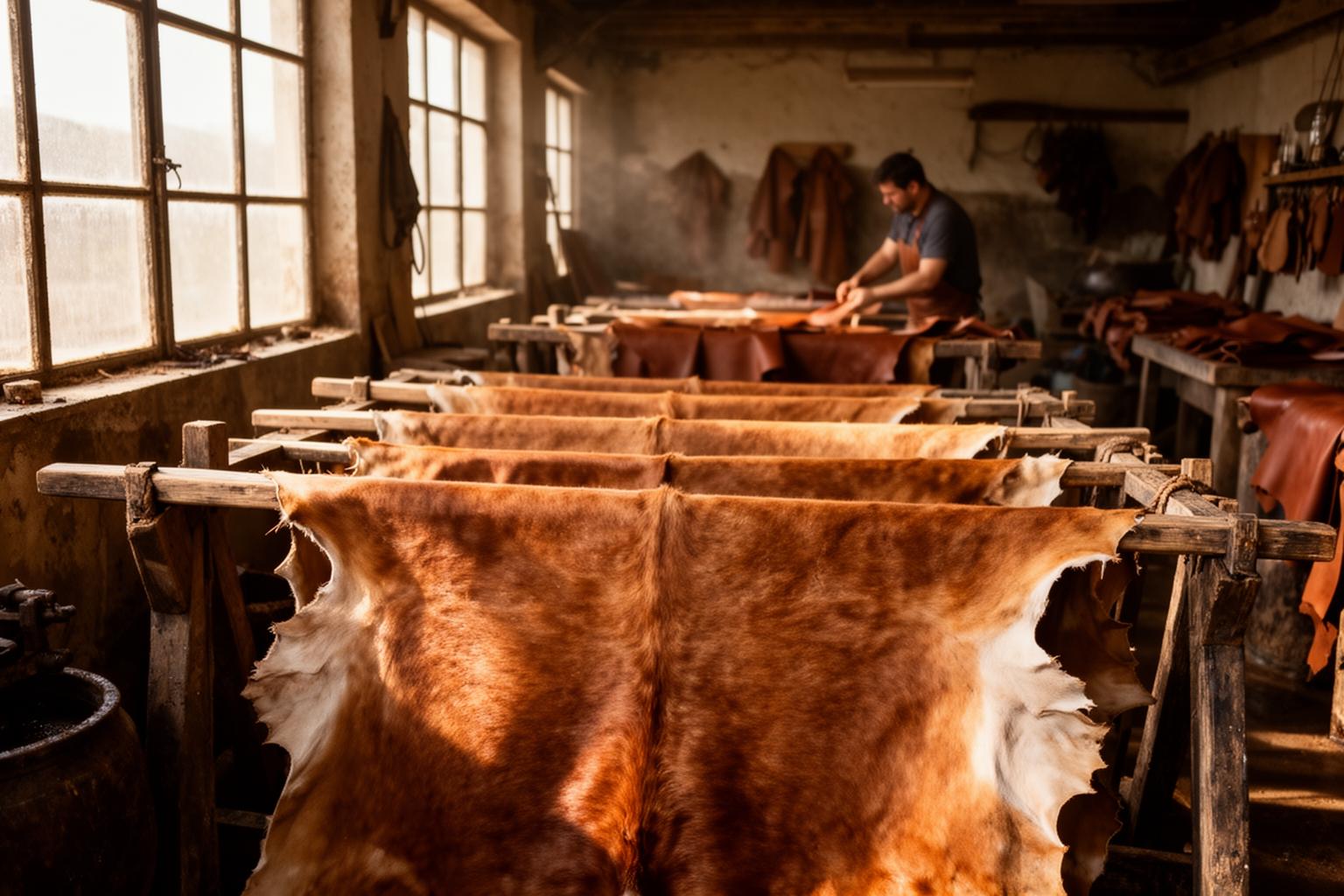
 Worker inspecting quality of cattle hide in abattoir
How it works in practice
In practice, the leather supply chain is a complex global network that starts at the slaughterhouse. When animals are processed, the hides are removed, salted to preserve them, and then sold to tanneries, often through brokers. These tanneries may be located in different countries from where the animal was raised, reflecting the international nature of the hide trade.
The hide's quality is crucial: it must be free from cuts, diseases, and parasites to fetch a premium. This is why cattle farmers and abattoirs invest in proper handling—a damaged hide can lose up to 50% of its value. This is a clear indicator that the hide is not a by-product but a product that requires careful management to realize its worth.
For the meat industry, the sale of hides provides a revenue stream that helps offset operational costs. In some countries, the income from hides can cover the cost of slaughtering and processing, making it a key factor in the viability of smaller abattoirs. According to a 2020 study in the journal "Meat Science," hides can contribute up to 8% of the total revenue from a beef animal, which is comparable to the contribution of other non-meat products like offal.
- ✅ Value to abattoirs: Hides provide a reliable additional income, improving profit margins.
- ⚠️ Quality sensitivity: A single blemish can reduce the hide's value significantly, discouraging careless handling.
- 🌱 Environmental impact: Traditional tanning uses chromium and other chemicals, but modern methods aim to reduce water and energy use.
Costs and trade-offs for consumers and planet
For consumers, the co-product status of leather has direct ethical and environmental implications. Buying leather, even from a brand that claims to use animal by-products, still injects money into the animal agriculture system. This means that a leather jacket is not an ethical loophole; it is a product that supports the same industry that produces beef, with all its associated emissions and biodiversity loss.
On the environmental side, the tanning process is notoriously polluting. According to the Norwegian Institute for Water Research (NIVA, 2019), the global leather industry discharges around 1.8 million tonnes of sludge annually, containing hazardous chemicals like chromium and sulfides. However, if leather were truly a by-product, these impacts might be considered unavoidable waste—but since it is a co-product, it is an intentional production activity that must be held to the same environmental standards as any other industry.
The trade-off for the planet is that leather production diverts resources (water, energy, chemicals) toward a non-essential product. For example, a 2018 study in the Journal of Cleaner Production found that the carbon footprint of a pair of leather shoes is on par with a pair of synthetic shoes, but the leather shoes also carry the hidden burden of animal agriculture, including methane emissions from cows.
Common objections to classifying leather as a co-product
A common argument is that if people stopped eating meat, animals would not be raised in sufficient numbers to produce leather, thus making leather production entirely dependent on the meat industry. This perspective suggests that leather merely 'makes use' of what would otherwise be discarded. However, this argument overlooks the independent demand for leather goods. While the supply of hides is indeed linked to meat production, the demand for leather items drives its value.
Another counter-argument posits that the environmental impact of leather tanning is so high that its 'by-product' status should not be used to justify its production. While the environmental concerns surrounding traditional tanning processes are valid – including water pollution from chemicals like chromium, and high energy consumption – this addresses the method of production, not its economic classification. Concerns over sustainability have led to innovations in tanning processes and the development of alternative materials, but they do not negate the hide's commercial value within the animal agriculture system.
Furthermore, some argue that because the income from hides is secondary to that from meat, it is still a by-product. However, a 'secondary' income stream can still be substantial enough to be considered a co-product, especially when it influences the overall economic viability of an operation. If the price of hides drops significantly, it can impact the profitability of cattle farming, demonstrating a symbiotic economic relationship.
"Bottom line: Calling leather a by-product is a semantic sleight of hand. It is a valuable, marketable commodity, and every leather purchase directly funds the animal agriculture industry."
Regional differences in leather production and perception
The economic reality of leather varies significantly by region. In industrialised countries like the US, EU, and Australia, cattle hides are often exported to developing nations for tanning, creating a global supply chain. For example, according to the US Commerce Department (2022), the US exports over 80% of its raw hides, with China as the largest buyer.
In developing regions, such as parts of South Asia and Africa, leather processing is a major industry, providing employment and income for millions. A 2021 report by the World Bank noted that leather contributes over 1% of GDP in Bangladesh and is a leading export sector in Pakistan and Ethiopia. This regional dependency means that classifying leather as a by-product could undermine the economic significance of the industry in these countries, but it also means that consumer choices in wealthy nations can have far-reaching effects on both livelihoods and environmental quality.
Environmental accounting and the future of leather
Recognizing leather as a co-product also has important implications for life-cycle assessment (LCA). In LCA, the environmental impacts of an animal are allocated across its various products—meat, leather, dairy, etc. If leather is treated as a by-product with minimal value, it might be assigned a negligible portion of the environmental burden, understating the impact of the animal and overstating the footprint of the meat. Conversely, if it is treated as a co-product, the burden is shared more equitably.
Current practice, according to the FAO (2023), often uses economic value as the basis for allocation, so leather typically receives a share proportionate to its 5-10% value. However, this is a simplification. A hidden issue is that the environmental cost of raising the animal is largely attributed to meat, while the leather industry benefits from the animal's life without bearing the full cost of its rearing. This leads to calls for more transparent sustainability standards, such as the Leather Working Group's protocol, which encourages better environmental practices but does not address the ethical concern of supporting animal agriculture.
For consumers, the future may bring more sustainable alternatives, such as plant-based leathers (mushroom, pineapple, cactus) and lab-grown leather. These technologies aim to decouple leather from animal farming, but they still face challenges in scale, cost, and performance. As of 2024, according to market research by Grand View Research, the global vegan leather market is worth about $15 billion, a fraction of the $100 billion animal leather industry. This gap underscores the economic entrenchment of animal-derived leather.
- ✅ Reality check: Animal leather is deeply embedded in global markets; changing it requires systemic shifts, not just individual choices.
- ⚠️ Innovation: Plant-based alternatives are growing, but they are not yet cost-competitive at scale.
- 🌱 Circular economy: Some argue that using hides from existing livestock is a form of recycling, but this ignores that the animal was raised to be slaughtered.
What you can do next
Understanding that leather is a co-product rather than a by-product empowers you to make more informed choices. Here are practical steps you can take:
- Choose second-hand leather: Opting for used leather goods does not create new demand for hides, reducing pressure on animal agriculture.
- Explore plant-based alternatives: When buying new, consider materials like Piñatex, mushroom leather, or cactus-based leather, which do not involve animal farming.
- Check brand transparency: Look for brands that explicitly state their sourcing policies and whether they use animal or synthetic materials.
- Advocate for better policy: Support regulations that require accurate environmental labeling, including the true impact of leather production.
- Offset your impact: If you already own leather, care for it properly to extend its life, reducing the need for replacements.
These actions, while not perfect, help reduce the financial support to the animal agriculture industry that your leather purchases currently provide.
Conclusion
The classification of leather as a co-product is not just a semantic nuance; it carries real consequences for how we perceive the ethics and environmental impact of leather. Acknowledging this forces us to confront the fact that every leather product, no matter how sustainably tanned, is tied to the practice of raising and slaughtering animals for profit. While the leather industry and some consumers attempt to frame it as a benign use of waste, the economic evidence shows otherwise. The best way forward for those concerned about animal welfare and the planet is to divest from animal leather and support the growing alternatives that align with a compassionate and sustainable vision.
References
- FAO (2023). "World Statistical Compendium for raw hides and skins, leather and leather footwear."
- UNIDO (2021). "Global Leather Industry Statistics."
- USDA (2022). "Livestock and meat trade data."
- Leather Working Group (2019). "Hide Market Report."
- International Trade Centre (2021). "Trade Map data on hides and skins."
- Norwegian Institute for Water Research (2019). "Pollution from global leather industry."
- World Bank (2021). "Leather sector in developing countries."
- "Meat Science" (2020). "Economic contributions of hides to beef revenue."
- "Journal of Cleaner Production" (2018). "Carbon footprint of leather vs. synthetic shoes."
*Image note: The placeholder
Worker inspecting quality of cattle hide in abattoir
should be replaced with a chart or infographic illustrating the economic value breakdown of a beef animal (meat, hide, offal, etc.), or a map of global hide trade flows.*
Trade-offs and ethical considerations
When assessing whether leather is a by-product or co-product, the trade-offs are both economic and ethical. Economically, treating hides as co-products supports the profitability of the meat industry, which can lower meat prices, but it also financially incentivizes animal slaughter. Environmentally, leather production can be resource-intensive—tanning often uses chromium and large amounts of water—yet it also repurposes material that would otherwise become waste, reducing landfill burden. Ethically, consumers who avoid meat for animal welfare reasons may still support the industry by buying leather, as leather demand contributes to hide prices and thus to the overall value of raising cattle. According to the Humane Society International (HSI, 2023), even a 10% drop in leather demand can reduce hide prices enough to affect abattoir returns, demonstrating that consumer choices in leather can influence meat production patterns. The key trade-off is that no simple label—by-product or co-product—captures the full moral weight of the decision, so individuals must weigh their own values about animal use and environmental impact.
Common objections and responses
Objection 1: "Leather is just waste, so buying it doesn't harm animals." This argument rests on a misunderstanding of market dynamics. According to a 2020 study by the World Wildlife Fund (WWF), hides contribute 5-10% of an animal's total value, and when hide prices fall, farmers may reduce herd sizes or shift to breeds with lower meat yields but better hides, altering production decisions. If hides were pure waste with no value, they would be disposed of at a cost, but they are actively traded and marketed, meaning their demand supports the livestock industry's bottom line. Objection 2: "If I stop buying leather, the hides will just be thrown away, so it doesn't matter." In reality, hides that are not sold to tanneries are often rendered into lower-value products like gelatin or pet food, or they may be incinerated, which carries environmental costs. However, a sustained drop in leather demand could lead to more hides being discarded, potentially increasing waste—a legitimate concern for environmentally conscious consumers. The response is nuanced: reducing leather demand may not prevent slaughter, but it could shift economic incentives toward more sustainable practices or alternative materials over time. Objection 3: "Vegan leather is always better, so I should just buy that." While vegan alternatives avoid animal use, many are petroleum-based (e.g., polyurethane), which have their own environmental disadvantages. According to a 2021 lifecycle assessment by the Leather Naturally group, conventional leather, when tanned with vegetable or chrome-free methods, can have a lower carbon footprint per square meter than some synthetic leathers, especially those made from virgin plastics. The objection is valid for animal welfare but requires careful comparison of environmental impacts before making a choice.
The regional angle for English-speaking readers
In the United States, leather is predominantly a co-product of the beef industry, with the USDA reporting (2022) that the hide accounts for roughly 5% of a live animal's value, and the country is one of the world's largest exporters of raw hides, mainly to China and Mexico for processing. For US readers, this means that buying American-made leather directly supports domestic cattle ranching, which has significant land and water footprints, especially in arid western states. In the UK, leather comes from both beef and dairy herds, but a notable share derives from dairy calves, which are often culled shortly after birth if not needed for milk production—a fact highlighted by the UK's Agriculture and Horticulture Development Board (AHDB, 2022) as a source of hides for lower-grade leather. Australian readers face a different dynamic: the country has a large export-oriented beef industry, and according to the Australian Bureau of Statistics (ABS, 2021), cattle hides are a major export commodity, with value tied to global leather demand, especially from the automotive sector in Japan and South Korea. Canadian leather production is smaller but similar to the US, with a focus on beef, while South African readers may encounter leather from both cattle and wildlife operations, adding complexity to ethical considerations. Across all regions, the classification of leather as a co-product holds, but the ethical weight varies: US and Australian readers are most directly connected to meat-driven hide supply, while UK and EU readers may see more dairy-derived hides, which involve separate welfare issues.
Comparison table: leather vs. alternatives
| Criteria | Conventional Cattle Leather | Chrome-Free/Vegetable-Tanned Leather | Synthetic Leather (PU/PVC) | Plant-Based Leather (e.g., Cactus, Mushroom) |
|---|---|---|---|---|
| Source | Cattle hides (co-product) | Cattle hides (co-product) | Petrochemicals | Agricultural by-products or fungi |
| Animal impact | High (directly supports slaughter) | High (directly supports slaughter) | None | None |
| Carbon footprint (per m²) | Moderate (with efficient tanning) | Lower (less chemical use) | High (fossil fuels) | Variable, often low |
| Water use | High (raw hide washing + tanning) | Moderate to high | Moderate (processing) | Low to moderate |
| Durability | Very high (10-15 years) | High (5-10 years) | Low to moderate (3-5 years) | Moderate (3-7 years) |
| Price point | Mid to high | Higher (premium niche) | Low to mid | Mid to high |
| End-of-life | Biodegradable (if no chrome) | Biodegradable (fully) | Not biodegradable | Biodegradable (some) |
This table is illustrative and based on a synthesis of data from the Leather Working Group (LWG, 2023) and the European Commission's Joint Research Centre (JRC, 2022). It shows that no option is universally "best"; consumers must prioritize what matters most—animal welfare, climate, or durability—when choosing materials.
Practical checklist for ethical leather decisions
- ✅ Check the source: Look for leather from certified tanneries (e.g., Leather Working Group Gold rating) that minimize chemical use and waste.
- ✅ Ask about the animal's origin: Prefer leather from animals raised on regenerative farms where meat is consumed fully, rather than from dairy calves (which have shorter lives) or unknown sources.
- ✅ Research the tanning method: Choose vegetable-tanned or chrome-free leather to avoid hexavalent chromium, which is a known carcinogen according to the International Agency for Research on Cancer (IARC, 2012).
- ✅ Consider secondhand first: Buying vintage or secondhand leather extends its life and avoids supporting new hide production entirely.
- ✅ Weigh alternatives carefully: If you avoid leather due to animal welfare, research plant-based options to ensure they don't rely on petrochemicals or excessive water use.
- ⚠️ Be wary of "by-product" marketing: Some brands claim leather is eco-friendly because it's a by-product, but as this page shows, that label is misleading—it's a valuable co-product that supports the meat industry.
- ⚠️ Mind the lifetime: A leather jacket that lasts 15 years may have a lower impact per year than a synthetic jacket replaced every 3 years, so factor durability into comparisons.
- 📉 Track your impact: If you choose to reduce leather consumption, consider measuring the change in your carbon and water footprint over a year to see the real effect.
"Key stat: The global leather trade is valued at over $100 billion annually (UNIDO, 2021), meaning consumer demand for leather is a major economic driver, not an incidental waste stream."
What to do next
If you're a consumer looking to make informed choices, start by asking where your leather goods come from—many brands now disclose their tannery sourcing on their websites. For those concerned about animal welfare, explore the growing market for plant-based alternatives, but be prepared to pay a premium and check for hidden plastic components. If you run a business, consider whether your products can use leather from certified sustainable sources or switch to alternatives that have lower environmental impacts, as some automotive brands have begun doing (e.g., Volvo's pledge to use animal-free interiors by 2030, announced 2023). Policy-wise, you can support regulations that require clearer labeling of leather origins and tanning methods, such as the EU's proposed Digital Product Passport, which could reveal environmental data. Finally, remember that your money is a vote: every purchase of leather or its alternatives sends a signal to markets, and as the trade data shows, that signal can shift hide prices and farming practices over time.
 Leather tanning drum machine in industrial operation
Conclusion: the bottom line
Leather is undeniably a co-product of the meat industry in economic and regulatory terms, not a mere by-product, because it carries substantial value and is actively managed for quality. However, this classification does not make it ethically neutral—whether you choose leather, a plant-based alternative, or secondhand goods, your decision has ripple effects on livestock economics and environmental health. The numbers, from the FAO's multi-billion-dollar hide trade to the LWG's value estimates, all confirm that hides are sold commodities, not waste. For the reader, the bottom line is empowerment: armed with the distinction between co-product and by-product, you can now see through marketing that downplays leather's impact, and you can make choices that align with your values—whether that means buying certified sustainable leather, opting for alternatives, or simply buying less and using longer.
"Bottom line: Leather is a co-product of meat, not a by-product, and informed choices—from sourcing to alternatives—can align your consumption with your ethics and the planet's limits."
Read next
The common questions