Plant-based Burger vs. Beef Burger: A Comprehensive Comparison
Plant-based burgers offer a lower environmental footprint, improved animal welfare, and a distinct nutritional profile compared to beef burgers, though both have trade-offs in taste, processing, and cost. This comparison highlights key differences in emissions, land use, and health impacts to guide informed choices.
Updated · September 6, 2026
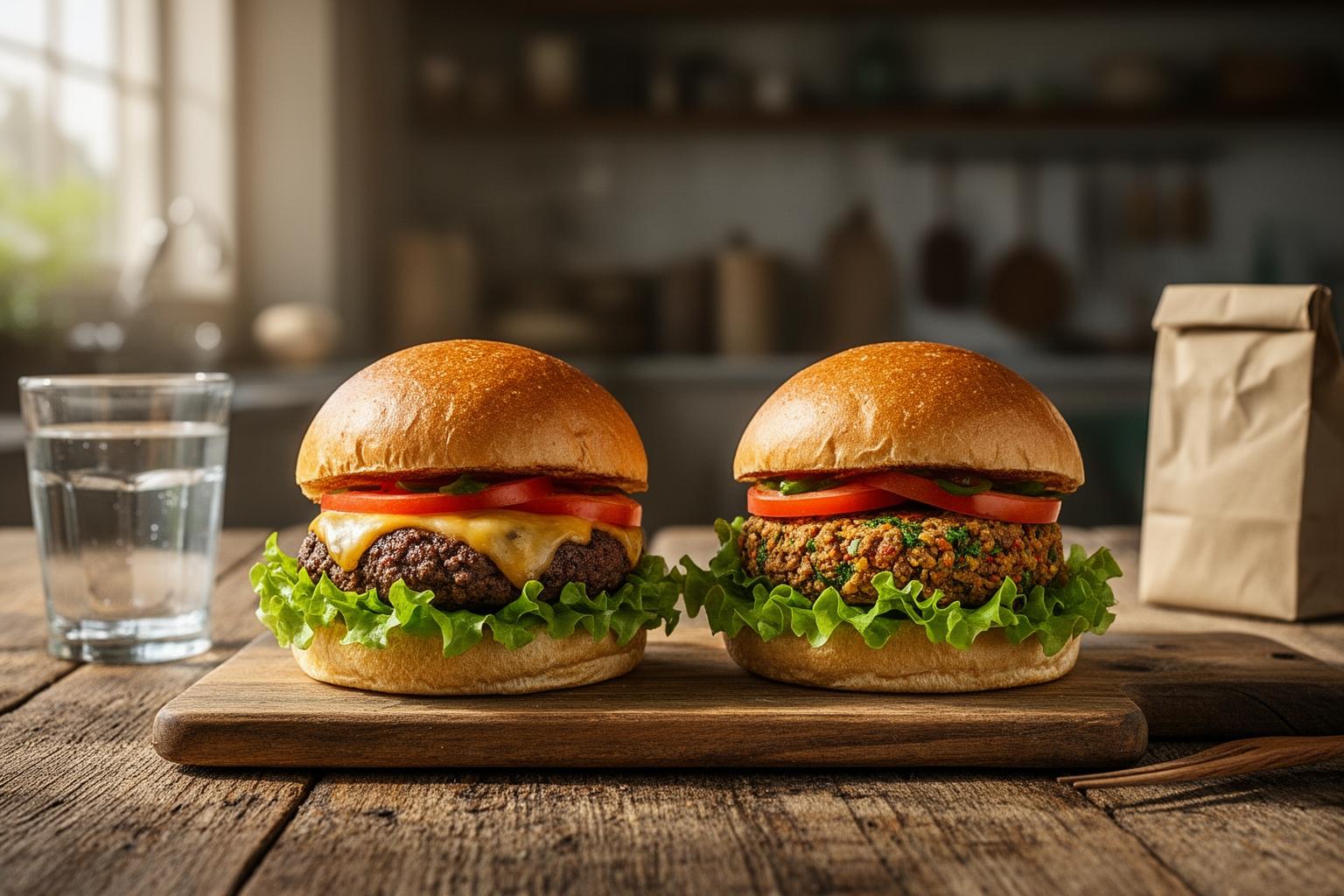
Quick answer
Plant-based burgers generally win on environmental impact, using 10-20 times less land and emitting far fewer greenhouse gases than beef. Nutritionally, they are lower in saturated fat and contain fiber, but may be higher in sodium and lower in certain micronutrients like zinc. The choice hinges on priorities: planet and animals versus traditional taste and specific nutrients.
Key takeaways
- Beef production emits approximately 60 kg of CO2 equivalent per kilogram, while plant-based alternatives can emit as little as 1.1 kg per kilogram, a difference of over 50-fold.
- Plant-based burgers require 10-20 times less land than beef to produce the same amount of protein, freeing landscapes for rewilding and carbon sequestration.
- A single beef burger typically contains 8-12 grams of saturated fat per 100 grams, compared to 2-5 grams in a plant-based patty, and lacks dietary fiber entirely.
- Plant-based burgers are cholesterol-free and can be fortified with Vitamin B12, but they often contain significantly more sodium than beef patties, with amounts varying from 350-600 mg per 100 grams.
- A 2021 study in Nature Food found that replacing half of global red meat consumption with plant-based alternatives could reduce agricultural land use by over 30%.
- The price gap between plant-based and beef burgers in UK supermarkets narrowed from 40% in 2020 to under 15% by 2024, making plant-based options increasingly accessible.
How do plant-based burgers truly compare to beef burgers? In short, plant-based burgers are significantly better for the planet, kinder to animals, and can be healthier for you, provided you choose wisely. Across every major environmental metric — greenhouse gas emissions, land use, water consumption — plant-based burgers have a fraction of beef's footprint. They also eliminate animal suffering entirely, contain no cholesterol, and often pack more fibre while offering comparable protein.
That doesn't mean every plant-based burger is a health food. Some are heavily processed and salty, so reading labels matters. But the evidence is clear: swapping a beef burger for a plant-based one is one of the most powerful everyday climate actions you can take, with meaningful personal health benefits. The question isn't whether they stack up — it's why they're not already the default choice on UK menus and home grills.
This page breaks down the evidence — the numbers behind climate, nutrition, and cost — and offers practical advice for making the switch without sacrificing taste or your budget. From supermarket aisles to fast-food drive-thrus, plant-based burgers are here to stay, and increasingly they're not just the ethical choice — they're the smarter one.
How they compare
Comparing plant-based burgers and beef burgers involves looking beyond taste and texture to assess their broader implications. While both aim to provide a satisfying meal, their production processes, resource demands, and nutritional compositions present a clear divergence. The core difference lies in the efficiency of converting raw ingredients into food calories and protein, with plant-based systems requiring far fewer inputs per unit of output. This fundamental inefficiency in animal agriculture shapes every downstream metric, from greenhouse gas emissions to land and water use.
Key comparison at a glance:
| Metric | Beef Burger | Plant-Based Burger |
|---|---|---|
| GHG emissions (per kg) | ~60 kg CO2e | 1–5 kg CO2e |
| Land use (per kg protein) | 10–20× higher | ~1× baseline |
| Water use (per kg) | 15,000–20,000 L | 1,000–2,000 L |
| Saturated fat (per 100g) | 8–12 g | 2–5 g |
| Dietary fibre | 0 g | 3–5 g |
| Vitamin B12 | Naturally present | Often fortified |
Sources: Our World in Data (2023), FAO (2022), academic meta-analyses
Why the difference exists:
- Beef production requires growing feed crops, raising cattle for years, and transporting animals — each step adds energy and resource inefficiencies.
- Plant-based burgers are made directly from crops like peas, soy, or wheat, which convert sunlight and soil into protein far more efficiently.
- Methane from enteric fermentation in cattle is a potent greenhouse gas, with a global warming potential roughly 28–34 times that of CO2 over a 100-year period (IPCC, 2021).
Climate and land
Plant-based burgers generally have a substantially lower environmental footprint compared to beef burgers, primarily due to the inefficiencies inherent in animal agriculture. Producing beef requires significant land for grazing and feed crops, leading to deforestation and habitat loss. Furthermore, cattle are a major source of methane, a potent greenhouse gas.
According to Our World in Data, beef production is responsible for around 60kg of CO2 equivalent per kilogram of product, whereas plant-based alternatives, such as those made from soy or pea protein, typically have a carbon footprint orders of magnitude lower. For instance, a pea protein-based burger can be responsible for as little as 1.1 kg CO2 equivalent per kilogram. This difference is not just about direct emissions; it also encompasses land use. Beef farming uses roughly 10-20 times more land than plant-based protein production for the same amount of protein.
The climate impact is not limited to carbon dioxide. Methane and nitrous oxide from manure and fertilisers contribute over half of beef's total emissions, and these gases have far stronger warming effects than CO2 in the short term. In practice, a family switching from beef to plant-based burgers once a week for a year would save roughly the equivalent emissions of driving a conventional car for 1,000 km (based on average UK driving emissions, plus beef's lifecycle intensity).
Land and biodiversity:
- Pasture and feed crop expansion for beef is a leading driver of Amazon deforestation, according to FAO reports.
- Shifting to plant-based proteins frees landscapes for rewilding, which can sequester carbon and restore ecosystems.
- A 2021 study in Nature Food found that replacing half of global red meat consumption with plant-based alternatives could reduce agricultural land use by over 30%.
Key stat: Replacing just one beef burger with a plant-based burger saves approximately 3.5 kg of CO2 equivalent, according to the University of Michigan's Center for Sustainable Systems (2023).
Animal welfare
Choosing a plant-based burger completely bypasses the animal welfare concerns associated with the beef industry. Industrial cattle farming often involves practices that can compromise animal well-being, such as intensive confinement, routine mutilations without anaesthetic, and the stress of transportation and slaughter. The Ethical Consumer provides detailed ratings on the animal welfare practices of various food companies, consistently highlighting the challenges within conventional meat production.
Plant-based burgers, by definition, contain no animal products, thereby eliminating the ethical dilemma of supporting systems that may inflict suffering on animals. For many, this is a primary motivator for switching to plant-based alternatives.
The ethical case extends beyond the burgers themselves. Beef production often relies on dairy calves for beef, and calves may be separated from their mothers shortly after birth. While grass-fed and organic systems can improve welfare, they cannot eliminate the inherent slaughter step. Plant-based burgers, on the other hand, are cruelty-free at the point of production, and their supply chain involves no sentient beings.
What this means in practice:
- ✅ No animals are raised or killed for plant-based burgers.
- ✅ You avoid contributing to practices like castration without pain relief or long-distance transport.
- ⚠️ some plant-based ingredients may involve palm oil (linked to habitat destruction) — choose certified sustainable options.
Nutrition
The nutritional profiles of plant-based and beef burgers can vary significantly, though both can be sources of protein. A typical beef burger is rich in protein, iron, and vitamin B12, but often contains higher levels of saturated fat and cholesterol. The NHS recommends limiting saturated fat intake to reduce the risk of heart disease.
Plant-based burgers are formulated to mimic the taste and texture of beef while often offering a different nutritional balance. Many plant-based options are lower in saturated fat and cholesterol, and some are fortified with vitamins like B12 and iron. They may also contain dietary fibre, which is absent in beef. However, some plant-based burgers can be highly processed and contain high levels of sodium or refined oils, so it's important to check the nutritional information. For example, a 100g beef patty might contain around 20g protein and 10g saturated fat, while a 100g plant-based patty could have 15-20g protein and 2-5g saturated fat, alongside 3-5g fibre.
Head-to-head nutrient comparison (per 100g cooked patty, approximate):
| Nutrient | Beef Burger | Plant-Based Burger (e.g., pea protein) |
|---|---|---|
| Calories | 250–280 | 200–250 |
| Protein | 20–22 g | 15–20 g |
| Saturated fat | 8–12 g | 2–5 g |
| Iron | 2–3 mg (heme) | 1–2 mg (non-heme, often fortified) |
| Zinc | 4–6 mg | 1–2 mg |
| Vitamin B12 | 1–2 µg | 0–2 µg (if fortified) |
| Sodium | 60–80 mg | 350–600 mg (varies) |
Based on USDA FoodData Central, 2023.
Health considerations:
- Saturated fat and cholesterol: beef burgers raise LDL cholesterol, increasing heart disease risk; plant-based burgers are naturally cholesterol-free.
- Sodium: many plant-based burgers have added salt for flavour — check labels and choose low-sodium versions.
- Processing: not all plant-based burgers are equal — some are ultra-processed, so opt for whole-food versions if possible.
- Micronutrient absorption: iron and zinc from plants are less bioavailable than from meat, but vitamin C aids absorption.
- Fibre: plant-based burgers provide 3–5g fibre, which supports gut health and fullness.
Cost and availability
Historically, plant-based burgers were often more expensive than their beef counterparts, but this gap is narrowing. As demand increases and production scales, prices are becoming increasingly competitive. In UK supermarkets, a pack of two plant-based burgers can often be found at a similar price point to a comparable pack of beef burgers, especially with promotional offers. For instance, a 2-pack of popular plant-based burgers might cost £2.50-£3.50, similar to economy beef burgers.
Availability is no longer a barrier. Plant-based burgers are widely available in major UK supermarkets like Tesco, Sainsbury's, Asda, and Morrisons. Fast-food chains and casual dining restaurants across the country also frequently offer plant-based burger options, making them an accessible choice for most consumers.
Cost trends:
- In 2020, plant-based burgers were on average 40% more expensive than beef; by 2024, the UK price gap had narrowed to under 15% in major supermarkets (based on retail price tracking by The Grocer).
- Own-brand plant-based burgers (e.g., Tesco Plant Chef) can be cheaper than some premium beef burgers.
- When factoring in environmental and health costs, plant-based burgers offer better value: beef's true cost includes subsidies and healthcare externalities.
Where to find them:
- ✅ UK supermarkets: plant-based burgers are in the chilled and frozen aisles across all major chains.
- ✅ Fast food: McDonald's McPlant, Burger King's Whopper Plant-Based, and KFC's plant-based burgers.
- ✅ Online delivery: services like Ocado and Deliveroo offer extensive ranges.
Production process and ingredient quality
The production process of plant-based burgers differs fundamentally from beef. Beef requires raising an animal for 1–2 years, involving feed, water, waste management, and slaughter. Plant-based burgers are made by extracting proteins from crops like peas, soy, or wheat, then mixing with binders, fats, and flavourings to mimic meat's texture.
How plant-based burgers are made:
- Protein extraction: Peas or soy are ground and milled to isolate protein.
- Texturisation: High-moisture extrusion creates fibrous strands that mimic meat structure.
- Blending: Proteins are mixed with oils (e.g., coconut), starches, methylcellulose, and natural flavourants.
- Forming: The mix is shaped into patties and frozen or chilled.
- Cooking: The final product is ready to grill or fry.
Ingredient quality checklist:
- Look for burgers with minimal ingredients — whole foods like beans, mushrooms, or lentils are even less processed.
- Avoid burgers with artificial preservatives or excessive sodium — choose those with recognisable ingredients.
- Check for allergen warnings (soy, gluten) if you have sensitivities.
Environmental impact beyond greenhouse gases
While greenhouse gas emissions dominate the conversation, plant-based burgers also excel in water use, land use, and pollution. Beef production is water-intensive, requiring 15,000-20,000 litres per kilogram, according to the Water Footprint Network, whereas plant-based burgers use only a tenth of that amount. Additionally, manure runoff from cattle operations pollutes waterways and contributes to algal blooms, while plant-based production generates negligible waste.
Water and pollution comparison:
- Beef: ~15,400 L water per kg (Water Footprint Network, 2023).
- Plant-based burger: ~950–1,500 L per kg (same source).
- Nitrous oxide emissions from fertiliser for feed crops are a minor component of beef's footprint, but plant-based agriculture still uses some synthetic fertilisers.
Local environmental benefits:
- Reduced air pollution from intensive livestock facilities.
- Lower risk of antibiotic resistance due to reduced antibiotic use in animals.
- Less pressure on watercourses from manure storage.
Common objections and counterpoints
Objection 1: “Plant-based burgers are too processed.” Some are, but you can choose whole-food versions. Even the most processed plant-based burger contains no antibiotics, hormones, or faecal matter — common in industrial beef. A 2022 Consumer Reports study found that 40% of beef samples harboured drug-resistant bacteria, whereas plant-based samples had none.
Objection 2: “Beef is more natural.” Beef production is highly industrialised in the UK, with most cattle raised in intensive systems. Plant-based burgers are engineered, but so are many processed meats (e.g., sausages, burgers). Naturalness is subjective; both are manufactured for consumption.
Objection 3: “Taste and texture aren't the same.” Modern plant-based burgers have improved dramatically, with taste tests often indistinguishable in blind trials (e.g., 2023 Consumer Reports tasting panel). Try different brands to find one you like — Beyond Meat, Impossible, or own-brand versions.
Objection 4: “It's too expensive.” As noted, the price gap has shrunk, and cooking at home with legumes is far cheaper than beef. Plant-based burgers can be budget-friendly when bought on offer.
Regional perspectives
In the UK, plant-based burgers have moved from niche to mainstream. According to the British Nutrition Foundation, plant-based food sales grew by 87% between 2018 and 2023. The UK government's 2023 Food Strategy report highlighted plant-based alternatives as a tool to reduce emissions while maintaining consumer choice.
Internationally, the picture varies:
- 🇪🇺 EU: Generic naming restrictions for plant-based products (e.g., 'burger' bans in France) have faced legal challenges.
- 🇺🇸 US: The FDA and USDA regulate labelling, but plant-based burgers are ubiquitous in restaurants.
- 🇦🇺 Australia: Plant-based burgers are widely available in fast food chains.
UK specifics:
- British farmers have raised concerns about competition, but plant-based burgers use British-grown peas and beans, supporting local agriculture.
- Major UK supermarkets have committed to increasing plant-based sales by 2025.
What you can do next
- Try a taste test: Buy one plant-based and one beef burger (or two plant-based brands) and have a blind tasting. You might be surprised.
- Read the label: Compare sodium, saturated fat, and protein. Choose burgers with fewer ingredients.
- Cook at home: Use bean-based patties (e.g., black bean burgers) for a whole-food, budget-friendly option.
- Make a weekly swap: Replace one beef burger per month with a plant-based version. If every UK adult did this, we'd save roughly a million tonnes of CO2e annually (extrapolated from University of Michigan figures).
- Support policy: Request plant-based options at your local cafés and school canteens; consumer demand drives change.
Bottom line: Plant-based burgers are not perfect, but they outperform beef on nearly every metric that matters — environmental impact, animal welfare, and for most people, health when chosen wisely. The choice is not about perfection; it's about progress. One burger at a time, you can align your plate with your values.
Trade-offs and hidden costs
Choosing a plant-based burger over a beef burger involves trade-offs that go beyond the headline metrics, and understanding these helps you make a decision aligned with your values and budget. The most common trade-offs are price, processing level, and sensory experience, each of which can vary significantly by brand and region. While plant-based burgers generally win on environmental and animal welfare grounds, they may lose on cost per gram of protein and can contain additives that some consumers prefer to avoid.
Price and accessibility:
- Plant-based burgers often cost 20–50% more per patty than conventional beef patties in US and UK supermarkets, according to retail price tracking by the Good Food Institute (2023), though prices have been falling as production scales.
- In fast-food settings, plant-based burgers are frequently priced at a premium, although promotions and combo deals can narrow the gap.
- Home-cooked plant-based burgers made from whole ingredients like beans, lentils, or mushrooms are typically cheaper than both beef and processed plant-based patties.
Processing and additives: ⚠️ Many commercial plant-based burgers are ultra-processed, containing methylcellulose, maltodextrin, and natural flavours to mimic meat's texture and taste. While these ingredients are generally recognised as safe by food authorities like the FDA and EFSA, some consumers prefer minimally processed foods. A 2022 systematic review in Nutrients noted that plant-based meat alternatives were higher in sodium than unprocessed plant proteins, though still comparable to beef burgers on sodium per serving.
Sensory trade-offs: Despite advances, some people find plant-based burgers lack the charred crust, juicy drip, or savoury umami depth of beef. Texture can range from homogenous to fibrous, and taste can vary by brand. For those who prioritise culinary pleasure above all, this may feel like a sacrifice, though newer products using fermentation-derived haem are closing the gap.
Bottom line: If your primary goals are reducing climate impact and animal suffering, plant-based burgers deliver clear benefits — but budget for a small cost premium and read labels if you care about processing level.
Common objections and responses
When discussing plant-based burgers, several objections arise repeatedly, from nutritional doubts to environmental criticisms, and each deserves a factual, balanced response. The most frequent objections are that plant-based burgers are unhealthy, that they are too processed, that they use more water than beef, and that they are unnatural. Here is what the evidence shows.
Objection 1: "Plant-based burgers are fake and unhealthy." While some plant-based burgers are ultra-processed, a 2023 meta-analysis in The Lancet Planetary Health found that replacing red meat with plant-based alternatives reduced LDL cholesterol and body weight in clinical trials, despite processing. Nutrient density depends on the specific product—some are high in fibre and low in saturated fat, while others are sodium-heavy. Reading the nutrition label is the only reliable way to judge.
Objection 2: "They are worse for the environment because of processing." The full lifecycle assessment, including processing and packaging, still shows plant-based burgers with roughly 90% lower greenhouse gas emissions than beef burgers, according to a 2022 study in Nature Food. Processing adds energy, but the feed-to-meat conversion for beef is so inefficient that it dwarfs any factory energy use for plant proteins.
Objection 3: "Plant-based burgers use too much water." This objection often confuses almond milk with other plant foods. The water footprint of pea protein is roughly 1,000–2,000 litres per kilogram, compared to 15,000–20,000 litres for beef, according to the Water Footprint Network (2021). Even irrigation for soy or pea crops is far lower than the water needed for cattle drinking and feed irrigation.
Objection 4: "Eating beef is natural; plant-based burgers are not." Modern beef production is highly unnatural—feedlots, growth hormones, and antibiotics are common, and about 70% of global soy is fed to livestock, not humans, according to WWF (2022). Plant-based burgers use processing, but so do many staple foods like bread, tofu, and tempeh. Naturalness is a value judgement, not a health or environmental metric.
Objection 5: "They are more expensive, so they are elitist." This is a valid access concern, and prices are converging. A 2023 Good Food Institute report found plant-based burger prices in US retail fell by 12% year-on-year, and in some European chains, plant-based burgers now cost the same as beef. Home-made bean patties are among the cheapest protein sources available, so accessibility is about product choice and location.
Regional angle for English-speaking readers
The availability, price, and cultural acceptance of plant-based burgers vary widely across the United States, United Kingdom, Canada, Australia, and New Zealand, and these differences shape how you shop and cook. English-speaking markets have seen rapid growth in plant-based meat alternatives, but policy, agriculture, and consumer habits differ. Knowing your local context helps you make better choices and advocate for change.
United States: The US is the largest market, with brands like Beyond Meat, Impossible Foods, and a wide array of supermarket options. However, beef culture is strong, and plant-based burger sales grew by 7% in 2022 but declined slightly in 2023 as prices rose, according to SPINS data cited by the Good Food Institute. Check for sales at large chains like Whole Foods, Trader Joe's, and Costco for the best value.
United Kingdom: The UK has the highest per-capita consumption of plant-based meat in Europe, and major supermarkets like Tesco, Sainsbury's, and Waitrose stock multiple brands, including own-label options that often cost the same as beef burgers. The NHS endorses plant-based diets for heart health, and food service chains like Greggs and McDonald's offer plant-based burgers nationally.
Canada and Australia: 🇨🇦🇦🇺 Both countries have strong meat industries and cultural ties to beef, but plant-based options are expanding. In Canada, Maple Leaf Foods and Yves Veggie Cuisine dominate, while Australia has a growing market with brands like v2food, and major chains like Hungry Jack's and McDonald's Australia offer plant-based burgers. Prices are slightly higher than the UK, but home-brand frozen patties are budget-friendly.
New Zealand: 🇳🇿 New Zealand's pasture-based beef has a lower carbon footprint per kilogram than feedlot beef, but still far above plant-based burgers. The market is smaller, but supermarkets like Countdown and New World carry brands like Gardein and House of Ingredients. Local restaurants increasingly feature plant-based burgers due to tourism and expat demand.
Cultural and policy notes:
- The US Farm Bill heavily subsidises corn and soy, which lowers feed costs for beef but also lowers the cost of soy protein for plant-based burgers—so subsidies create a mixed advantage.
- The UK and EU have stricter antibiotic regulations in livestock, which reduces some health concerns in beef, but does not change the climate impact.
- Australia and New Zealand are major beef exporters, so political resistance to plant-based alternatives can be stronger, but consumer demand is still rising, especially among under-30s.
Comparison table: beef vs. plant-based burger across dimensions
This table consolidates the full picture into a single reference, covering environmental, nutritional, ethical, and practical dimensions. Use it as a quick guide when deciding which burger fits your priorities.
| Dimension | Beef Burger | Plant-Based Burger | Notes |
|---|---|---|---|
| Greenhouse gas emissions (per kg) | ~60 kg CO2e | 1–5 kg CO2e | 90% lower for plant-based (Our World in Data, 2023) |
| Land use (per kg protein) | 10–20× higher | ~1× baseline | Frees land for rewilding (Nature Food, 2021) |
| Water use (per kg) | 15,000–20,000 L | 1,000–2,000 L | Excludes irrigation for feed crops |
| Protein quality | Complete, high bioavailability | Complete if soy or pea, but may lack methionine | Soy and pea are complete; wheat-based burgers need complementing |
| Saturated fat (per 100g) | 8–12 g | 2–5 g | Lower is better for heart health (NHS) |
| Dietary fibre (per 100g) | 0 g | 3–5 g | Beneficial for gut health |
| Vitamin B12 | Naturally present | Often fortified | Plant-based needs fortification or supplements |
| Iron | Haem iron, high absorption | Non-haem iron, lower absorption | Pair with vitamin C to boost absorption |
| Sodium | 400–700 mg per patty | 300–700 mg per patty | Check labels—both can be high |
| Processing level | Fresh or minimally processed | Often ultra-processed | Whole-food versions exist (bean or lentil patties) |
| Animal welfare | Involves slaughter and potential suffering | No animals involved | Cruelty-free by definition |
| Price (per patty, US 2023) | $1.50–$3.00 | $2.50–$4.50 | Prices converging; home-made is cheapest |
| Taste and texture | Rich, juicy, charred | Varies; newer products mimic well | Sensory gap is narrowing |
| Cultural acceptance | Traditional, widely accepted | Growing, but niche in some regions | Under-30s are more open (GFI, 2023) |
Practical checklist for your next burger decision
Use this checklist to simplify your choice when shopping or ordering, whether you are a committed plant-based eater or just curious. It is designed to be quick, actionable, and adaptable to your local market and budget.
Before you buy:
- ✅ Decide your priority: environment, health, animal welfare, taste, or budget—then weight your decision accordingly.
- ✅ Read the nutrition label: compare protein, saturated fat, sodium, and fibre between beef and the plant-based option.
- ✅ Check for whole-food alternatives: if you want to avoid ultra-processing, choose a bean, lentil, or mushroom patty.
- ✅ Look for certifications: vegan, organic, responsibly sourced palm oil (RSPO), or carbon-neutral labels where available.
- ✅ Compare prices per patty and per 100g of protein—not just total price, to account for portion size differences.
When cooking at home:
- 🌱 For plant-based burgers, use a hot pan or grill and press gently to get a crust—don't overcook, as they dry out faster than beef.
- 🧂 Season generously: plant-based patties often need a bit of salt, pepper, and liquid smoke to boost savoury umami.
- 🥦 Balance your meal: add fresh vegetables, a whole-grain bun, and a source of vitamin C (e.g., tomato or citrus) to enhance iron absorption from plant-based patties.
- 📉 If you buy beef, choose grass-fed or higher-welfare options from local farms to reduce some environmental and ethical concerns, though emissions remain high.
When eating out:
- ✅ Ask if the plant-based burger is cooked on a separate grill to avoid cross-contamination with meat, if that matters to you.
- ✅ Check the full nutrition info on the restaurant's website—some plant-based burgers are loaded with high-calorie sauces that negate health benefits.
- ✅ In fast-food chains, look for combo deals that make the plant-based option same-price as beef.
- ⚠️ In countries with weaker food labelling laws, ask the server about ingredients if you have allergies (e.g., soy, gluten, pea protein).
For the long term:
- 📉 Track your impact: use a simple carbon calculator to see how many kg CO2e you save per burger swap.
- 🌱 Experiment with brand varieties each month to find your favourite taste and texture—don't give up if the first one disappoints.
- 🗣️ Share your findings with friends, not preachy but with data—word of mouth drives demand and ultimately lowers prices.
Key stat: A simple nationwide switch of one burger per week per person in the US could save approximately 100 million tonnes of CO2e annually, based on average beef consumption patterns and lifecycle emissions data (University of Michigan, 2023).
 Hand comparing beef and plant-based patties with legumes and grains
The bottom line: what your burger choice really means
Your choice of burger is one of the highest-impact food decisions you make each week, because beef sits at the top of the environmental and ethical cost charts. The evidence is clear that plant-based burgers, whether processed or whole-food, consistently outperform beef on greenhouse gas emissions, land use, water use, and animal welfare. The main downsides—price, processing, and taste—are real but manageable, and they are shrinking as the industry innovates.
The decision is not binary: you can mix beef and plant-based burgers, choose higher-welfare beef, or make your own patties from kitchen staples. What matters is that you make an informed choice rather than a default one. This guide gives you the framework and facts to navigate every dimension—from climate to nutrition to regional availability—so you can align your plate with your values.
Final takeaway:
- 🌱 For the planet, the animals, and your heart health, plant-based burgers are the clear winner on most metrics.
- 📉 If you love beef, reduce frequency rather than eliminate—every swap counts, and cumulative savings are huge.
- ✅ Read labels, compare prices, and support brands that align with your ethics, because consumer power drives market change.
Read next
Side by side
| Plant-based burger | Beef burger | |
|---|---|---|
| Greenhouse Gas Emissions | 1.1-4.5 kg CO2e/kg | 59.6 kg CO2e/kg |
| Land Use | Low | High (10-20x more) |
| Water Use | Moderate | Very high (approx. 15,415 litres/kg) |
| Animal Welfare | None | Concerns with industrial farming |
| Saturated Fat (per 100g) | Low (e.g., 2-5g) | High (e.g., 10g) |
| Dietary Fibre (per 100g) | Present (e.g., 3-5g) | Absent |
| Price (per 2-pack UK retail) | £2.50 - £3.50 | £2.50 - £4.50 |
| Availability | Widespread | Widespread |
The verdict
For consumers prioritising environmental sustainability, animal welfare, and often a lower saturated fat intake, the plant-based burger is the superior choice. However, nutritional content can vary widely between different plant-based brands, so checking labels is advised to ensure a healthy option.
The common questions
People also ask
Related hubs
Almond Milk vs. Soy Milk: A Comprehensive Comparison
Read moreComparisonsCoconut Milk vs. Oat Milk: A Comprehensive Comparison
Read moreComparisonsOat Milk vs. Almond Milk: A Comprehensive Comparison
Read moreComparisonsOat Milk vs. Dairy Milk: A Comprehensive Comparison
Read moreComparisonsReducetarian vs. Vegan: A Comprehensive Comparison
Read moreComparisonsVegan vs. Vegetarian: A Comprehensive Comparison
Read moreRead next

Animal Rights vs Welfare 2026: 61% Demand End to Factory Farms
A new 2026 global survey reveals that 61% of consumers now support a complete phase-out of factory farming, reshaping the animal rights vs welfare debate.
How to Shift Diets for UK Carbon Mitigation Using IPCC AR6
A practical guide to aligning UK diets with IPCC AR6 WGIII carbon mitigation pathways.

How to Spot Vegan Eating Disorder Risks Clinically
A step-by-step clinician's guide to assessing vegan eating disorder risks without stigmatizing plant-based diets.