The Egg Industry: An Overview
The egg industry is a global system of hen breeding, farming, and egg distribution, with major implications for animal welfare, environmental impact, and public health. Production systems range from conventional cages to organic free-range, and consumer demand is driving a shift towards cage-free practices.
Updated · September 7, 2026
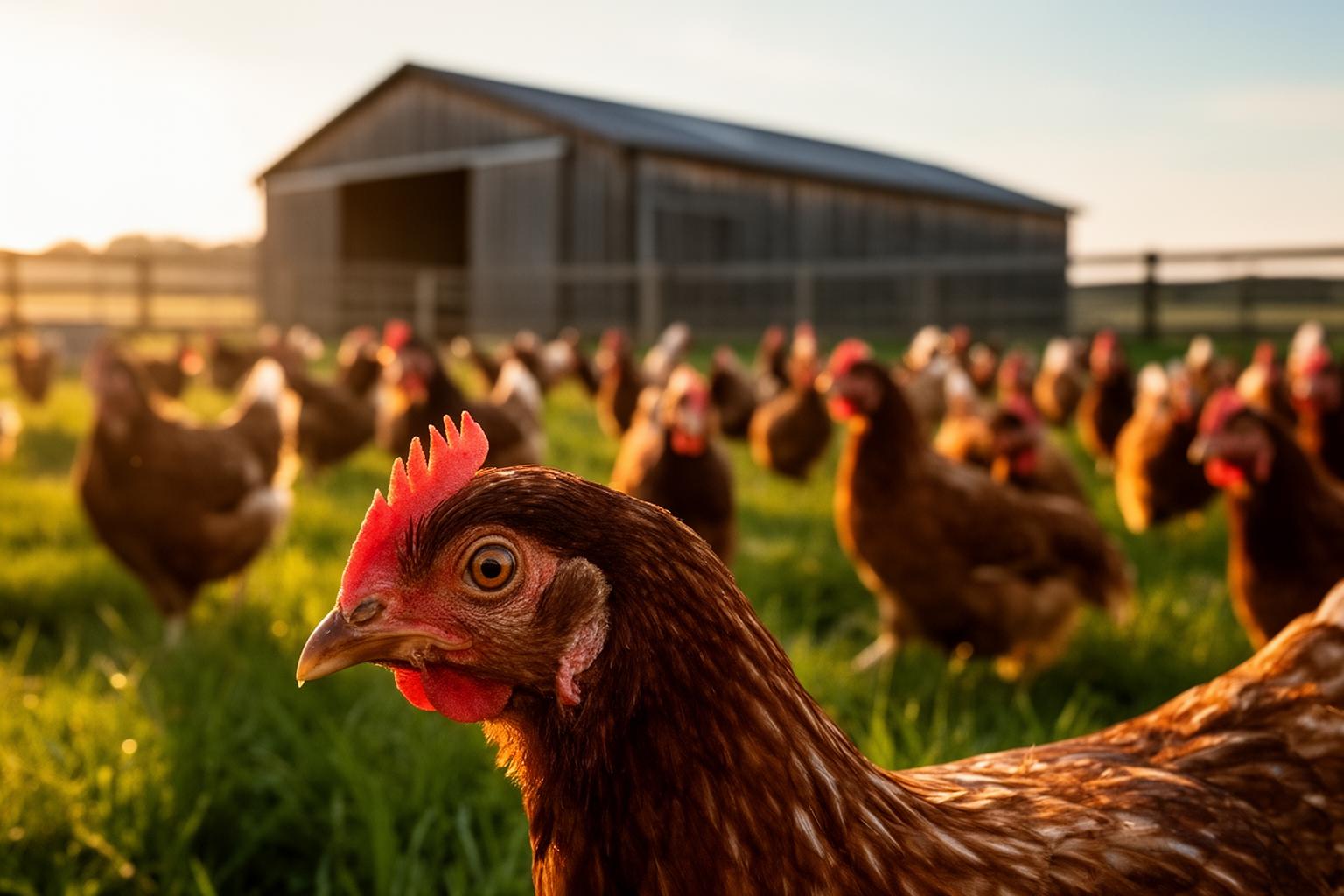
Quick answer
The egg industry globally produces over 1.6 trillion eggs annually, with the vast majority from hens in intensive systems. However, consumer pressure and legislation are moving many countries towards cage-free and free-range production, improving welfare but introducing new environmental and management trade-offs.
Key takeaways
- Global egg production reached 87 million metric tonnes in 2022, equivalent to roughly 1.6 trillion eggs.
- China is the largest egg producer, accounting for around 35% of global output.
- In the UK, 68% of eggs produced in 2023 were free-range, with only 7% from enriched cages.
- Producing 1 kg of eggs generates about 2.1 to 4.7 kg CO2e, lower than chicken meat (6.9 kg) and beef.
- Cage-free systems allow natural behaviours like dustbathing but increase risks of keel bone fractures and aggressive pecking.
- In-ovo sexing technology is eliminating the need to cull male chicks, with commercial use in several countries.
The egg industry is a massive global enterprise, responsible for producing billions of eggs each year for food. While eggs are a common and versatile ingredient in many diets, the methods of their production have become a significant point of discussion and debate. This overview delves into the structure of the egg industry, the welfare of laying hens, environmental considerations, and the emerging trends that are reshaping its future.
The central question is simple: How does the egg industry work, what is its real cost, and how can consumers make more ethical and sustainable choices? The answer is that the industry is highly efficient but carries serious welfare and environmental burdens that vary dramatically by production system. The good news is that consumer pressure is driving a steady move away from the worst forms of confinement, and technological advances are already eliminating some of its most brutal practices. Understanding the trade-offs is the first step toward being part of the solution.
This page provides a data-driven overview, covering the core facts, the evidence behind welfare and environmental claims, how different systems operate in practice, and what you can do to align your purchasing power with your values.
What it is
The egg industry refers to the global system of breeding, raising, and processing chickens (primarily hens) for egg production, along with the distribution and sale of their eggs. This industry is a substantial component of the agricultural economy worldwide, providing a relatively inexpensive and protein-rich food source. The vast majority of eggs consumed globally come from domesticated chickens, specifically breeds selected for high egg-laying capacity.
Egg production systems vary significantly, impacting animal welfare, environmental footprint, and cost. The main systems include conventional cages, enriched cages, barn, free-range, and organic. Conventional cages, now banned in the EU and UK, provided minimal space for hens. Enriched cages offer slightly more space and amenities like perches and nesting areas. Barn systems allow hens to move freely within a barn, often across multiple levels, but without outdoor access. Free-range systems provide hens with outdoor access during the day, in addition to indoor shelter. Organic systems typically combine free-range access with organic feed and stricter welfare standards.
Production Systems Overview
| System | Description | Welfare Considerations |
|---|---|---|
| Conventional Cages | Hens kept in small wire cages, minimal space. | Severe restriction of natural behaviours, high stress. |
| Enriched Cages | Cages with more space, perches, nesting areas, litter. | Improved but still limited space; natural behaviours restricted. |
| Barn | Hens free to roam indoors, often multi-tiered, no outdoor access. | Better mobility, some natural behaviours, potential for respiratory issues. |
| Free-Range | Hens have daytime outdoor access, indoor shelter at night. | Improved welfare, access to fresh air/foraging, weather dependency. |
| Organic | Free-range standards, organic feed, stricter welfare and stocking density. | Highest welfare standards, emphasis on natural behaviour and environment. |
Why it matters
The egg industry matters due to its significant impact on animal welfare, environmental sustainability, and public health. Millions of hens are involved in egg production globally, and their living conditions vary dramatically depending on the farming system. Concerns about the welfare of laying hens often focus on confinement, the inability to express natural behaviours like foraging and dustbathing, and routine practices such as beak trimming and the culling of male chicks.
From an environmental perspective, egg production contributes to greenhouse gas emissions, primarily through feed production and manure management. It also requires substantial land and water resources. The carbon footprint of eggs can vary significantly based on the production system, with more intensive systems often having a lower per-egg footprint due to efficiency, but at a higher welfare cost. Public health considerations include the risk of foodborne illnesses, such as Salmonella, which can be mitigated through proper hygiene and vaccination practices, as well as nutritional aspects of egg consumption.
Societal values regarding animal treatment and environmental protection are increasingly influencing consumer choices and regulatory landscapes. This shift drives innovation and demands for greater transparency within the industry. For example, consumer demand in the UK has led to a significant increase in free-range and barn egg production, alongside commitments from major retailers to transition away from caged eggs entirely.
The numbers
The scale of the egg industry is immense, with billions of eggs produced and consumed annually worldwide. In 2022, global egg production reached approximately 87 million metric tonnes, equivalent to roughly 1.6 trillion eggs. China is by far the largest producer, accounting for around 35% of the global total, followed by the European Union and the United States.
In the UK, over 80 billion eggs are produced each year. The market share of different production systems has seen significant shifts over the past two decades. In 2023, approximately 68% of eggs produced in the UK were free-range, 25% were barn, and a declining 7% were from enriched cages. This trend reflects strong consumer preference and retailer commitments to higher welfare standards, particularly the phasing out of caged eggs.
Regarding environmental impact, the production of one kilogram of eggs (approximately 16-20 eggs) is estimated to generate between 2.1 and 4.7 kg of CO2 equivalent, depending on the farming system and regional factors. This compares to roughly 6.9 kg CO2e for chicken meat and significantly higher for beef. Water usage for egg production is also notable, with estimates ranging from 300 to 500 litres per kilogram of eggs, mainly attributed to feed cultivation.
Another key number is the number of laying hens worldwide, estimated at over 4 billion according to the Food and Agriculture Organization (FAO, 2023). The vast majority of these hens are housed in caged systems, particularly in Asia and the Americas, though the trend is shifting toward cage-free in many high-income countries.
The evidence
Research consistently shows that cage-free systems improve hen welfare, but they also come with trade-offs. A 2020 systematic review by the University of Bristol found that while cage-free systems allow natural behaviours like dustbathing and wing-flapping, they also have higher rates of keel bone fractures and aggressive pecking, leading to higher mortality in some flocks.
On the environmental side, a life cycle assessment by Poore and Nemecek (2018) in Science found that eggs have a relatively low environmental footprint compared to other animal proteins, but that feed production is the dominant contributor, accounting for over 60% of the carbon footprint. The same study noted that pasture-raised systems can have slightly higher land use but similar greenhouse gas emissions per kilogram of eggs.
Public health evidence is clear: proper vaccination and hygiene can dramatically reduce Salmonella risk. The USDA estimates that Salmonella prevalence in US shell eggs dropped from 0.5% in the early 1990s to under 0.05% by 2020, largely due to industry-wide vaccination and refrigeration requirements.
Key stat: A 2019 European Food Safety Authority (EFSA) review concluded that the welfare of laying hens in enriched cages is significantly improved over conventional cages, but that non-cage systems, particularly those with outdoor access, provide the highest welfare potential, despite introducing new risks.
How it works in practice
Supply chain and production cycle
The egg industry operates on a tightly controlled production cycle. Breeding flocks are selected for high egg output, and hatcheries supply pullets (young hens) to farms. Hens typically start laying at around 18-20 weeks of age and are kept for one or two laying cycles, each lasting about 12-14 months. After peak production, hens are often culled, and their carcasses may enter low-value processing streams.
In practice, the system type determines day-to-day management. In barn systems, hens are housed in houses with litter (such as wood shavings) and perches. In free-range systems, popholes give access to outdoor pasture, which must be rotated to avoid soil erosion and disease build-up. In organic systems, feed must be 100% organic, and flocks are smaller.
Beak trimming and chick culling
Routine practices include beak trimming, which is used to reduce pecking injuries in high-density environments. The practice is painful and is banned or restricted in several countries, including the UK, which plans to phase it out. Male chicks, which cannot lay eggs and grow too slowly for meat, are culled at day-old. This practice is legal in most countries, though regulations are tightening, and alternatives are increasingly available.
In-ovo sexing and other technologies
In-ovo sexing is a technology that uses spectroscopy to determine the sex of an embryo before it hatches. It is now used commercially in several European countries, and the USDA has approved its use in the US. The technology eliminates the need for chick culling, and its adoption is growing.
- Technologies in use: In-ovo sexing, automated welfare monitoring using cameras and AI, and feed additives that reduce ammonia emissions.
- Retailer commitments: Major supermarkets like Waitrose, Sainsbury's, and Tesco in the UK have committed to sourcing only cage-free eggs, and many have also pledged to stop culling male chicks by 2025.
Costs and trade-offs
Higher welfare systems cost more to produce. According to the UK Department for Environment, Food and Rural Affairs (Defra, 2023), the cost of production for free-range eggs is about 15-20% higher than for enriched cage eggs, primarily due to higher feed intake, lower stocking density, and higher labour costs. Organic eggs can be 30-50% more expensive, depending on feed and certification costs.
These higher costs are passed to consumers, but the price premium has not dampened demand in many markets. In the UK, free-range eggs have been the most popular choice since 2015, and sales of cage-free eggs are growing. However, for lower-income households, the price increase can be a barrier, and some argue that this creates a welfare inequality.
⚠️ Trade-off: Intensive systems have lower per-egg environmental footprints, making them attractive for climate goals, but at the expense of hen welfare. Conversely, free-range and organic systems have slightly higher carbon footprints but better welfare.
Common objections
“Eggs are a natural food; we’ve always eaten them.” While true, the industrialisation of egg production is only a few decades old. In 1950, hens kept in small flocks had an average lifespan of several years; today, commercial hens are typically culled at around 72 weeks, according to the FAO. The “natural” argument often ignores the welfare compromises of modern systems.
“Cage-free is better, but consumers can’t afford it.” That’s a valid concern, which is why many animal welfare groups advocate for higher welfare across all price points, including improvements to barn systems. The Good Egg Project and the Humane League work with retailers to make better options more accessible.
“The carbon footprint of eggs is already low, so what’s the problem?” While eggs are relatively low-impact compared to beef or lamb, they still have a measurable footprint. Moreover, welfare and environmental issues are not mutually exclusive – consumers can choose systems that do well on both fronts, such as free-range or organic.
Regional angle
Egg production and welfare standards vary widely by region. In the European Union, conventional cages have been banned since 2012, and the EU has set a 2027 deadline to phase out all cages, including enriched cages. In the United States, cage-free commitments are growing, but many states still allow conventional cages. California, Massachusetts, and Michigan have passed laws requiring cage-free production, and several other states are considering similar measures.
Asia, which produces nearly 60% of the world’s eggs, is the largest market. China alone produces 35% of global eggs, but its production is dominated by conventional cages. Japan has a high rate of cage-free adoption for certain premium eggs, but still uses cages for the majority. India is experiencing rapid growth and has a large backyard poultry sector alongside commercial producers.
🌱 Policy initiatives are also emerging. India’s Animal Welfare Board has proposed standards for enriched cages, and several organisations are promoting “higher welfare” labels. The global shift toward cage-free is gaining momentum, with over 2,000 companies worldwide having made cage-free commitments, according to the Compassion in World Farming (2023).
What you can do
Individuals can play a role in influencing the egg industry through their purchasing decisions and dietary choices. Opting for eggs from higher-welfare systems, such as free-range or organic, supports farms that provide hens with more space and better living conditions. Look for certifications from reputable animal welfare organisations, such as the RSPCA Assured or the Soil Association in the UK, which often indicate stricter standards than baseline legal requirements.
For those concerned about animal welfare and environmental impact, exploring plant-based egg alternatives is another impactful option. A variety of products are now available that can replace eggs in cooking and baking, from liquid egg replacers made for scrambling to powdered versions for baking. Companies like JUST Egg and Crackd are examples of brands offering these alternatives. Embracing a plant-based diet or reducing egg consumption can significantly lower an individual's environmental footprint and reduce demand for industrial egg production.
Supporting advocacy organisations that work to improve animal welfare standards in the egg industry can also make a difference. These organisations often campaign for policy changes, raise public awareness, and engage with producers and retailers to push for more humane practices. Educating yourself and others about the realities of egg production fosters informed choices and contributes to a more compassionate food system.
Steps you can take today
- Check labels: Choose eggs with a high-welfare certification, such as RSPCA Assured or Soil Association Organic.
- Reduce waste: Use eggs fully – even the shells can be composted.
- Try egg alternatives: Use liquid egg replacers for baking or tofu scramble for breakfast.
- Speak up: Ask your local supermarket or restaurant about their egg sourcing policy.
Bottom line: The egg industry is at a crossroads – the choices you make at the grocery store help decide whether it moves toward higher welfare or continues to rely on cost-driven intensive systems.
 Veterinarian using in-ovo sexing device on an egg
Trade-offs in Egg Production Systems
The choice of egg production system involves balancing animal welfare, environmental impact, and cost, with no single system excelling in all areas. Cage-free systems generally improve welfare by allowing natural behaviours like foraging and dustbathing, but they often incur higher feed and energy costs, and can lead to increased mortality from keel bone fractures or feather pecking (University of Bristol, 2020).
Conventional cages, now banned in the EU and UK, were highly efficient in terms of space and per-egg footprint, but at the expense of severe behavioural restriction. Enriched cages offer a middle ground, yet still limit movement and natural perching. Barn and free-range systems provide more space and enrichment, but require more feed because hens are more active, and they complicate manure management, which can increase ammonia emissions. Organic systems add the cost of certified organic feed, which is typically more expensive, and often have lower productivity per hen, raising the price per dozen eggs.
From a consumer perspective, the trade-off is reflected in shelf price: eggs from cage-free or organic systems routinely cost 30-100% more than caged alternatives, depending on the region and retailer. 🌱 Buyers who prioritise welfare must accept this premium, while those on a tight budget may feel the pinch. A pragmatic compromise is to choose barn or free-range over organic if cost is a barrier—these still offer significant welfare gains without the full organic price.
Bottom line: Every system involves a unique mix of animal welfare, environmental, and economic costs; no single choice is perfectly sustainable, so the trade-off must be made consciously based on your values and budget.
Common Objections and Nuanced Responses
Some consumers argue that eggs are a necessary and inexpensive protein, and that higher-welfare systems are unaffordable luxuries. However, per-egg price differences are modest when compared to other protein sources like meat or fish, and eggs remain one of the cheapest animal proteins even at premium prices (FAO, 2023). Additionally, bulk buying or choosing smaller egg sizes can mitigate cost increases for budget-conscious households.
Others claim that cage-free systems are actually worse for hen health due to higher rates of keel bone fractures (often 30-50% in free-range flocks, compared to lower rates in cage systems). While this is true in some studies, the overall welfare balance is complex: cage-free hens can express natural behaviours, which many welfare scientists deem more important than avoiding every physical ailment. Advances in diet (e.g., calcium supplementation) and flock management are also reducing fracture rates.
A frequent objection is that free-range eggs have a higher environmental footprint per egg because hens require more feed and land. Life-cycle assessments show that the carbon footprint of eggs is relatively low across systems (around 2.1-4.7 kg CO2e per kg eggs, with cage-free often at the higher end), but the difference is small compared to the carbon savings from avoiding meat, particularly beef. So, while cage-free is not a climate panacea, it is not a climate villain either.
Finally, some argue that individual consumer choices are meaningless without systemic change, since corporate policies and regulations drive the majority of egg production. This is partially true, but consumer demand has been a major catalyst for retailer commitments, as seen in the EU and UK. Supporting higher-welfare eggs sends a market signal, and every purchase is a vote for the system you want to see scaled up.
Key stat: According to a 2023 YouGov poll in the UK, 73% of consumers agree that phasing out cages for laying hens is important, regardless of their own egg-buying frequency.
The Regional Angle for English-Speaking Readers
Across English-speaking countries, egg production and welfare standards vary widely, shaped by legislation, retailer power, and consumer attitudes. In the UK, cages are banned since 2012, and over 90% of eggs are now from free-range or barn systems, thanks partly to supermarket policies and consumer awareness campaigns (British Egg Industry Council, 2023).
In the European Union, the conventional cage ban came into force in 2012, and the EU is currently debating a phase-out of all cages by 2027, with many member states already voluntarily moving to enriched or cage-free systems. However, enforcement and transition costs differ, and some countries like Spain still rely heavily on enriched cages. The UK's departure from the EU has not reversed its own cage ban, but it has changed trade dynamics, with imported eggs sometimes coming from caged systems unless labelled otherwise.
The United States has a fragmented landscape: some states (e.g., California, Massachusetts, Michigan) have passed cage-free laws, while others have no specific requirements. Most large US food brands and retailers have made voluntary cage-free commitments, but progress is slow, and a significant share of US production remains caged. Canada is ahead of the curve nationally, with a phased transition to free-run (enriched) housing by 2036, and a industry target to reduce routine beak trimming by 2030.
Australia and New Zealand present a mix: Australia has no national cage ban, but many major supermarkets stopped selling caged eggs in the late 2010s, and as of 2023, around 60% of Australian eggs are from cage-free systems (Australian Egg Industry Association, 2023). New Zealand banned conventional cages in 2023, transitioning to enriched cages, though free-range and organic are growing. Ireland, like the UK, has a high share of free-range eggs, with over 80% in 2023.
For English-speaking consumers, this means your choice depends heavily on where you live: in the UK or Ireland, free-range is the norm; in the US or Australia, you may need to look for explicit labels like "cage-free" or "free-range". Imported eggs in any country may come from caged systems, so always check origin and labelling. 🌍
Comparison Table: Egg Production Systems at a Glance
| Aspect | Conventional Cage | Enriched Cage | Barn | Free-Range | Organic |
|---|---|---|---|---|---|
| Space per hen | < 550 sq cm | ~750 sq cm | ~1,100 sq cm | ~4 sq m outdoor | ~4 sq m outdoor, higher indoor space |
| Natural behaviour | Severely restricted | Some (perching, nesting) | More (foraging, dustbathing) | Good, with outdoor access | Best, with pasture access |
| Typical mortality (lay cycle) | low (2-5%) | low-moderate (3-6%) | moderate (4-8%) | moderate-high (5-10%) | moderate-high (5-10%) |
| Carbon footprint per egg | Lowest (e.g., 1.5-2.5 kg CO2e/kg) | Slightly higher (2-3 kg CO2e/kg) | Moderate (2.5-3.5 kg CO2e/kg) | Higher (3-4 kg CO2e/kg) | Higher, varies with pasture management |
| Cost per dozen (US, 2023) | $1.50-2.50 | $2.00-3.50 | $2.50-4.00 | $3.50-5.00 | $5.00-6.00 |
| Regulatory status (major markets) | Banned in UK, EU; allowed in US (except some states) | Banned in UK, EU; allowed in US and NZ | Permitted, common in EU & UK | Permitted, common in UK & Ireland | Permitted, certified in many countries |
Note: Space per hen and mortality figures are approximate, based on industry and academic sources (e.g., DEFRA, 2022; United Egg Producers, 2023).
Practical Checklist for Conscious Choice
When you stand at the egg aisle, take a minute to weigh these factors—your choice matters both for hens and for the planet. Use this checklist to make an informed decision that aligns with your values, budget, and local availability:
- ✅ Recognise labels: "Cage-free" means hens are not in cages, but could be indoors; "Free-range" guarantees outdoor access; "Organic" includes free-range and organic feed, with stricter stocking density.
- ✅ Check the packaging: Look for the Lion Mark (UK) or equivalent national quality assurance, which ensures vaccinations and traceability.
- ✅ Support retailer commitments: Choose brands that have made timetabled cage-free pledges, and use your purchasing power to encourage others.
- ⚠️ Be cautious with "barn" eggs: They are better than cages, but still lack outdoor access; if you want outdoor, look for "free-range" specifically.
- ✅ Balance nutrition and cost: For budget, choose large or medium free-range eggs, which are often cheaper per gram than premium sizes.
- ✅ Reduce food waste: Buy only what you need; eggs last several weeks refrigerated, but use older ones for baking.
- ♻️ Repurpose eggshells: Crush and add to compost or garden soil as calcium source.
- 📉 Think about the whole meal: Eggs have a relatively low footprint, but the greatest environmental impact of a meal often comes from sides like meat or cheese; making plant-based sides lowers overall footprint.
The Path Forward: What You Can Do Next
Beyond your shopping basket, you can drive change in the egg industry through advocacy, education, and consumer activism. Start by sharing evidence-based information on social media—post a link to this page or cite the comparative table to debunk myths about cage-free eggs being nutritionally inferior (they are not).
Contact your local legislators: in the US, support state-level cage-free laws like those in California and Michigan; in Australia, ask your MP to phase out cages nationally. If you’re a student, petition your university’s dining services to source higher-welfare eggs, as many campuses have already committed to cage-free.
For business owners, consider switching your procurement to certified free-range or organic eggs—this not only improves animal welfare but can also appeal to ethically conscious customers. Even small cafés and restaurants can make a difference by updating their suppliers.
Finally, stay informed: the industry and welfare science are evolving, with innovations like in-ovo sexing (to avoid male chick culling) and insect-based feeds on the horizon. To keep your knowledge current, revisit trusted sources like the RSPCA’s Standards or the FAO’s Livestock and Poultry quarterly reports. 🌱
 Aerial view of a hen barn with outdoor range
References and Further Reading
This page synthesises data from leading organisations and peer-reviewed studies. For deeper dives, the following resources are reliable and openly accessible:
- Food and Agriculture Organization (FAO). (2023). Livestock and Poultry Statistics. FAO Statistics Division.
- University of Bristol. (2020). Systematic Review of Laying Hen Welfare. Bristol Veterinary School.
- British Egg Industry Council. (2023). UK Egg Market Report. BEIC Publications.
- United Egg Producers. (2023). Cage-Free Commitment Report. UEP.
- Australian Egg Industry Association. (2023). Australian Egg Industry Statistics. AEIA.
Read next
The common questions
People also ask
Sources
- Food and Agriculture Organization (FAO) - Egg production data
- Department for Environment, Food & Rural Affairs (DEFRA) - United Kingdom egg statistics
- University of Bristol - Systematic review on laying hen welfare
- Poore & Nemecek (2018) - Life cycle assessments in Science
- United States Department of Agriculture (USDA) - Egg safety and Salmonella estimates
- European Food Safety Authority (EFSA) - Welfare of laying hens