Factory Farming: Understanding Industrial Animal Agriculture
Factory farming is an intensive animal agriculture system that prioritizes efficiency and profit over animal welfare, causing significant environmental damage, public health risks, and ethical concerns. This page explores its definition, scale, controversies, and alternatives.
Updated · September 7, 2026
Quick answer
Factory farming is an industrial method of raising animals for food, marked by extreme confinement, high density, and efficiency-driven practices. It dominates global meat, dairy, and egg production, but comes with heavy ethical, environmental, and health costs. Reducing animal product consumption and supporting higher-welfare systems are key steps to counter it.
Key takeaways
- Factory farming is the dominant method of producing meat, dairy, and eggs globally, with about 80% of poultry meat and 70% of eggs coming from intensive systems.
- More than 99% of farmed animals in the U.S. are raised in factory farm conditions, according to a 2023 Sentience Institute report.
- Food production contributes about 25% of global greenhouse gas emissions, with animal products playing a disproportionate role.
- Antibiotic use in factory farms accelerates the rise of antibiotic-resistant bacteria, posing a global health threat.
- In the U.S., four firms control approximately 85% of beef processing, illustrating high market concentration.
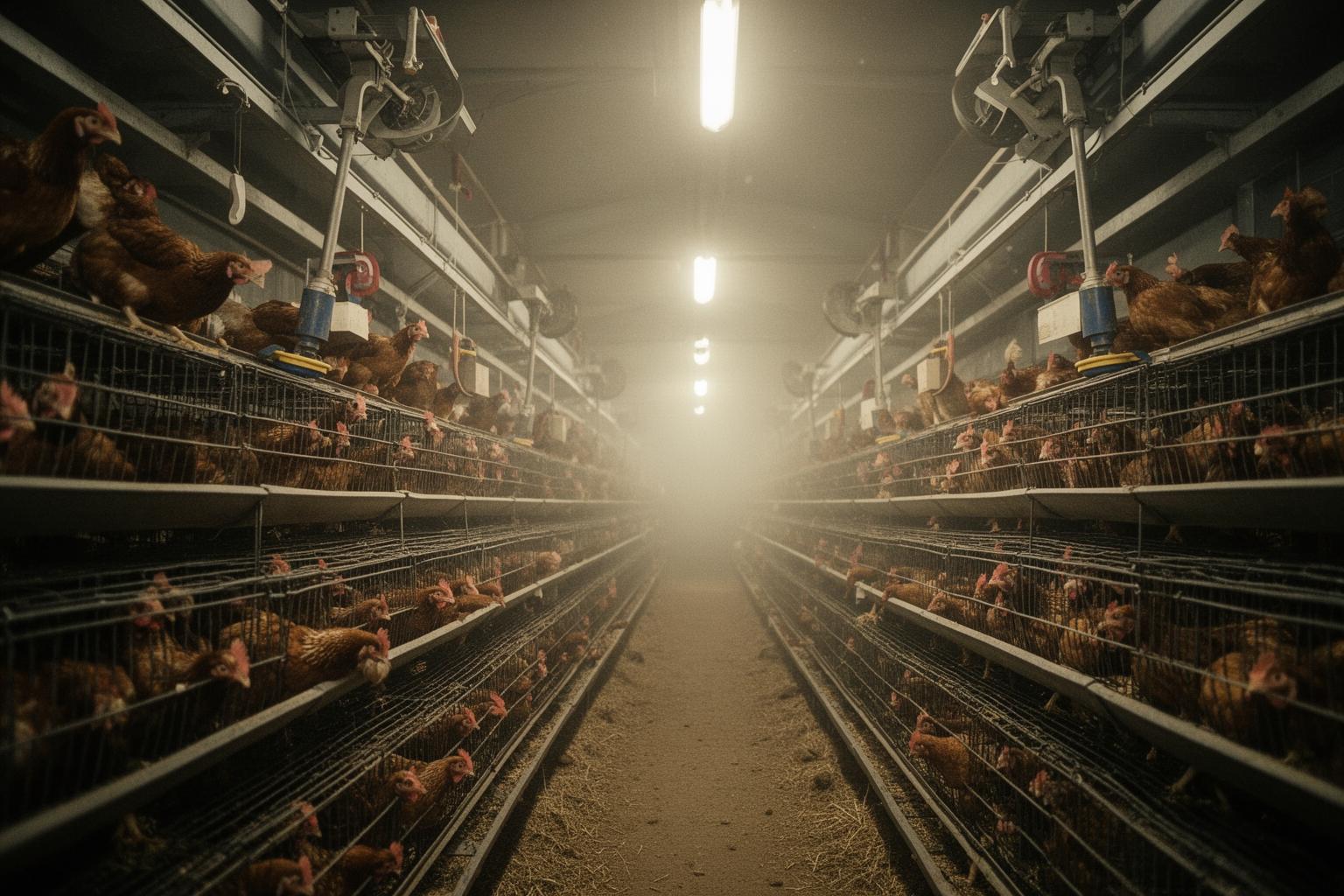
- Factory farming confines animals in spaces as small as 67 square inches per hen, denying them natural behaviors and causing suffering.
Factory farming, a term widely used to describe modern industrial animal agriculture, involves raising vast numbers of animals—often hundreds of thousands—in highly controlled, confined environments. This system has become the dominant method of animal product production globally, driven by consumer demand for affordable meat, dairy, and eggs. While highly efficient in terms of output, it has sparked considerable debate and criticism regarding its implications for animal welfare, environmental sustainability, and public health.
This page will delve into the definition and practices of factory farming, explore where it is most prevalent, and discuss the various reasons why it remains a contentious topic in contemporary society. By understanding this complex system, we can better appreciate its impacts and the ongoing discussions surrounding food production and ethical consumption.
Definition
Factory farming is an intensive system of animal agriculture designed to maximize the production of meat, eggs, and dairy products at the lowest possible cost. This approach typically involves housing a large number of animals in confined spaces, often indoors, where their environment, diet, and health are meticulously managed. The goal is to achieve rapid growth rates and high yields through methods that often prioritize efficiency over the natural behaviors and well-being of the animals.
Key characteristics of factory farming include severe confinement, often in cages, crates, or crowded pens, and highly specialized breeding programs. Animals are typically fed a diet formulated for quick weight gain, often consisting of grains and soy rather than their natural forage. The widespread use of antibiotics, both therapeutically and as growth promoters (though this practice is increasingly regulated), is also common to prevent disease outbreaks in dense populations and to accelerate growth.
Types of Factory Farms
Factory farming encompasses various sectors, each with its specific practices:
- Poultry: Chickens (broilers for meat, layers for eggs) are often housed in large sheds, with layer hens frequently kept in barren battery cages or enriched colony cages. Broiler chickens are typically raised on floors in crowded barns.
- Pigs: Sows are often confined in gestation crates during pregnancy and farrowing crates during nursing, while piglets are raised in crowded pens.
- Cattle: Beef cattle are often sent to concentrated animal feeding operations (CAFOs) for fattening before slaughter, while dairy cows may be kept in intensive indoor systems.
Scale and Prevalence
Factory farming is the dominant mode of animal agriculture globally, with the vast majority of meat, dairy, and eggs now produced in such systems. According to the Food and Agriculture Organization (FAO), around 80% of global poultry meat and 70% of eggs come from intensive systems, and similar trends are seen for pork and dairy. The shift toward industrial production has been accelerating since the mid-20th century, driven by rising global demand for cheap animal protein and the consolidation of supply chains.
Global hotspots
Factory farming is particularly concentrated in regions with high meat consumption and strong export markets. Key hotspots include the United States, Brazil, China, and parts of Europe (notably the Netherlands, Spain, and Germany). In the US, more than 99% of farmed animals are raised in factory farm conditions, according to a 2023 report by the Sentience Institute. China has rapidly expanded its intensive pig and poultry operations to feed its growing middle class, while Brazil has become a leading exporter of beef and chicken from large-scale operations.
Why it's contested
Factory farming is highly contested for a multitude of reasons, spanning animal welfare, environmental impact, public health, and ethical considerations. The fundamental tension lies between the economic efficiencies it offers and the severe drawbacks it creates. Animal welfare advocates argue that the extreme confinement and lack of stimulation inherent in factory farms cause immense suffering, denying animals the ability to express natural behaviors. This perspective aligns with the principles of [Animal rights] and challenges the anthropocentric view that animals are mere commodities.
Environmental concerns are equally pressing. Factory farms generate vast amounts of manure, which can pollute soil and waterways with nitrates, phosphates, and pathogens. The production of feed, particularly soy and corn, drives deforestation in biodiverse regions and requires significant land, water, and fertilizer inputs. Furthermore, livestock farming is a major contributor to greenhouse gas emissions, primarily methane from ruminant digestion and nitrous oxide from manure management, impacting climate change. This makes factory farming a significant focus for discussions around [Climate] and sustainable food systems.
Public health risks also contribute to the controversy. The routine use of antibiotics in factory farms is a significant factor in the rise of antibiotic-resistant bacteria, posing a global health threat. The close proximity of large numbers of genetically similar animals can also create breeding grounds for zoonotic diseases, which can then jump to human populations. These concerns highlight the interconnectedness of animal health, human health, and environmental well-being. Critiques from a [What is Carnism?] perspective often highlight how societal norms obscure the realities of factory farming.
Ethical Debates
Ethical debates around factory farming question whether industrialized animal agriculture can ever be justified, even with welfare improvements. Some argue that any farming system that treats animals as commodities violates their inherent value, while others believe that high-welfare, extensive systems can be acceptable. The concept of [Speciesism] — discrimination based on species — is central, with critics arguing that factory farming exemplifies how we devalue animals solely because we see them as less important. The principle of [Sentience] undercuts this view, as animals demonstrably experience pain and suffering.
Bottom line: Factory farming pits efficiency against ethics. While it delivers cheap meat, dairy, and eggs, it does so by stripping animals of their basic needs and dignity. The debate centers on whether such trade-offs are ever acceptable, and increasingly the answer is no.
Costs and Trade-offs
Factory farming offers significant economic benefits, including low prices and high productivity, but these come with hidden costs that are rarely reflected in the checkout price. Environmental costs—pollution, greenhouse gas emissions, and biodiversity loss—are largely externalized, meaning that the producer and consumer do not pay directly for them. According to a 2015 study in the journal Nature Climate Change, food production is responsible for about 25% of global greenhouse gas emissions, with animal products contributing disproportionately. Public health costs from antibiotic resistance and zoonotic disease outbreaks add another layer of economic burden, as do the long-term costs of degraded soil and water.
| Aspect | Factory Farming | Alternative Systems (e.g., pasture-based) |
|---|---|---|
| Price to consumer | Low | Higher |
| Environmental footprint | High (pollution, emissions) | Lower per unit (often) |
| Animal welfare | Generally poor | Better, but still constrained by exploitation |
| Antibiotic use | High (prophylactic) | Lower (but still used) |
| Scalability | High | Low to moderate |
How It Works in Practice
Factory farming works by concentrating large numbers of animals in small spaces and managing their inputs (feed, water, medication) and outputs (waste) with industrial efficiency. Animals are bred for extreme productivity: broiler chickens grow to slaughter weight in about six weeks, and dairy cows are kept on a near-constant lactation cycle. Manure is often stored in large lagoons and then sprayed onto fields as fertilizer, which can lead to runoff and pollution. The system relies on intensive feed production, using corn, soy, and other crops grown with synthetic fertilizers and pesticides, creating a food chain that is highly dependent on fossil fuels.
Typical layout of a CAFO
A concentrated animal feeding operation (CAFO) typically consists of long, windowless barns or open-air pens with automated feeding and watering systems. In pig operations, sows are housed in gestation crates (now banned in several countries) that restrict movement entirely, while fattening pigs are kept in pens with slatted floors that allow waste to fall through. Poultry operations vary, but layer hens often live in battery cages with just 67 square inches per bird (according to the Humane Society International), barely more than a standard sheet of paper.
Supply chain and market forces
Factory farming is embedded in a supply chain that spans from feed producers to processors, retailers, and fast-food chains. A handful of companies control the majority of the market—for example, in the US, four firms process about 85% of beef, as noted in a 2023 USDA report. These companies can dictate prices to farmers and streamline the flow of cheap meat into stores. Retail price is the main driver, but sustainability and animal welfare certifications are slowly gaining ground, pushing some producers to adopt higher-welfare practices.
What Can You Do Next?
If you want to reduce the impact of factory farming, the most effective steps are to reduce or eliminate animal product consumption, support higher-welfare farming, and advocate for policy change. Adopting a plant-based diet is the single biggest lever, as it directly reduces demand for factory-farmed products. If you still consume animal products, choose certified organic or pasture-raised sources—though these are not always cruelty-free, they typically offer better welfare and lower environmental impact. Policy measures—such as banning cages and crates, restricting antibiotic use, and implementing true cost accounting—can also be supported through voting and activism.
Related terms
Understanding factory farming often requires familiarity with several related concepts that shed light on its broader context and implications:
- Concentrated Animal Feeding Operation (CAFO): This is a specific regulatory term used in the United States to define large-scale animal agricultural facilities, often associated directly with factory farming practices. CAFOs are subject to environmental regulations regarding waste management due to their potential for pollution.
- Animal Welfare: This concept refers to the physical and mental well-being of animals. Critics of factory farming often argue that it fails to meet even basic animal welfare standards, as animals are unable to live free from hunger, thirst, discomfort, pain, injury, disease, fear, and distress, or express normal behavior. See also: [Welfarism: Understanding the Movement for Animal Welfare] and [What is Animal Welfare?].
- Speciesism: This term describes the discrimination against non-human animals based solely on their species. Many argue that factory farming is a prime example of speciesism, as it treats animals purely as means to an end, disregarding their capacity for sentence and suffering. See also: [Speciesism: Unpacking the Bias Against Non-Human Animals] and [Sentience: Understanding the Capacity to Feel].
- Veganism: As an ethical stance, veganism opposes the exploitation of animals, which inherently includes the practices of factory farming. A vegan diet excludes all animal products, directly opting out of systems like factory farming. See also: [What is Veganism?].
- Anthropocentrism: This worldview places humans at the center of existence and considers human interests as paramount. Critics argue that anthropocentrism underpins the justification for factory farming, where animal lives are valued only in terms of their utility to humans. See also: [Anthropocentrism: Understanding Humanity's Place in the World].
 Aerial view of factory farm barns with a large manure lagoon nearby.
Regional Variations
Factory farming is not uniform; its practices vary widely across regions, driven by local regulations, culture, and market demands.
- European Union: The EU has stricter welfare standards, including bans on battery cages (since 2012) and gestation crates (since 2013), though many animals still live in barren, high-density conditions. The EU is a major exporter of dairy and pork.
- United States: The US is the largest producer of beef and poultry, with CAFOs prevalent. Welfare regulations are minimal at the federal level, and states vary, with some passing bans on gestation crates and veal crates.
- Asia (e.g., China, Indonesia): Rapid expansion of intensive systems to meet rising demand. Welfare standards are still evolving, and there is heavy use of antibiotics, though some countries are starting to restrict growth promoters.
- Latin America: Brazil and Argentina are major beef exporters, with extensive ranching coexisting with growing intensive poultry and pig operations. Deforestation for feed production is a pressing concern.
Common Objections and Responses
Some people defend factory farming or question the need for change. Here are common objections, along with evidence-based responses.
-
Objection: "Factory farming is necessary to feed the world's growing population."
- Response: The problem is not lack of production but distribution and dietary choices. Feeding crops directly to people is more efficient than cycling them through animals; a 2020 review in Nature Food found that plant-based diets could feed more people with less land and reduce emissions.
-
Objection: "Animals don't really suffer because they don't have consciousness like we do."
- Response: Scientific consensus, backed by organizations like the American Veterinary Medical Association, recognizes that farm animals are sentient and can experience pain, fear, and distress. The Cambridge Declaration on Consciousness (2012) affirms this for mammals and birds.
-
Objection: "Free-range or organic farming is too expensive and only for the rich."
- Response: Higher welfare products cost more because they internalize more of the true costs, but they are becoming more accessible. In addition, reducing meat consumption—rather than just switching—can offset the price difference.
Trade-offs and externalized costs
Factory farming's economic efficiency is real, but it is achieved by shifting heavy costs onto society, animals, and the environment. According to a 2023 FAO assessment, the hidden environmental costs of global agrifood systems, dominated by livestock, exceed $10 trillion annually — roughly 10% of global GDP. These externalized costs include water and air pollution, soil degradation, greenhouse gas emissions, and public health burdens from antibiotic resistance and zoonotic disease outbreaks.
For consumers, the price of a factory-farmed chicken breast rarely reflects the cost of cleaning up downstream nitrate pollution or treating resistant infections. A 2021 study in Nature Food estimated that if producers had to internalize all environmental and health costs, factory-farmed meat prices would rise by an average of 35-40%. This does not even account for animal welfare, which is often treated as having zero monetary value in production models. Recognizing these trade-offs is essential for informed choices: cheap food today can mean expensive health and environmental bills tomorrow.
 Sows confined in gestation crates inside a dimly lit pig barn.
Common objections and rebuttals
Many objections to factory farming are reasonable but rest on assumptions that crumble under inspection. Here are the most frequent ones and evidence-led counterpoints:
- "Factory farming is necessary to feed the world" — Global hunger is a distribution and access problem, not a production one. According to the UN Food Systems Summit (2021), we already produce enough food to feed 10 billion people; the issue is waste, poverty, and inequality. Extensive and regenerative systems, while yielding less per animal, can reduce waste and repurpose marginal land for pasture, contributing to food security without mass confinement.
- "Cage-free free range is better, but still problematic" — Yes, cage-free systems improve welfare for laying hens, but they do not eliminate issues like beak trimming, male chick culling, or high mortality from pecking. A 2022 review in Poultry Science found that cage-free farms have higher rates of respiratory disease and keel bone fractures. However, well-managed pasture-raised systems with intact flocks show lower stress markers and better leg health.
- "Antibiotic use is already banned in many places" — Growth promoter bans exist (e.g., EU, 2006; US, 2017), but therapeutic use, especially in crowded conditions, remains widespread. The World Health Organization (2023) notes that antimicrobial resistance causes 1.27 million direct deaths annually, and livestock use is a major driver. Reducing reliance requires better housing and hygiene, not placebo replacements.
- "Cattle are bad for the climate, period" — Ruminant methane is indeed potent, but well-managed rotational grazing can sequester soil carbon, offsetting up to 20-30% of emissions, per a 2020 study in Nature Sustainability. Factory-farmed beef, however, has a carbon footprint up to three times higher than extensive systems due to feed production and manure lagoons.
Key stat: Factory farming accounts for about 14.5% of global greenhouse gas emissions, with feed production and manure management being the largest contributors (FAO, 2023).
Regional angle for English-speaking readers
Factory farming's shape and regulation differ markedly across English-speaking countries, affecting what consumers can do and what standards exist. In the United States, more than 99% of farmed animals are in CAFOs, but federal penalties for welfare violations are rare, and "cage-free" labels are often unenforced. State-level ballot initiatives have banned gestation crates and battery cages in several states (e.g., California, Massachusetts, 2018-2022), yet these laws do not apply to out-of-state production.
United Kingdom and Australia present contrasting models: the UK has stricter welfare codes, including a partial ban on sow stalls and a higher rate of free-range eggs (around 55% of total, according to Defra, 2022). Australia, conversely, still allows battery cages and gestation crates, though consumer pressure has led major retailers (e.g., Coles, Woolworths) to phase them out by 2025. Canada has a mix: provinces vary, with some mandating enriched cages, while others have no phase-out plans.
For English-speaking readers, the practical implication is that local and state/provincial lobbying matters as much as national policy. Supporting regional producers who follow higher welfare standards—such as pasture-raised beef from the UK or free-range eggs from Australia—can shift supply chains, as seen with the UK's Red Tractor scheme and Australia's RSPCA Approved.
Comparison: factory vs. alternative systems
To help readers visualize the differences, here is a table comparing key attributes of factory farming and its main alternatives:
| Attribute | Factory (CAFO) | Free-range/pasture | Regenerative/agroecological |
|---|---|---|---|
| Animal density | >50,000 birds per shed; 10-15 pigs per pen | Lower density; outdoor access required | Very low; rotational grazing, multi-species |
| Welfare risks | High: confinement, feather pecking, lameness | Medium: outdoor exposure, predator risk | Lower: natural behaviors, but requires skilled management |
| Environmental footprint | High: manure lagoons, feed crop emissions | Moderate: lower feed input, but more land use | Lower: carbon sequestration, biodiversity gains |
| Antibiotic use | High dependence | Reduced, but not eliminated | Minimal, only therapeutic use |
| Cost to consumer | Low | Medium (10-30% premium) | Higher (30-100% premium) |
| Availability | Global, mass market | Growing in UK, EU, parts of US/Australia | Niche; farmer's markets and CSA |
This table is a simplification; individual farms vary. But it clarifies that the trade-off is not just price versus ethics — it is also long-term costs versus short-term savings.
Practical checklist for concerned consumers
If you want to reduce your support for factory farming, here is a step-by-step list you can act on today:
- Learn to read labels — Look for "Certified Humane," "Animal Welfare Approved," or UK's "Soil Association Organic." Avoid vague terms like "natural" or "farm-raised." Check if the seal requires outdoor access and lower stocking densities.
- Buy whole foods over processed — Processed meat products (nuggets, sausages) are almost exclusively factory-farmed, as lower-quality trimmings are used. Whole cuts from a local butcher can be traced to source.
- Vote with your plate, weekly — Replace one or two meat meals per week with plant-based proteins, which have a significantly lower environmental impact. A 2023 study in Nature Food found that shifting 50% of meat consumption to plant-based could cut agriculture emissions by 31%.
- Support policy change — Write to your local representative about strengthening welfare laws, or donate to campaigns that push for cage-free housing and antibiotic restrictions. In the US, pressure on the FDA to ban the use of medically important antibiotics in animal feed is ongoing.
- Where possible, choose pasture-raised eggs — Studies show that pasture-raised eggs have higher omega-3s and vitamin E, and hens have better physical and mental well-being. Even a small shift, like buying higher-welfare eggs, can encourage producers to switch.
- Use your consumer voice — Send a quick email or tweet to your favorite food brands asking them to report on their animal welfare policies. Public pressure has led to global cage-free commitments from 2,600 companies (The Humane League, 2023).
"Bottom line" — Every meal is a vote. You don't have to be perfect, but consistently choosing higher-welfare options sends a signal to farmers and corporations alike that factory farming is not the only way.
Read next
The common questions
People also ask
Sources
- Food and Agriculture Organization (FAO)
- Sentience Institute - 99% of farmed animals in factory farms
- Nature Climate Change - Food production emissions
- Humane Society International - Battery cage facts
- USDA - Meat industry concentration
- World Health Organization - Antibiotic resistance
- United Nations Environment Programme - Livestock and climate change