How much water does it take to produce a kilo of beef?
Producing one kilogram of beef requires a significant amount of water, with global averages ranging from 5,000 to 15,000 liters, and the most cited figure being around 15,415 liters per kilogram. This water is predominantly used for growing feed crops, which account for over 90% of the total footprint, while direct drinking water and pollution dilution make up the rest. The exact amount varies widely based on production systems, geography, and feed types, with grass-fed and rain-fed systems often having lower blue water footprints than irrigated feedlots.
Updated · September 7, 2026

Quick answer
Producing one kilogram of beef demands about 15,415 liters of water on average globally, though estimates range from 5,500 to 20,000 liters depending on production methods. Over 90% of this water is used to grow feed crops like corn and alfalfa, not for the animals' drinking needs. The figure varies significantly with local climate and farming practices.
Key takeaways
- Beef requires approximately 15,415 liters of water per kilogram, enough to fill 77 bathtubs or provide drinking water for 14 years.
- Over 90% of beef's water footprint comes from green water used to grow feed crops, not from animals drinking directly.
- Water footprints for beef range from 5,500 to over 20,000 liters per kilogram depending on production systems and geography.
- Beef's water footprint is roughly 2.5 times that of pork, 3.5 times that of chicken, and 7 times that of tofu.
- Grass-fed beef often has lower blue water use but may require more land and emit more greenhouse gases than grain-fed systems.
- Switching two beef meals a week to lentils for a family of four can save about 60,000 liters of water annually.
How much water does it take to produce a kilo of beef? The most cited figure is a startling 15,415 litres per kilogram — enough to fill over 77 bathtubs — based on global averages from the Water Footprint Network (WFN). But that number, while useful as a benchmark, hides enormous variation depending on where and how the cattle are raised, ranging anywhere from 5,000 to over 20,000 litres per kilogram.
This water footprint isn't just about what the cow drinks (a minor fraction). It's overwhelmingly about the water needed to grow its feed — rainwater for pasture and irrigation for crops like corn and soy — plus the water required to dilute pollutants from farming. Understanding this breakdown is essential for anyone making food choices, setting policy, or managing water resources in an increasingly water-stressed world.
In this page, we'll break down the evidence, compare beef to other proteins, explore regional differences, and offer practical steps you can take — whether you're a consumer cutting back on meat, a producer seeking water efficiency, or a policymaker crafting sustainable agriculture strategies.
The short answer
Producing one kilogram of beef demands a substantial amount of water, with global averages ranging from 5,000 to 15,000 litres. The most frequently cited global average for the water footprint of beef is approximately 15,415 litres per kilogram, according to studies by organisations like the Water Footprint Network. This figure represents the total volume of fresh water used directly and indirectly in the production process.
To put this in perspective, that's enough water to fill about 77 standard bathtubs or provide a person with drinking water for nearly 14 years (at 3 litres per day). The sheer scale of this number explains why beef sits at the top of most water footprint comparisons among common foods. However, as we'll explore, this average masks enormous variation depending on how and where the cattle are raised.
The evidence
The water footprint of beef is a complex calculation that considers three main categories of water: green, blue, and grey water. Green water refers to rainwater stored in the soil as moisture, which is primarily used to grow feed for the animals. Blue water is surface and groundwater, used for irrigation of feed crops and for the animals to drink. Grey water is the volume of fresh water required to assimilate the load of pollutants resulting from production processes to meet ambient water quality standards.
Studies from the Water Footprint Network indicate that green water constitutes the largest component, often accounting for over 90% of beef's total water footprint. This highlights the significant role of feed production, particularly grazed pasture and irrigated fodder crops, in the overall water demand. Blue water usage varies widely depending on whether feed crops are rain-fed or irrigated, and the local climate. Grey water accounts for the environmental impact of nutrient runoff from farms, requiring water to dilute these pollutants to acceptable levels.
Breakdown of Water Usage per Kilogram of Beef (Global Average)
| Water Type | Percentage of Total Water Footprint | Primary Use |
|---|---|---|
| Green Water | 90-95% | Rainwater for growing feed crops (pasture, silage) |
| Blue Water | 2-5% | Irrigation of feed crops, animal drinking water |
| Grey Water | 2-5% | Dilution of pollutants from farming activities |
Source: Based on data from the Water Footprint Network
Factors such as the type of production system (e.g., extensive grazing versus intensive feedlots), geographical location, climate, and the specific diet of the animals all influence the final water footprint. For instance, cattle raised on irrigated pastures in arid regions will have a much higher blue water footprint than those grazing on rain-fed grasslands in temperate zones. Similarly, feed types heavily reliant on irrigated crops like corn or soy contribute more blue water than those primarily based on natural pastures.
Beyond the global average: how the numbers vary
The 15,415-litre figure is a global average, but regional and system-specific numbers tell a more nuanced story. According to a 2019 study published in Science by Poore and Nemecek, the water consumption (blue and green water combined) for beef ranges from about 5,500 to over 20,000 litres per kilogram depending on production methods. The same study found that beef from dairy herds (where animals are culled after their milk-producing years) tends to have a lower water footprint than beef from dedicated beef herds, because the water burden is shared with dairy production.
Here's a quick comparison of water footprints for common protein sources, based on Water Footprint Network data:
- Beef: ~15,415 L/kg
- Pork: ~5,988 L/kg
- Chicken: ~4,325 L/kg
- Tofu: ~2,100 L/kg (soy-based)
- Lentils: ~1,250 L/kg
- Potatoes: ~287 L/kg
"Key stat: Beef's water footprint per kilogram is roughly 2.5 times that of pork, 3.5 times that of chicken, and 7 times that of tofu — yet many of these alternatives provide comparable protein per serving."
The hidden role of feed crops
A common misconception is that the water a cow drinks directly is the main driver. In reality, drinking water accounts for only about 2-5% of the total — the overwhelming majority goes to growing feed. Feed crops like alfalfa, corn, and soy are among the most water-intensive crops cultivated globally. When these are irrigated in arid regions (e.g., the US High Plains or parts of California's Central Valley), they draw heavily on groundwater aquifers that are being depleted faster than they recharge, according to the US Geological Survey.
How this works in practice
Understanding the water footprint of beef isn't just an academic exercise — it has real-world implications for water management, food security, and climate policy. In practice, the water footprint concept helps governments and businesses identify 'hotspots' where water stress is most acute and where interventions could have the greatest impact.
For producers, reducing blue water use is often the most actionable lever. Practices that help include:
- Precision irrigation for feed crops (drip irrigation instead of flood irrigation)
- Rotational grazing to maintain soil moisture and reduce the need for irrigated pasture
- Selecting drought-tolerant feed varieties or using by-products from food processing as feed
- Improving animal productivity so that less feed and water are needed per kilogram of meat produced
For consumers, the most practical shift is dietary. Replacing beef with plant-based proteins or even chicken can cut your personal water footprint by thousands of litres per week. For example, if a family of four replaces two beef-based meals per week with lentil-based alternatives, that saves roughly 60,000 litres of water per year — equivalent to about 240,000 standard glasses.
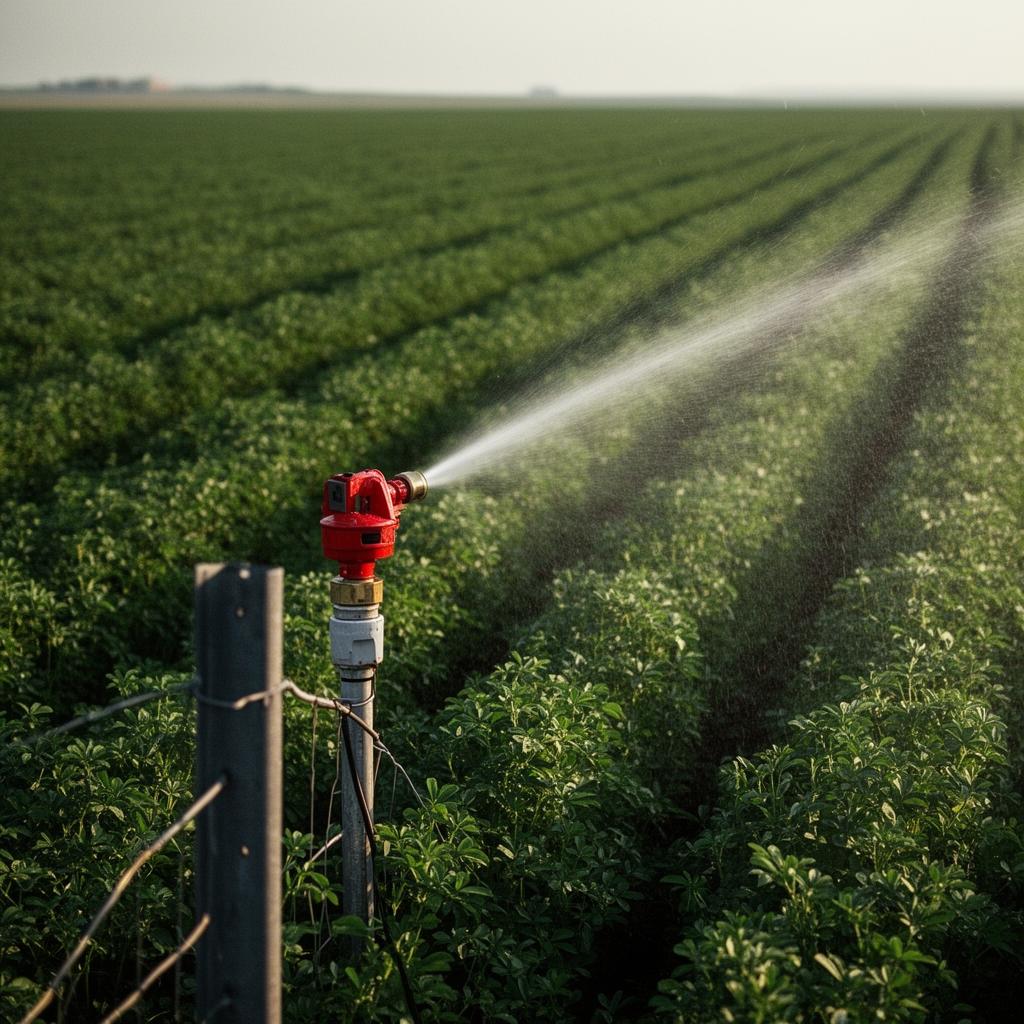 Irrigation sprinkler watering a crop field for cattle feed.
Water footprint labelling, similar to carbon labelling, is another emerging practical tool. The EU currently uses the Product Environmental Footprint (PEF) methodology, though it doesn't yet mandate water footprint labels on all food products. However, voluntary schemes like the Water Footprint Network's certification are gaining traction among brands that want to communicate their sustainability efforts.
Costs and trade-offs
Reducing beef's water footprint involves real trade-offs that need to be acknowledged. For producers, shifting to more water-efficient systems can be costly — installing drip irrigation or changing feed regimes requires capital investment and technical know-how. Smallholder farmers in developing countries may lack the resources to make these changes without external support.
There's also a nutritional trade-off. Beef is a dense source of protein, iron, zinc, and B-vitamins, and in regions where plant-based alternatives are scarce or expensive, it plays a critical role in meeting dietary needs. Simply telling everyone to stop eating beef ignores these realities, especially in parts of sub-Saharan Africa or South America where cattle are raised on land that cannot easily support other crops.
Additionally, while grass-fed beef often has a lower blue water footprint than grain-fed beef, it may require more land and produce higher greenhouse gas emissions per kilogram due to slower growth rates, according to a 2021 meta-analysis in Nature Food. This illustrates why water footprint is just one lens — it must be weighed alongside carbon, land use, and biodiversity impacts.
Common counter-arguments
One common argument against these high water footprint figures is that green water, being rainwater, would have fallen regardless and is therefore 'not consumed' in the same way as blue water. While it's true that green water is not directly extracted from rivers or aquifers, its appropriation for specific agricultural uses means it is no longer available for other ecosystem functions or human uses during its residence time in the soil. Furthermore, efficient use of green water is critical, as its mismanagement can lead to soil degradation and reduced agricultural productivity.
Another counter-argument suggests that local contexts matter significantly, and global averages can be misleading. This is certainly true; the water footprint of beef produced in a rain-rich European country with extensive grazing might be lower than that from an irrigated feedlot in a drought-prone region. However, global averages still provide a valuable benchmark for understanding the overall scale of resource use and for comparing different food products on a macro level. The sheer volume of beef consumed globally means that even variations within regions still contribute to a significant global water demand.
Some also argue that livestock play an important role in managing grasslands and converting otherwise inedible plant matter into protein. While this is true in certain ecological contexts, particularly in marginal lands not suitable for crop production, the vast majority of beef consumed globally comes from systems that rely heavily on dedicated feed crops, thereby competing with human food production for land and water resources.
A further objection is that the water footprint concept doesn't account for water scarcity — using 1,000 litres of water in a water-abundant region is not the same as using 1,000 litres in a desert. This is a valid critique, and researchers have developed the 'water scarcity footprint' (also called the AWARE method) to weight water use by local scarcity. For example, beef raised in the drought-stricken US Southwest will have a much higher scarcity-weighted footprint than beef from the rainy UK highlands, even if the physical water volumes are similar.
Regional angle: water stress and beef production
The water footprint of beef is not evenly distributed across the globe. In water-scarce regions, such as the Middle East, North Africa, parts of India, and the western United States, producing beef places an outsized strain on already limited freshwater resources. According to the World Resources Institute, by 2025, two-thirds of the world's population could face water stress, a trend that will make water-intensive foods like beef increasingly problematic in drought-prone areas.
Conversely, in temperate, rain-rich regions like New Zealand, Ireland, or the UK, beef production relies heavily on green water, with minimal blue water extraction. However, this doesn't mean these systems are without environmental costs — they still contribute to greenhouse gas emissions and land-use change, which indirectly affect water cycles and ecosystem health.
Trade complicates the picture further. Many countries import beef from regions with far higher water stress, effectively 'outsourcing' their water footprint. For instance, the UK imports significant amounts of beef from Brazil and Argentina, where deforestation for pasture and feed crops has profound impacts on local water cycles. This makes it essential for consumers to consider not just 'where' but 'how' their beef is produced.
What you can do next
If you're concerned about the water footprint of your food, the most effective steps are not all-or-nothing. Gradual shifts can have meaningful impact:
- Reduce beef frequency — try going from seven beef meals a week to three; that alone can cut your personal water footprint by nearly half.
- Choose better beef when you do eat it — opt for grass-fed, locally raised options where possible, though be aware these may have higher land and carbon footprints.
- Diversify protein sources — incorporate legumes, poultry, or sustainably sourced fish to replace some meat meals.
- Support policy changes — advocate for water footprint labelling and subsidies for water-efficient farming practices.
- Educate yourself — read more on related topics like our pages on "Does going vegan actually reduce carbon emissions?" or "Do vegans get enough protein?" to understand the full picture.
"Bottom line: Beef's water footprint is significant, but it's not a reason for despair — it's a reason for informed choices. Whether you're a consumer, a farmer, or a policymaker, there are practical levers to pull that can reduce water use without sacrificing nutrition or livelihoods."
Ultimately, addressing the water footprint of beef requires a multi-faceted approach involving producers, consumers, and governments to foster more sustainable practices and consumption patterns. Small changes, multiplied across millions of people, can lead to billions of litres of water saved annually. And as water scarcity intensifies, these choices will only become more critical.
Trade-offs: what the water footprint doesn't tell you
The water footprint of beef is a powerful lens, but it's not the whole story — and focusing on it alone can lead to incomplete conclusions. The biggest trade-off is that most of beef's water footprint is "green" rainwater, which is fundamentally different from the "blue" irrigation water that competes with human and ecosystem needs. In rain-fed pastures, green water would otherwise be absorbed by natural vegetation or evaporate, so using it for cattle feed doesn't necessarily reduce water availability elsewhere. That's why a kilogram of beef from a Scottish hill farm has a very different environmental meaning than one from an irrigated Californian feedlot, even if the total litres look similar.
Another trade-off is that water footprinting doesn't inherently weigh local water stress: a litre of water in a rainy region is not equal to a litre in a drought-prone one. The Water Footprint Network's global average of 15,415 L/kg therefore mixes apples and oranges, which is why researchers increasingly use a "water scarcity footprint" that weights consumption by local scarcity (according to the Water Footprint Network, 2011). Substituting beef with chicken or lentils almost always reduces total water use, but if the alternative crop is irrigated in the same stressed basin, the local benefit may be smaller than expected. The practical takeaway is that water is one metric alongside carbon, land, biodiversity, and nutrition — and the best choice depends on your region, your values, and the alternatives available.
Common objections: "But cows drink water that would otherwise be wasted" and more
A frequent objection is that cattle drink only a small fraction of the water, so "beef doesn't really waste water." While it's true that drinking water is just 2–5% of the total, the feed-growing water is what drives the footprint — and in irrigated systems, that feed water could be used for human food crops or natural ecosystems. Another objection is that "grazing lands are too dry for crops, so beef is the only option." That has merit in some arid or hilly areas, but those marginal lands still require feed from elsewhere in many systems, and the water footprint is often higher precisely because of irrigation.
A third objection is that "the water footprint double-counts rain that cows don't actually consume." Critics note that green water is evapotranspired by feed crops, not directly drunk, but it's still water that could have supported other plants or recharged groundwater (according to the Food and Agriculture Organization, 2020). Finally, some argue that "local beef has a lower footprint than imported plant protein." That can be true when the plant protein is irrigated in a water-stressed region, but it's not a universal rule — a 2018 study in Environmental Research Letters found that the variability in beef footprints is so high that the best-sourced plant protein almost always beats the worst-sourced beef on water. The key is to look at the production specifics, not the label.
The regional angle: how water footprints differ for English-speaking readers
For readers in the US, UK, Canada, Australia, and New Zealand, the water footprint of beef is anything but uniform — and your national context shapes what "sustainable" means. In the United States, beef production is concentrated in the Great Plains and the West, where substantial irrigation of feed crops like corn and alfalfa draws on the Ogallala Aquifer, which is being depleted faster than it recharges (according to the US Geological Survey, 2021). A 2019 USDA estimate put the average water footprint of US beef at around 3,700 litres per kilogram of boneless meat, but that is the blue-water consumption only — the full footprint is far higher when green water is included.
In the UK and Ireland, where most beef is grass-fed on rain-fed pasture, the blue-water footprint is relatively small, but the green-water footprint still accounts for the vast majority of the total — and it competes with land for biodiversity and carbon storage. Canada and Australia both have highly variable climates, with northern and coastal regions relying on natural pasture while southern and inland areas use irrigation for feed; Australia's beef industry, for instance, uses irrigation for only a small share of feed, but drought cycles can spike water use unpredictably (according to Meat & Livestock Australia, 2022). New Zealand, with its temperate climate, has one of the lowest blue-water footprints for beef globally because of its reliance on rain-fed pasture. For all these regions, the practical implication is that your local "water footprint" depends heavily on whether your beef is grass-fed and rain-fed versus grain-fed and irrigated — so asking your butcher or checking the label matters more than just picking any beef.
Comparison table: water footprints of beef across production systems and proteins
Water footprint of beef varies more than the choice of protein itself — here's a side-by-side comparison.
| Production system / Protein | Blue + Green Water (L/kg) | Notes |
|---|---|---|
| Beef from irrigated feedlots (US High Plains) | 15,000–20,000 | High blue water from irrigation of corn/alfalfa; grey water adds 10–20% (Poore & Nemecek, 2019) |
| Beef from rain-fed pasture (UK, New Zealand) | 8,000–12,000 | Mostly green water; low blue-water stress |
| Beef from dairy herds (culled cows) | 5,500–10,000 | Water burden shared with milk production (Poore & Nemecek, 2019) |
| Pork | ~5,988 | Global average (Water Footprint Network) |
| Chicken | ~4,325 | Global average (Water Footprint Network) |
| Tofu | ~2,100 | Global average (Water Footprint Network) |
| Lentils | ~1,250 | Global average (Water Footprint Network) |
| Potatoes | ~287 | Lowest in this comparison |
Source: Water Footprint Network (2023) and Poore & Nemecek (2019) for ranges.
The table shows two things: first, beef's footprint is 3–7 times higher than most plant proteins, but second, the variation within beef (from 5,500 to 20,000 L/kg) is as large as the difference between beef and pork. That means a consumer can cut water use by choosing better-sourced beef, but switching to chicken or lentils is an even more reliable way to drastically reduce your personal water footprint.
"Bottom line: Don't look at one number alone — ask where the beef came from and how it was raised, because the water footprint can swing threefold based on system and region."
Practical checklist: what you can do next to reduce your beef-related water footprint
You don't need to overhaul your diet overnight — small, informed shifts can make a meaningful difference. Here's a checklist you can use right away:
- ✅ Check the label: Look for "grass-fed" or "pasture-raised" and "no added irrigation" claims — this often indicates a lower blue-water footprint.
- ✅ Ask your butcher or farm: At a farmers' market, ask how the cattle were raised — rain-fed pasture or irrigated feed? If they don't know, that's a signal.
- ✅ Reduce portion size: Halving your beef portion cuts water use proportionally; try a 50/50 mix with lentils or mushrooms.
- ✅ Choose legumes for some meals: Swap 1–2 beef meals per week for lentils, beans, or chickpeas — that alone can save 2,000–4,000 litres of water per week for a family of four.
- ⚠️ Be cautious with "local" claims: Local isn't always better — a local beef farm in a drought area may have a higher water footprint than an imported, rain-fed roast from New Zealand.
- 🌱 Support water-wise farming: Seek out farms that use rotational grazing and dryland farming (no irrigation) — these practices reduce blue water use significantly.
- 📉 Track your progress: Use an online water footprint calculator to see the impact of small changes over a month.
- ♻️ Ask restaurants and supermarkets: Consumer demand for low-water beef can shift supply chains, so don't underestimate the power of a question.
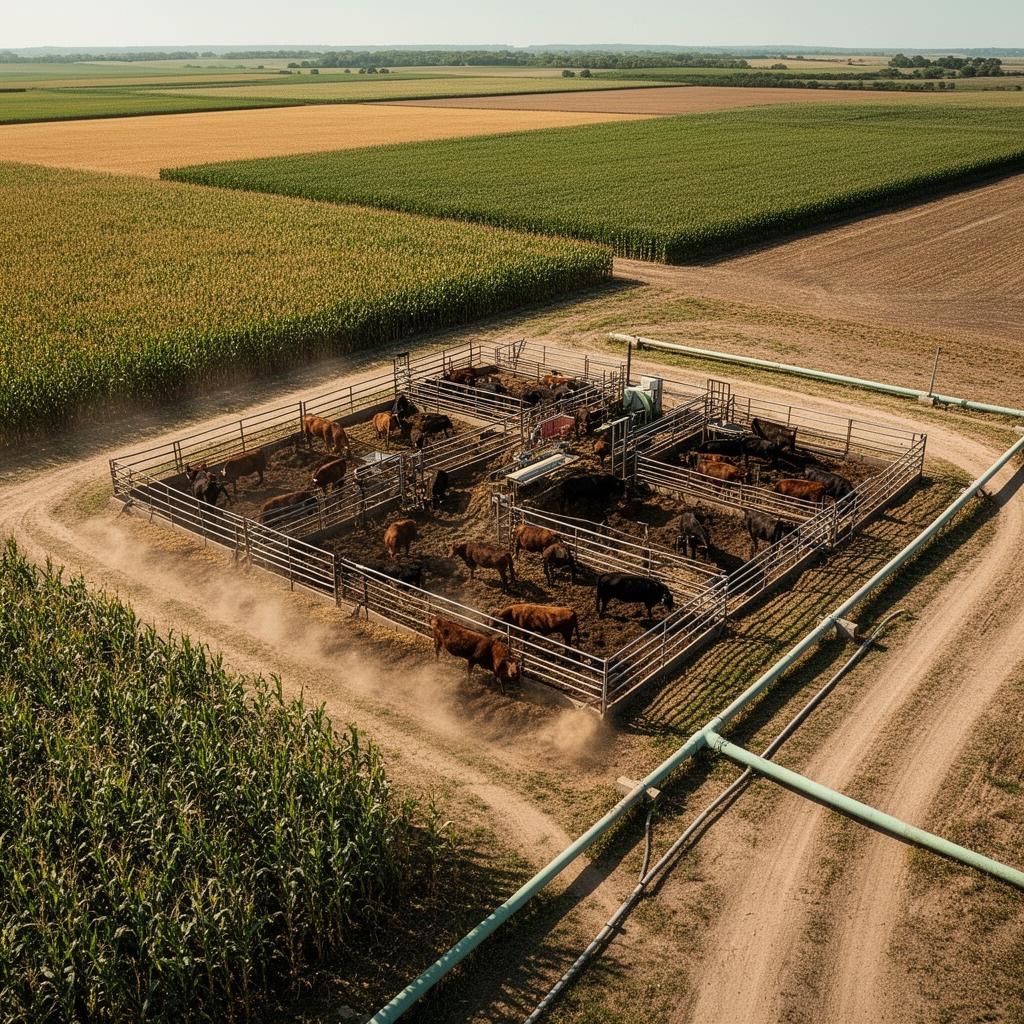 Aerial view of a feedlot surrounded by irrigated crop fields.
These steps aren't about perfection — every single change helps. Even reducing your beef consumption by one meal a week can save thousands of litres of water annually, which is a significant contribution in water-stressed regions.
What the reader can do next: deeper dives and community action
If you're ready to go beyond personal choices, there are three paths you can take: learn more, advocate for change, and engage your community. To learn more, read the full Poore & Nemecek (2019) study in Science (it's open access) and explore the Water Footprint Network's interactive tool to see footprints for your area. For advocacy, pressure policymakers to include water scarcity in agricultural subsidies — for example, by supporting measures that incentivize farmers to shift away from irrigation in depleted aquifers.
On a community level, start a conversation at your local farmers' market or food co-op: ask them to stock beef from rain-fed farms and label it clearly. You can also support research by universities or NGOs that map regional water footprints, such as the World Wildlife Fund's water risk filter. Finally, if you're a teacher, business owner, or content creator, share the table above — the more people understand the nuance, the smarter our collective choices become. Remember, the goal isn't to eliminate beef for everyone; it's to make water — and all natural resources — count where they matter most.
Read next
The common questions