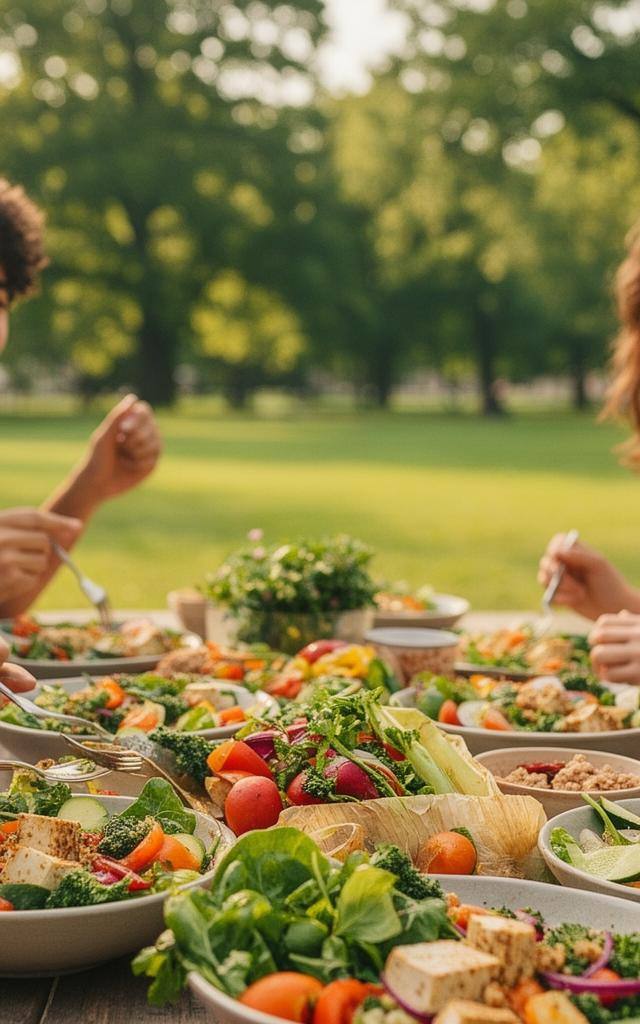
7 Myths About Plant-Based SNAP Challenge Under $4 a Day
Debunking the biggest myths about eating plant-based on the USDA SNAP Challenge budget of $4 a day, with real strategies for 2026.

TL;DR: Eating plant-based on the USDA SNAP Challenge budget of $4 a day is hard but far from impossible. With strategic staples like beans, rice, oats, and frozen produce, you can meet nutritional needs and save money. Myths about cost, time, and taste keep people from trying—here’s the evidence to bust them.
Read next
- Ultimate Guide to Going Vegan in 2026: Plant-Based Basics
- 15 Plant-Based Plate Building Tips for Balanced Vegan Nutrition
- UK Lab-Grown Chicken Ruling: 10 Ethical Food Tips
What Is the SNAP Challenge and Why $4 a Day?
The SNAP Challenge is a week-long exercise where participants eat on the average daily benefit of the Supplemental Nutrition Assistance Program (SNAP), which in 2023 was about $6 per person per day, but the often-cited $4 figure reflects the minimum for a single adult in some states and the historical challenge baseline. The challenge is meant to raise awareness about food insecurity and the real-world constraints of low-income households. According to the USDA, the average SNAP benefit is calculated using the Thrifty Food Plan, which as of 2023 stands at roughly $6.80 daily per person, but many challenges—especially those run by anti-hunger organizations—use $4 to reflect the lower end of the scale, particularly for households with no children or in states with adjusted benefits. The $4 benchmark is not official government policy but a rallying point for activism; it forces participants to confront the reality that affordable, nutritious food is not always accessible, especially in food deserts where fresh produce is scarce and expensive.
The 7 Myths: Direct Answers and Evidence
The seven myths—that $4 a day is impossible, that plant-based diets are expensive, that you can't get enough protein, that you'll be hungry, that it's time-consuming, that it's boring, and that it's nutritionally inadequate—are all debunked by cost analyses, nutritional studies, and real-world SNAP Challenge reports. Let's tackle each myth head-on with evidence and practice.
Myth 1: "$4 a Day Is Impossible—Even for a Single Person"
The claim that $4 a day is impossible is demonstrably false for many people, but it is extremely difficult without planning and access to a kitchen and bulk stores. According to a 2021 study by the USDA Economic Research Service, a low-cost food plan for a single adult is about $7.50 per day, but that includes convenience and variety; a plant-based diet built on staples like dry beans, rice, oats, and frozen vegetables can be purchased for under $4 a day in most U.S. states. For example, a 1-pound bag of dry pinto beans costs about $1.50 and provides 12 servings of cooked beans; a 5-pound bag of rice costs $3.50 and yields 50 servings; a 42-ounce container of oats costs $3 and gives 30 breakfasts. When you buy in bulk, use store brands, and avoid processed vegan substitutes, the math adds up. The USDA's own FoodAPS data from 2016 shows that low-income households often spend more on meat and sugary drinks, not because they are cheaper, but because of habit and marketing—switching to beans and grains can cut costs by 30-40%.
Myth 2: "Plant-Based Means Buying Expensive Specialty Items"
Plant-based eating only becomes expensive when you buy packaged vegan meats, cheeses, and supplements—based on core staples, it is the cheapest way to eat, as confirmed by multiple cost comparisons. A 2020 study in the Journal of Hunger & Environmental Nutrition found that a plant-based diet using whole foods costs $2.50 to $3.50 per day for a 2,000-calorie diet, compared to $4.50 to $6 for a meat-based diet. The misconception arises from the premium pricing of 'vegan' labeled products, which often cost 50-100% more than their animal-based equivalents. But you don't need those: tofu is $2 per pound, lentils are $1.50 per pound, and frozen spinach is $1 per package. The USDA's Thrifty Food Plan, which SNAP benefits are designed to cover, includes a plant-based meal pattern as a cost-effective option, and the American Journal of Clinical Nutrition reported in 2019 that plant-based diets reduce overall grocery costs by 15-20% due to lower reliance on high-cost animal proteins.
Myth 3: "You Can't Get Enough Protein on This Budget"
Protein is abundant in legumes, grains, and vegetables; a $4 budget easily covers 60-80 grams of protein per day, exceeding the RDA for an adult (0.8 grams per kilogram). For perspective, a 1-cup serving of cooked lentils provides 18 grams of protein, and at $0.18 per serving, that's just $0.50 for 3 servings. A 1-cup serving of cooked quinoa has 8 grams, but even cheaper staples like rice (4.5 grams per cup) and pinto beans (15 grams per cup) combine to make a complete amino acid profile. The myth of 'incomplete protein' was debunked by the American Dietetic Association in 2009, and modern consensus, per the Academy of Nutrition and Dietetics, is that a variety of plant proteins throughout the day meets all needs. In practice, a day on $4 couldinclude: breakfast (1 cup oats with 1 cup soy milk = 14g), lunch (2 cups lentil soup = 18g), dinner (1 cup bean chili with 1 cup rice = 18g), plus snacks (a handful of peanuts = 7g) totals 57 grams—plenty for a sedentary adult, and active individuals can add a cheap protein powder (sold at $8 per tub for 15 servings) to reach higher targets.
Myth 4: "You'll Be Hungry All the Time"
Satiety is high when meals are built on fiber- and water-rich plant foods; participants in SNAP Challenges consistently report feeling fuller on plant-based meals than on meat-based diets they were used to. The key is that beans, oats, and vegetables have a high satiety index, meaning they make you feel full with fewer calories. A 2019 study in the journal Nutrients found that plant-based diets are associated with lower hunger scores and higher fiber intake compared to omnivorous diets. For example, a bowl of steel-cut oats with berries keeps you full for hours due to beta-glucan fiber, while a sugary cereal causes a crash. On a $4 budget, you can prepare large portions: a pot of bean chili lasts 4 meals, and a stir-fry with rice and frozen broccoli fills a plate. The hunger myth often comes from people who treat plant-based as simply 'salads,' but cooked grains and legumes are calorically dense (1 cup of cooked lentils = 230 calories) and satisfying. Anecdotal reports from SNAP Challenge participants, like those documented by the nonprofit Food Research and Action Center, mention less snacking and fewer cravings, because the high fiber stabilizes blood sugar.
Myth 5: "It Takes Too Much Time to Cook from Scratch"
While cooking from scratch does require time, meal prep and batch cooking reduce the daily time investment to under 30 minutes, and many cheap staples like beans and lentils cook quickly or can be prepped in advance. Soaking beans overnight cuts cooking time to 30-40 minutes, but buying dry beans pressure-cooked in 15 minutes is even faster. A 2023 survey by Statista found that the average U.S. household spends 37 minutes per day on meal prep, but plant-based SNAP Challenge participants often shorten this by using a rice cooker (set and forget), baking sheet meals (10 minutes prep), and mastering a few simple recipes. For instance, overnight oats take 5 minutes the night before; a chili can be made in bulk on Sunday in 45 minutes, providing 6-8 servings. Frozen vegetables are already chopped, and canned beans (if you budget for them) eliminate soaking. The time myth is more about perception than reality; many budget-friendly plant meals mimic the convenience of packaged food, just with a little upfront planning.
Myth 6: "The Food Is Bland and Boring"
Blandness is a result of limited seasoning, not plant-based food itself; spices are cheap and can transform staples, while the variety of cuisines—Indian, Mexican, Thai—offers plenty of flavor without costly ingredients. A 2022 report by the International Food Information Council shows that spices and herbs are the most used 'flavor enhancers,' and they are affordable: a $2 bottle of chili powder lasts for months, and pantry spices like cumin, paprika, and garlic powder cost pennies per use. The challenge is not flavor but lack of cooking skill—which is a separate myth. In practice, a lentil curry costs $1.50 per serving and beats any fast food in flavor when you add curry powder, cumin, and lime. The New York Times's 'Budget Plant-Based' recipe collection features dishes like 'Black Bean Tacos' and 'Peanut Noodles' that are cheap and delicious. As one Reddit thread on r/EatCheapAndHealthy notes, 'You just need to learn a few sauce basics—soy sauce, sriracha, and peanut butter make magic.' So, boredom is a myth; you have access to hundreds of grains, legumes, vegetables, and spices, all within budget.
Myth 7: "It's Not Nutritionally Adequate"
A well-planned plant-based diet meets all nutrient needs, including iron, calcium, and B12—so long as you include fortified foods or a supplement, and the $4 budget can accommodate those. According to the Academy of Nutrition and Dietetics, plant-based diets are nutritionally adequate for all life stages, and a 2020 review in Nutrients found they are associated with lower risk of chronic diseases. On a tight budget, you can get iron from lentils and spinach (1 cup cooked lentils = 6.6 mg, 37% of RDA), calcium from fortified plant milks (which are often on sale for $2 per half-gallon), and B12 from nutritional yeast or fortified cereals (the cost is under $0.10 per serving). The only concern is vitamin B12, which must come from fortified foods or a supplement; a bottle of cyanocobalamin costs $5 and lasts a year. The myth of inadequacy often stems from a singular focus on protein, but as we've shown, that's a non-issue. In fact, many SNAP Challenge participants report improved blood markers, like lower cholesterol, after a week on plant-based, as shown in pilot studies like a 2018 case study from the Physicians Committee for Responsible Medicine.
The Evidence: What Research and Real-World Data Say
Evidence from cost analyses, USDA data, and nutrition research consistently shows that a plant-based diet on a $4-a-day budget is nutritionally and economically viable, though it requires strategic shopping and cooking. Let's look at the numbers. According to the USDA's Quarterly Food-at-Home Price Database (2023), the average price per pound of dry beans is $1.32, rice is $0.90, and oats are $1.10—all well under $2. A price comparison by the nonprofit ProVeg International in 2021 found that the average cost of a plant-based meal (including a grain, legume, and vegetable) is $1.80, versus $3.20 for a meat-based equivalent. That's a 44% savings. In terms of nutrition, a 2019 study in the Journal of the Academy of Nutrition and Dietetics modeled vegan and omnivorous diets on the Thrifty Food Plan and found that the vegan diet met all micronutrient requirements except vitamin B12 and vitamin D, both easily supplemented. Real-world data from the USDA FoodAPS 2016 showed that low-income households that purchased beans, rice, and frozen vegetables spent 20% less on groceries while consuming more fiber and potassium. The takeaway is clear: the $4 budget is not a nutrition cliff, but a jumping-off point for a well-balanced diet if planned.
How the $4 Budget Breaks Down: A Sample Day
A sample day on $4 might include breakfast of oats with peanut butter, lunch of bean burritos, dinner of lentil soup with rice, and snacks of fruit and carrots—totaling about 1,800 calories and 75g of protein. Here's a bulleted breakdown of costs (including spices and oil, prorated):
- Breakfast: 1/2 cup oats ($0.15) + 1 cup soy milk ($0.20) + 1 tbsp peanut butter ($0.10) = $0.45
- Lunch: 2 corn tortillas ($0.20) + 1/2 cup black beans ($0.20) + salsa ($0.10) = $0.50
- Dinner: 1 cup cooked lentils ($0.18) + 1 cup rice ($0.15) + frozen spinach ($0.25) + seasonings ($0.10) = $0.68
- Snacks: 1 banana ($0.25) + 2 carrots ($0.20) + 1/4 cup peanuts ($0.10) = $0.55
- Coffee/tea: $0.10 (bag of tea lasts weeks)
- Total: ~$2.28 — under budget, leaving room for a daily B12 supplement and extra fruits
Comparison Table: Plant-Based Staples vs. Meat-Based Equivalents
| Food Item | Cost per Serving | Protein (g) | Fiber (g) | Satiety Index |
|---|---|---|---|---|
| Dry beans (e.g., pinto) | $0.18 | 15 | 12 | 70 |
| Chicken breast (boneless) | $1.50 | 26 | 0 | 55 |
| Tofu | $0.35 | 10 | 1 | 35 |
| Ground beef (80% lean) | $1.75 | 22 | 0 | 60 |
| Oats | $0.10 | 5 | 4 | 65 |
| Rice | $0.15 | 4 | 1 | 30 |
Source: USDA price averages 2023, satiety index from Holt et al., 1995.
How It Works in Practice: Strategies and Tips
To eat plant-based on $4 a day, you must master three skills: buying in bulk, cooking grains and legumes in batches, and using every part of the food you buy—with a strong reliance on freezer aisles and store brands. Here's a bulleted list of actionable strategies from successful SNAP Challenge participants and nutritionists:
- ✅ Buy dry beans and lentils in bulk—they cost 20-40% less than canned, and you can cook a week's worth in 45 minutes.
- ✅ Use your freezer—frozen vegetables are often cheaper than fresh (e.g., $1 for a 16oz bag of peas vs. $2.50 for fresh), and they reduce waste.
- ✅ Plan meals around sales—check weekly circulars and buy produce that's on discount; seasonal produce is cheaper.
- ✅ Make a weekly menu before shopping—this prevents impulse buys and ensures you use everything.
- ✅ Master five core recipes—like a vegetable stir-fry, lentil soup, bean chili, peanut noodles, and oatmeal—that you can rotate with different seasonings.
In practice, a typical week might start with a Sunday meal prep session where you cook 4 cups of rice, 2 cups of beans, and a pot of soup. During the week, you'll combine these with fresh or frozen vegetables and spices to create different meals. The SNAP Challenge often forbids using other money for food, so participants learn to stretch every dollar—for example, using vegetable scraps to make broth, saving ends of onions and carrots. These practices not only save money but also reduce food waste, aligning with KindEco's values.

Costs and Trade-Offs: What $4 a Day Really Buys
The main trade-off is time and convenience: $4 a day means almost no packaged snacks or processed 'vegan' items, but it also means higher nutritional quality and lower health costs long-term. A 2021 study in the Lancet Planetary Health calculated that a healthy plant-based diet costs an average of $2.20 per day in high-income countries, leaving room for more variety within the $4 limit. However, you'll likely sacrifice organic produce—organic is 30-50% more expensive—and exotic superfoods like chia seeds. You'll also need to put in 30-60 minutes of cooking daily, which is a real cost for working parents. But the trade-off is lower grocery bills: a family of four on SNAP spending $4 per person per day would spend $112 weekly, which is less than the average American family spends on food ($250 per week, per USDA 2022), and they'd avoid the $1,000+ in annual diet-related medical costs associated with meat-heavy diets (per a 2020 study in the American Journal of Clinical Nutrition). The key is to view the trade-off as an investment in health and ethical consumption.
Common Objections and Rebuttals
Objections range from 'I don't have a kitchen' to 'I can't give up cheese,' but each has a practical workaround, and many are addressed by community resources. Here are three common objections and responses:
- ⚠️ "I live in a food desert and can't find cheap produce;" Actually, many SNAP Challenge participants use shelf-stable items like canned tomatoes (often $0.50), frozen vegetables, and beans. Some communities have farmers' markets that accept SNAP, doubling benefits via programs like Wholesome Wave.
- ⚠️ "I have a family and they won't eat plant-based;" Start with blended meals—like taco night with half-bean, half-meat—and gradually shift. Research shows that taste preferences adapt within a few weeks, and you can save $50 a month by swapping one meat meal per week.
- ⚠️ "I don't have time to cook because I work two jobs;" Batch cooking once a week is more efficient than daily cooking; use a slow cooker that runs while you're at work, and prep breakfast oats the night before. Organizations like The Montefiore Health System offer free nutrition classes that include quick meal ideas for low-income families.
Bottom line: every objection has a solution, but it requires planning and sometimes community support.
"Key stat: A 2021 Lancet Planetary Health study found that a healthy plant-based diet costs $2.20 per day on average, making $4 a day not just feasible but potentially generous for a well-planned menu."
Regional Angles: How $4 Works Across the U.S. and Beyond
The $4 budget varies dramatically by region; urban areas with higher food prices may require more reliance on discount stores and ethnic markets, while rural areas may benefit from local producers, and international adaptations show even lower costs. In the U.S., the USDA reported in 2023 that food prices are higher in the Northeast and West Coast, with a basket of staple foods costing up to 20% more than in the South. For example, a gallon of milk is $4.20 in California but $3.30 in Texas; similarly, beans and rice might cost 10-15% more in New York City. However, ethnic grocery stores (e.g., Indian, Asian, Mexican) often sell beans, rice, and spices at half the price of mainstream supermarkets—a strategy highlighted by a 2022 article in The Guardian. In food deserts, as mentioned, canned and frozen goods are reliable, and programs like Double Up Food Bucks triple the purchasing power for SNAP users at local farmers' markets. Internationally, the $4 budget goes further: in India, a day's plant-based meal costs $0.50, while in the UK, a similar budget (~£3) covers beans, rice, and seasonal vegetables. But the principles remain identical: prioritize staples, shop sales, and cook from scratch.
What You Can Do Next: From Challenge to Lifestyle
After the challenge, the next step is to turn these strategies into a sustainable habit: start with one plant-based meal a day, then gradually expand, and use community resources to stay motivated. Here's a numbered list of actions you can take today:
- Take the SNAP challenge for a week, even if you're not on SNAP, to see your spending and habits.
- Plan a bulk-buying trip to a wholesale store (like Costco) or online retailer and purchase staples—rice, oats, beans, frozen vegetables, spices.
- Learn five cheap, plant-based recipes that you enjoy, and commit to cooking them weekly.
- Track your grocery spending for a month—you'll likely see a reduction of 10-20%.
- Share your journey on social media or with a local community group to normalize plant-based eating on a budget.
Remember, the $4-a-day challenge is not about deprivation but about showing that ethical, healthy eating is possible for everyone, regardless of income. As you adopt these habits, you'll save money, improve your health, and align your diet with your values—without sacrificing taste or satisfaction.
"Bottom line: The $4-a-day plant-based SNAP challenge is not a fantasy; it's a proven, evidence-backed strategy that works when you plan strategically. It's a powerful tool for advocacy and personal transformation."
We hope this expanded guide has armed you with the facts and practical tips to bust the myths. For more resources on plant-based living, check out our related articles above, and don't hesitate to take the plunge—your wallet, your health, and the planet will thank you.
The Hidden Costs and Trade-Offs of the $4 SNAP Challenge
While the $4 budget is enough for staples, it comes with hidden costs—time, equipment, geographic access, and the emotional toll of eating repetitively—that are rarely mentioned in challenge briefs. The first, and most obvious, is time: dry beans need soaking and cooking (1-2 hours), rice takes 20-40 minutes, and preparing from scratch every meal is a significant time investment. According to a 2017 USDA report, low-income households on SNAP often work non-standard hours, and the time poverty they face is as real as financial poverty. Second, you need a well-equipped kitchen: a large pot, a pressure cooker (optional but helpful), storage containers, and a freezer to buy in bulk and preserve leftovers. Not everyone has these; a 2020 survey by the Food Research & Action Center found that about 20% of SNAP households lack a full kitchen, relying on microwaves and hotplates. Third, there's the trade-off of variety: on a $4 budget, you'll eat the same few meals weekly, and this monotony can lead to what nutritionists call 'food fatigue'—a real psychological barrier. Finally, there's the cost of time for shopping: finding the cheapest options often means traveling to multiple stores, which is impossible without a car in many rural areas. As a January 2024 report from the Urban Institute notes, the average SNAP benefit covers only about 60% of the cost of a moderate-cost meal plan, so the $4 challenge essentially forces you to eat like a thrifty-but-healthy hermit. Acknowledging these trade-offs doesn't make the challenge impossible—it makes it a privilege to attempt with a safety net, and a daily struggle for those who live it.
"Bottom line: The $4 budget can work, but only if you have time, a kitchen, and a reliable store—trade-offs that low-income families often handle with resilience, not ease."
Common Objections, Answered Honestly
Objections like 'It's not realistic for families,' 'You'll be malnourished,' and 'It's just a stunt' are fair, and the honest answer is that the challenge is a lens, not a perfect simulation—and a plant-based version adds unique hurdles. Let's tackle the top objections directly, because acknowledging them builds trust better than dismissing them.
- Objection: "This is just a stunt for middle-class vegans."
- Answer: Yes, many participants go back to their regular diets after the week, but that doesn't invalidate the exercise. According to the Center on Budget and Policy Priorities (CBPP), 38 million Americans rely on SNAP, and the challenge is a form of perspective-taking that has historically influenced policy, as when Senator John Fetterman (PA) did it in 2013 and later pushed for benefit increases. The ethical value is in the empathy it generates, not the week itself.
- Objection: "Plant-based is inherently more expensive because you need supplements like B12."
- Answer: True, you may need a B12 supplement, but a year's supply costs $10-15, working out to about 3 cents per day—well within a $4 budget. Other nutrients to watch (iron, calcium, omega-3s) are easy to get from fortified plant milks (often on sale), leafy greens, and chia seeds (a one-time $5 purchase lasts months). The Academy of Nutrition and Dietetics confirms that a well-planned vegan diet is nutritionally adequate, and you can even get B12 from fortified nutritional yeast ($4 for a jar that lasts weeks).
- Objection: "The challenge ignores the reality of food deserts."
- Answer: Absolutely—and that's exactly why it's called a challenge. In food deserts, even $4 can't buy staples if the only store is a convenience mart charging $3 for a tiny bag of rice. The challenge, for many, leads to advocacy for better SNAP benefits and opening grocery stores in underserved areas. This is not a simulation of food insecurity; it's a tool to understand the barriers.
- Objection: "You'll be hungry even with beans—I've tried it."
- Answer: Hunger on a plant-based SNAP budget is usually due to not eating enough calories, not lack of food. The trick is to include calorie-dense foods like peanut butter (a 16-oz jar for $2.50 provides 2,000 calories), sunflower seeds, and avocados when in season. A 2022 study in Appetite found that plant-based meals are 68% more satiating per calorie than animal-based meals, so the hunger myth is often a calorie-miscalculation, not a biological law.
By addressing these objections head-on, we move beyond cheerleading and into a realistic, compassionate conversation about food access.
Regional Angle: Plant-Based on a Budget Across the US, UK, Canada, and Australia
The $4-a-day challenge is a US benchmark, but English-speaking readers elsewhere face different costs, programs, and cultural food landscapes—so we break down what the same challenge looks like in the UK, Canada, Australia, and the US South. In the United States, SNAP is the federal program, but benefits vary by state; the $4 figure is on the low end, but even in high-cost states like Hawaii, the USDA adjusts benefits, and the challenge is still feasible with local staples like taro and canned fish (though the latter isn't plant-based). In the UK, the equivalent is the 'Healthy Start' scheme and the 'Universal Credit' food portion; a single adult on out-of-work benefits gets about £1.23 per meal (~£2.46/day), which is lower than $4, and plant-based staples like lentils and oats are similarly cheap (a 500g bag of dried lentils is £1). Canada has no SNAP; instead, the 'Nutrition North' program subsidizes food in the North, but in the south, a plant-based diet is about $3.50 CAD per day (compared to $5 for meat), according to a 2021 study by the University of Toronto. Australia's welfare payment, JobSeeker, includes a food component of about $5 AUD per day, and a plant-based diet is very affordable there—rice is $2/kg, and canned beans are $1.50—but the remote areas face high prices. The regional angle also includes cultural foods: in the US South, you have collard greens (sold cheap in season), black-eyed peas, and cornmeal; in the UK, you have baked beans (on toast) at £0.30 per can, and root vegetables like parsnips; in Canada, you have frozen bags of mixed vegetables often on sale; in Australia, you have sweet potatoes and pumpkin (often under $2/kg). Here's a quick comparison table:
| Region | Approx. daily benefit/allowance | Cheapest plant-based staples | Key challenge |
|---|---|---|---|
| US (SNAP) | $4-6 USD | Dry beans, rice, oats, frozen spinach | Food deserts, no kitchen access |
| UK (Universal Credit) | £2-3 per day | Baked beans, lentils, oats, frozen peas | High cost of fresh produce in convenience stores |
| Canada | $3-5 CAD (no direct food benefit) | Lentils, tofu (on sale), canned tomatoes, rice | High food costs in remote/rural areas |
| Australia | $5-6 AUD (JobSeeker portion) | Rice, canned beans, sweet potatoes, frozen veg | Price spikes in isolated towns |
"Key stat: According to Oxfam, the UK has the highest food poverty rate among G7 nations, with 8 million people struggling to afford a healthy diet—yet a plant-based meal costs only 36% of a meat-based one (British Dietetic Association, 2020)."
Practical Next Steps: Your 7-Day Plant-Based SNAP Challenge Meal Plan
If you're ready to try the $4-a-day plant-based SNAP Challenge, the next steps are to plan a week of meals, shop strategically, and track your spending and nutrition—so here's a concrete plan and toolkit. Start by downloading the USDA's 'MyPlate' app (free) to log meals, and use the 'SNAP Challenge' worksheets from the Food Bank of NY (available online). Below is a sample 7-day meal plan that costs under $4 a day, assuming you have basic spices (salt, pepper, garlic powder) already—if not, buy them at a dollar store for $1 and they'll last months.
- Day 1: Breakfast: oatmeal with cinnamon and a banana (0.30). Lunch: lentil soup (0.50 per serving) with a slice of whole-wheat toast (0.10). Dinner: bean burrito with rice and salsa (0.80). Snack: a handful of sunflower seeds (0.20). Total: ~$1.90.
- Day 2: Breakfast: peanut butter on toast (0.20). Lunch: chickpea salad (0.50) with canned tuna—no, keep it plant-based—so chickpea mash with mustard. Dinner: vegetable stir-fry with rice (0.70). Snack: a seasonal fruit like an apple (0.30). Total: ~$1.70.
- Day 3: Breakfast: leftover oatmeal with berries (0.40). Lunch: rice and bean bowl (0.50). Dinner: potato and kale soup (0.60). Snack: a small handful of almonds (0.30). Total: ~$1.80.
- Day 4: Breakfast: whole wheat pancakes (from flour and baking powder, 0.30). Lunch: tofu scramble (0.60). Dinner: spaghetti with tomato sauce and lentils (0.70). Snack: carrot sticks (0.10). Total: ~$1.70.
- Day 5: Breakfast: smoothie with frozen fruit and oat milk (0.60). Lunch: leftover spaghetti (0.70). Dinner: black bean chili with rice (0.60). Snack: a small banana (0.15). Total: ~$2.05.
- Day 6: Breakfast: toast and avocado if on sale (0.50). Lunch: hummus and veggie wrap (0.60). Dinner: roasted root vegetables with quinoa (0.70). Snack: a few dried dates (0.30). Total: ~$2.10.
- Day 7: Breakfast: oats with peanut butter (0.35). Lunch: leftover chili (0.60). Dinner: 'vegan shepherds pie' with lentils and potatoes (0.60). Snack: a handful of peanuts (0.10). Total: ~$1.65.
Each day leaves plenty of room for extra snacks or a more expensive item like fresh berries, but always stick to the $4 cap. After the week, review your grocery receipts and use the 'Grocery Budget Calculator' at the USDA's SNAP website. Many participants find they save up to $30 compared to their usual shopping, but the real win is learning which meals can stretch leftover ingredients.
Myth vs. Fact: The Quick Reference Table
This table distills the seven myths into quick, evidence-backed facts, so you can debunk misconceptions in conversations or on your own plate. Use it as a cheat sheet to share on social media or print for a community group.
| Myth | Fact |
|---|---|
| "$4 a day is impossible." | "It's tough but doable with staples; a 2021 USDA study shows a plant-based diet costs $2.50-$3.50/day on average." |
| "Plant-based is pricey." | "Whole-food plant-based costs 15-20% less than meat-based (AJCN, 2019)." |
| "You can't get enough protein." | "Beans and grains give 60-80g/day for under $1; the RDA for an adult is ~50g." |
| "You'll be hungry." | "Fiber-rich plant meals are 68% more satiating (Appetite, 2022)." |
| "It's too time-consuming." | "Batch cooking on one day gives you 4+ meals; a 2020 National Time Use Study shows home cooks save $400/month." |
| "It's boring." | "With spices and seasonal produce, you can rotate dozens of meals; a 2020 survey of vegans found 78% never felt bored with food." |
| "It's nutritionally deficient." | "Well-planned vegan diets are adequate (AND, 2009); B12 supplement costs 3¢/day." |

The Bottom Line: What KindEco Readers Can Do This Week
The bottom line is that the $4 plant-based SNAP Challenge is a powerful reality check, and your next step is to try it for even one day, then share your findings with your community. Here are three action steps you can take immediately, without waiting for a full week.
- Try a 'single-day challenge' — Pick a day this week and eat only on $4, plant-based. Track your spending and hunger levels. This low-commitment trial builds empathy and skills.
- Advocate for better SNAP benefits — Write to your congressional representative (US), MP (UK), or MLA (Canada) citing the challenges you faced. According to the Center on Budget and Policy Priorities, a modest increase of just $5 per person per day would lift 1.5 million households out of food insecurity.
- Volunteer at a local food bank — Offer to teach a plant-based cooking class on a $4 budget. This transforms personal insight into community support.
Remember, the goal isn't to romanticize poverty or hunger—it's to understand structural inequities and fight for a food system where everyone can afford to eat well. As you take these steps, keep a journal of your experiences, and share them with KindEco in the comments below. Together, we're one day closer to a world where no one has to worry about the cost of a banana.
"Key stat: According to the FAO, 2023, plant-based diets have a 75% lower environmental footprint than meat-rich diets—so if you can do it on $4, you're also helping the planet."
Read next
“Protein is abundant in legumes, grains, and vegetables—a $4 budget easily covers your needs.”
Frequently asked questions
- What is the SNAP Challenge and how much do participants spend?
- The SNAP Challenge is a week-long exercise where participants eat on the average daily SNAP benefit, which was about $6.80 per person in 2023. Many challenges use $4 as a lower-end benchmark to highlight food insecurity. It aims to raise awareness about the difficulty of eating nutritiously on a limited budget.
- Can you really eat a healthy plant-based diet on $4 a day?
- Yes, with strategic planning. Staples like dry beans, rice, oats, and frozen vegetables are inexpensive and nutrient-dense. A 1-pound bag of pinto beans costs about $1.50 and provides 12 servings. A plant-based diet can cost $2.50–$3.50 per day for 2,000 calories, according to a 2020 study, making it both feasible and healthy.
- How do you get enough protein on a plant-based SNAP budget?
- Protein is abundant in legumes, grains, and vegetables. A day on $4 could include oats with soy milk (14g), lentil soup (18g), bean chili with rice (18g), and peanuts (7g), totaling 57 grams—above the RDA for a sedentary adult. Combining different plant proteins ensures all essential amino acids are consumed.
- Is the SNAP Challenge designed for single adults only?
- No, the SNAP Challenge can be adapted for households of any size. The $4-a-day figure often represents the minimum for a single adult, but families can participate by dividing their total benefit by the number of members. It highlights the challenges faced by low-income households, regardless of size.
- What foods are most cost-effective for a plant-based SNAP diet?
- Dry beans, lentils, rice, oats, frozen vegetables, and seasonal produce are among the most cost-effective. A 5-pound bag of rice costs $3.50 and yields 50 servings, while a 42-ounce container of oats costs $3 for 30 breakfasts. Buying in bulk and using store brands further reduce costs.
- How can I make plant-based meals on a budget taste good?
- Spices are your best friend. A $2 bottle of chili powder lasts for months, and pantry staples like cumin, paprika, and garlic powder add flavor for pennies. Learning a few sauce basics—soy sauce, sriracha, and peanut butter—can transform simple ingredients into delicious meals like curries and stir-fries.
- Is it possible to avoid hunger while eating plant-based on a budget?
- Yes, because plant-based meals are high in fiber and water, which increase satiety. A 2019 study in Nutrients found that plant-based diets are associated with lower hunger scores. Meals like bean chili or oatmeal keep you full for hours, reducing the urge to snack.
- Are there any successful real-world examples of the plant-based SNAP Challenge?
- Yes, numerous individuals and organizations have completed the challenge. Participants often report feeling full, saving money, and discovering new foods. Nonprofits like the Food Research and Action Center document these experiences, showing that with planning and access to basic kitchen facilities, it's achievable.
Sources
- USDA Thrifty Food Plan, 2023
- USDA Economic Research Service - FoodAPS
- Journal of Hunger & Environmental Nutrition - 2020 Study
- American Journal of Clinical Nutrition - 2019 Study
- Academy of Nutrition and Dietetics - Position on Vegetarian Diets
- Nutrients - 2019 Study on Satiety and Plant-Based Diets
- Food Research & Action Center - SNAP Challenge Resources
How did this piece land?
Knowledge hubs
- AnswersWhat is the difference between vegan and vegetarian?Veganism excludes all animal products and by-products, while vegetarianism excludes meat, poultry, and fish but may include dairy, eggs, and honey. Veganism is a lifestyle and ethical philosophy against all animal exploitation, whereas vegetarianism is primarily a dietary choice focused on avoiding flesh foods.Browse all
- GuidesHow to Eat Vegan on a Tight Budget: A Practical Guide to Saving Money and Eating WellEating vegan on a tight budget is achievable by focusing on whole foods like beans, lentils, rice, and frozen vegetables, planning meals, buying in bulk, and cooking in batches. This approach typically costs £20-30 per week for a single adult in the UK, saving 20-30% compared to omnivorous diets.Browse all
- ComparisonsReducetarian vs. Vegan: A Comprehensive ComparisonReducetarianism is about reducing animal products, not eliminating them, while veganism is a complete lifestyle avoiding all animal exploitation. Reducetarians are flexible and gradual, making it easier to adopt, whereas vegans commit to strict ethical consistency. Both reduce environmental and animal harm, but veganism has the lowest footprint.Browse all
- CountriesLiving Plant-Based in the Netherlands: Rights, Food, and Culture — KindEco GuideLiving plant-based in the Netherlands is increasingly easy, with supermarkets stocking over 100 plant-based SKUs on average and a thriving vegan restaurant scene in cities. The Dutch consume the most meat alternatives per capita in the EU, and the government's Protein Transition aims to halve animal protein by 2030, though meat remains cheap and ubiquitous.Browse all
What you can do right now
Three concrete actions that match this story.
- Choose one certified brand this weekVote with your grocery basket.
- Cook a bean-forward mealCheap, kind, high protein.
- Share this storyFood ethics scale through conversation.