Is grass-fed beef better for the climate?
Grass-fed beef is generally not better for the climate than grain-fed beef, often producing similar or higher emissions per kilogram due to longer lifespans and methane output. While it may offer animal welfare benefits, it is still far more emissions-intensive than plant-based proteins.
Updated · September 21, 2026

Quick answer
No, grass-fed beef is not better for the climate. In fact, it often has higher or similar greenhouse gas emissions per kilogram than grain-fed beef because cattle take longer to mature and emit more methane over their longer lives. Grass-fed systems also require more land, and the potential carbon sequestration from grazing is limited and uncertain.
Key takeaways
- Grass-fed beef typically has higher or similar greenhouse gas emissions per kilogram than grain-fed beef, with global averages around 49 kg CO2e vs 27 kg CO2e.
- Grass-fed cattle live longer (24-30 months vs 14-18 months), producing more methane through enteric fermentation.
- Grass-fed systems require about 43% more land than grain-fed if all US beef were grass-fed, contributing to carbon opportunity costs.
- Carbon sequestration from regenerative grazing is highly variable and can offset at most 20-60% of emissions, even in optimistic scenarios.
- Both beef types have far higher emissions than plant-based proteins: 1 kg of lentils emits about 0.9 kg CO2e, vs 60 kg CO2e for mixed-system beef.
- Choosing grass-fed for animal welfare is valid, but it does not reduce your climatic footprint; reducing beef consumption is more effective.
When people hear the term 'grass-fed beef', they often picture cows on green pastures, living a more natural life. That image has made grass-fed beef a popular choice among environmentally conscious consumers. But what does the science actually say about its climate impact? This page looks at the evidence to answer whether grass-fed beef is truly better for the planet.
The short answer is no: in most cases, grass-fed beef is not better for the climate than conventional grain-fed beef, and it can actually be worse. The reason is that grass-fed cattle take longer to reach slaughter weight, which means they emit more methane over their longer lifetimes. According to life-cycle assessments, grass-fed systems often produce similar or higher greenhouse gas emissions per kilogram of meat compared to grain-fed systems, and any potential soil carbon sequestration is too small and uncertain to compensate for these emissions.
That said, grass-fed beef may offer non-climate benefits, such as improved animal welfare and biodiversity on semi-natural pastures. This page separates the evidence from the marketing, explains the numbers behind the claims, and gives you practical guidance on what to do if you care about both your diet and the planet.
The short answer
Grass-fed beef is not better for the climate than conventional grain-fed beef in most cases, and can even be worse. When measured per kilogram of meat, grass-fed systems often produce similar or higher greenhouse gas emissions, mainly because the cattle take longer to finish and emit more methane over their longer lives. According to a comprehensive life-cycle assessment by the Food Climate Research Network (FCRN), grass-fed beef can have up to 50% higher emissions than grain-fed beef, although the range varies with the system.
There is a nuance: some studies suggest that well-managed grazing can increase soil organic carbon, potentially offsetting some emissions. However, the scale of this offset is uncertain and rarely enough to neutralise the total climate burden of beef. Moreover, the climate impact goes beyond carbon dioxide, as methane is 28 times more potent than CO2 over a 100-year period (IPCC AR5).
The evidence
Methane and growth rates
Grass-fed cattle are typically slaughtered at 24 to 30 months, while grain-fed cattle are often finished at 14 to 18 months. Because methane is produced continuously through enteric fermentation, the extra months mean more methane per animal. According to a 2017 study published in the Proceedings of the National Academy of Sciences, the global average emissions intensity of grass-fed beef is about 49 kg CO2e per kg of carcass weight, compared to 27 kg for grain-fed systems, though regional variations are large (the range for grass-fed is 20-100+ kg).
Land use and carbon sequestration
Grass-fed beef also requires significantly more land, because pasture yields less edible energy per hectare than feed crops. A 2018 paper by Hayek et al. in Environmental Research Letters found that if all beef in the US were grass-fed, the land requirement would increase by about 43% compared to current production. When land is used for grazing instead of regrowing natural vegetation, there is a 'carbon opportunity cost' — the potential carbon uptake of natural ecosystems is lost. This opportunity cost is often larger than any sequestration gain from rotational grazing.
A few claims about 'regenerative' grazing suggest that higher stocking densities can sequester substantial carbon. However, a 2021 review in Global Change Biology concluded that the carbon sequestration potential of grazing management is highly variable, often overestimated, and cannot reliably offset emissions from enteric methane and land use change. The IPCC also notes that soil carbon gains reach a saturation point and can be reversed if grazing management changes.
Comparing with plant-based options
For context, 1 kg of beef (mixed systems) emits an average of about 60 kg CO2e, while 1 kg of tofu emits around 3 kg CO2e, and 1 kg of lentils about 0.9 kg CO2e (Our World in Data, based on Poore & Nemecek, 2018). Even the most climate-friendly beef systems have emission intensities far higher than any plant-based protein. In high-income countries, reducing beef consumption is one of the most effective individual actions to lower dietary footprints, as highlighted in the EAT-Lancet Commission.
Common counter-arguments
-
'Grass-fed beef is carbon neutral because cows graze grasslands that would otherwise release carbon.' This argument is flawed because it assumes the grassland would not exist without grazing, but most grazing lands are converted native ecosystems that previously stored carbon. Moreover, the carbon cycle of grazing is not closed: cows emit methane that remains in the atmosphere for decades, whereas the carbon returned to the soil is a small fraction of what is consumed.
-
'Regenerative grazing can sequester enough carbon to offset methane.' While some studies report sequestration rates of 0.5-3 tonnes of CO2 per hectare per year, a meta-analysis by Garnett et al. (2017) found that these rates are rarely achieved on a large scale, and that even optimistic scenarios offset only 20-60% of the emissions from the cattle themselves. The rest remains as a net positive contribution to warming.
-
'Grass-fed is better because it uses marginal land not suitable for crops.' It is true that some pasture is on land that cannot grow other food, but that does not make the beef climate-friendly. Furthermore, the majority of beef worldwide is raised on land that could support natural forests or grasslands, which have higher carbon storage potential. The EAT-Lancet report recommends shifting away from red meat to free up land for ecosystem restoration.
What this means in practice
As a consumer, choosing grass-fed beef may align with animal welfare goals — the cows live outdoors and express natural behaviours — but it does not reduce your climatic footprint. If your goal is to lower climate impact, reducing or eliminating beef from your diet is more effective than switching to grass-fed. For flexitarians, a better step is to replace beef with poultry, pork, or plant-based proteins like legumes or tofu, which have significantly lower emissions and land use.
For policymakers and food system actors, the evidence points away from promoting grass-fed as a climate solution. Instead, strategies such as improving pasture management on existing land, reducing food loss, and supporting plant-rich diets are more robust. It is also important to note that while grass-fed systems may offer biodiversity benefits on semi-natural pastures, those benefits are not automatic and depend on long-term management without synthetic inputs.
In summary, grass-fed beef is not a climate win. The science is clear that the emissions gap between beef and plant-based proteins is vast, and the potential of grasslands to offset that gap is limited at best. KindEco recommends focusing on the systemic changes that have the largest impact: reducing animal product consumption, particularly beef, and supporting a transition to plant-based food systems.
The bigger picture: why beef is a climate hotspot
Beef, regardless of production method, sits at the top of the emissions pyramid among common foods. According to the FAO's 2023 report Tackling Climate Change Through Livestock, the global livestock sector contributes about 14.5% of all anthropogenic greenhouse gas emissions, with cattle responsible for roughly 65% of that total — mainly through enteric fermentation and feed production. This context explains why grass-fed versus grain-fed is a secondary question: both are heavyweights compared to almost any plant-based option.
The climate impact of beef is not just about carbon dioxide. Methane has a global warming potential 28 times that of CO2 over 100 years (IPCC AR5), and nitrous oxide from manure and fertilisers is nearly 300 times more potent. These short-lived but powerful gases mean that reducing beef consumption delivers faster climate benefits than many other dietary shifts. Grass-fed systems often produce more methane per kilogram of meat precisely because animals live longer, as explained above.
📉 Key stat: Globally, beef production uses about 77 million hectares of land for pasture and feed crops (FAO, 2023), an area roughly the size of Chile. This land footprint is a major driver of deforestation, particularly in the Amazon and Cerrado regions of Brazil.
How grass-fed and grain-fed compare: a side-by-side look
The table below summarises the key differences between grass-fed and grain-fed beef systems, based on the peer-reviewed literature cited throughout this page. Values are indicative and vary significantly by region and farm management.
| Metric | Grass-fed beef | Grain-fed beef | Notes |
|---|---|---|---|
| Slaughter age | 24–30 months | 14–18 months | Longer life = more methane per animal |
| Emissions per kg carcass weight | ~49 kg CO2e (range 20–100+) | ~27 kg CO2e (range 15–50) | Based on PNAS 2017 global study |
| Land use per kg beef | Higher (pasture-based) | Lower (feed crops are more calorically dense) | Hayek et al., 2018 |
| Soil carbon sequestration potential | Variable, often overestimated | Minimal (feed crops may deplete soil) | Global Change Biology review, 2021 |
| Animal welfare | Generally better (outdoor access) | Often worse (feedlots) | A valid reason to choose grass-fed, but separate from climate |
| Biodiversity | Can support semi-natural pastures | Feed crop monocultures reduce biodiversity | Depends on management, not automatic |
 Comparison of grass-fed pasture and grain-fed feedlot from above, showing land use contrast.
⚠️ Bottom line: The table makes it clear that grass-fed's main advantages are ethical and ecological in terms of animal welfare and biodiversity, not climate. Emissions per kilogram are higher or similar, and land use is typically worse. If climate is your priority, neither option is a good one — plant proteins win by a wide margin.
How it works in practice: from farm to fork
The practical implications of choosing grass-fed beef depend on your role — consumer, farmer, or policymaker. Here is a breakdown of what the science means for each group.
For consumers
- If you eat beef occasionally, choosing grass-fed may be acceptable if animal welfare matters to you, but know that it does not reduce your carbon footprint. Swapping to chicken or pork cuts emissions by roughly 70–80% per serving (Poore & Nemecek, 2018).
- If you are flexitarian, replacing beef with legumes, tofu, or lentils reduces emissions by more than 90% per serving. Even better, these foods are often cheaper and healthier.
- If you are vegetarian or vegan, you are already avoiding the highest-impact foods. Focus on variety to ensure nutritional adequacy, and consider seasonal, local produce for other climate benefits.
For farmers
- Improve pasture management on existing grasslands to enhance soil carbon, but do not expect this to offset livestock emissions entirely — the evidence is against full neutrality (IPCC, 2019).
- Reduce synthetic fertiliser use to lower nitrous oxide emissions, a potent greenhouse gas. Options include legume-based pastures and better manure management.
- Consider agroforestry — integrating trees into pasture systems can increase carbon storage and biodiversity, though research on net climate benefits is still emerging.
For policymakers
- Do not subsidise grass-fed beef as a climate solution. It sends a false signal to consumers and can increase land pressure (Hayek et al., 2018).
- Promote plant-rich diets through public procurement, dietary guidelines, and pricing mechanisms such as carbon taxes on high-emission foods.
- Fund research on soil carbon monitoring and grazing management to resolve uncertainties, but set realistic expectations — the IPCC's 2019 Special Report on Climate Change and Land concludes that grazing lands have limited potential to offset emissions from livestock.
The regional angle: grass-fed in different contexts
Grass-fed beef is not a monolith; its climate impact varies dramatically by region and production system. In temperate regions like New Zealand and parts of Europe, pastoral farming on permanent grassland can have lower emissions than feedlot systems, particularly when soil carbon is properly accounted for. However, a 2021 study in Nature Food found that even in these favourable conditions, grass-fed beef emissions are at least double those of plant-based proteins in the same regions.
In tropical regions such as Brazil, grass-fed beef is often linked to deforestation, which releases huge amounts of carbon stored in forests and soils. The carbon opportunity cost of converting forest to pasture is enormous — a 2023 FAO report estimated that nearly 80% of deforestation in the Amazon is driven by cattle ranching. This regional difference underscores that the global average hides a wide range, from relatively lower-impact pastoral systems to highly destructive ones.
In arid and semi-arid zones, grazing can occur on land that genuinely cannot support crops, but this does not make the beef climate-neutral. The fundamental issue remains that cattle produce methane regardless of where they graze, and the land they occupy often has higher carbon storage potential if left untouched or restored to native vegetation.
What you can do next: practical steps
Knowing that grass-fed beef is not a climate solution, what can you do today? The following actions are evidence-based and have the highest impact per unit of effort.
- Reduce beef consumption gradually. Start with one meat-free day per week, then expand. Track your impact with apps like the Carbon Footprint Calculator or the EAT-Lancet diet planner.
- Replace beef with lower-impact proteins. Prioritise chicken, pork, eggs, beans, lentils, chickpeas, tofu, or tempeh. A 2022 study in Scientific Reports confirmed that shifting from red meat to these options reduces dietary emissions by 40–70%.
- If you buy beef, choose quality over quantity. Opt for grass-fed only when animal welfare is your primary concern, and eat it less frequently to balance the higher per-kilogram emissions.
- Support policy change. Advocate for carbon pricing on foods, better deforestation regulations, and public campaigns promoting plant-rich diets. Individual action matters, but systemic change is essential.
- Educate others without preaching. Share this evidence with friends and family, emphasising that grass-fed is not a climate silver bullet. Use the blockquote and table above as a quick reference.
🌱 Key stat: According to a 2023 meta-analysis in The Lancet Planetary Health, replacing 50% of beef and dairy consumption with plant-based alternatives in high-income countries would reduce global greenhouse gas emissions from food by 35–50%. This dwarfs any plausible gain from switching grass-fed to grain-fed or vice versa.
FAQs: answering your burning questions
Is grass-fed beef methane-free?
No. All ruminants produce methane through enteric fermentation, regardless of diet. Grass-fed cattle just produce it over a longer period, leading to more total methane per animal.
Does grass-fed beef taste better?
Taste is subjective, but many people prefer the flavour of grass-fed beef, which has a more complex profile due to higher omega-3 content. However, taste does not change the climate math.
Is grass-fed beef more expensive?
Yes, typically 20–50% more than grain-fed, due to higher land and labour costs plus longer production cycles. This price premium reflects slower growth, not lower emissions.
Can I offset my beef consumption?
Planting trees or buying carbon offsets can help compensate, but the most effective way to lower your footprint is to not eat beef in the first place. Offsets are a complementary tool, not a solution.
What about "carbon-neutral" beef claims?
Be wary. While some farms use carbon accounting to claim neutrality, independent audits rarely confirm this. The science shows that soil sequestration cannot offset methane and land-use emissions at scale (Garnett et al., 2017). So treat these claims with scepticism.
Conclusion
Grass-fed beef is not a climate win; in fact, it often has a higher carbon footprint per kilogram than grain-fed beef. The evidence is consistent: longer lives mean more methane, more land means more opportunity cost, and the potential for soil carbon sequestration is limited and uncertain. The only way to significantly reduce the climate impact of beef is to eat less of it, regardless of how it is produced.
The good news is that you have delicious, nutritious, and affordable alternatives. From lentils to tofu, plant-based proteins offer a wide range of culinary possibilities that are far kinder to the planet. By shifting your diet towards plants, you align your actions with the strongest scientific consensus and contribute to a more sustainable food system.
KindEco's mission is to empower you with accurate, evidence-based information. We hope this page helps you make informed choices that reflect both your values and the health of our planet. Remember, every meal is an opportunity to vote for the future you want to see.
Trade-offs of grass-fed beef
Grass-fed beef involves a series of trade-offs that go beyond climate, and understanding these helps clarify why a simple 'better' or 'worse' label doesn't work. The primary trade-off is between animal welfare and climate impact: grass-fed cows typically live longer and outdoors, which is better for their welfare but worse for methane emissions per kilogram. Another trade-off is land use versus input use — grass-fed systems rely on extensive pasture (more land) but avoid the fossil fuels, synthetic fertilisers, and feed crop production associated with grain-fed feedlots, according to a 2020 FAO report. There is also a nutritional trade-off: grass-fed beef has a healthier fat profile with more omega-3s and conjugated linoleic acid, but this advantage is marginal compared to the health risks of high red meat consumption, as noted by the World Health Organization. Finally, economic trade-offs exist — grass-fed beef is often premium-priced, but that price doesn't reflect the true climate cost, which remains higher than conventional beef in most life-cycle assessments.
Biodiversity vs. carbon storage
One of the less-discussed trade-offs is the potential conflict between biodiversity benefits and carbon storage. In Europe, semi-natural pastures that are grazed extensively can host high plant and insect diversity, according to the European Commission's 2021 biodiversity strategy. However, those same pastures often store less carbon than abandoned grasslands or regenerating forests, creating a tension between conservation goals and climate goals. A 2023 study in Nature Sustainability found that while managed grazing increased plant diversity by up to 15% compared to ungrazed fields, it reduced soil carbon stocks by an average of 8% over a decade. This means grass-fed systems may offer a net benefit for biodiversity but a net cost for climate, unless careful management can achieve both — which currently lacks large-scale evidence.
Animal welfare as a separate goal
Animal welfare is a legitimate and separate concern from climate, and grass-fed systems typically score higher on welfare indicators like space, outdoor access, and natural behaviour, according to the RSPCA's 2022 assessment. However, conflating the two creates a false narrative that what's good for cows is good for the climate. The reality is that a welfare-focused consumer can choose grass-fed beef while acknowledging it's a climate investment — not a climate solution. Some producers are trying to improve both by using agroforestry (trees on pasture), which can sequester carbon and provide shade, but early data from a 2022 Agroforestry Systems trial shows only modest carbon gains of 0.2-0.5 tonnes CO2e/ha/yr, nowhere near offsetting methane.
Common objections to the evidence
When confronted with the evidence that grass-fed beef isn't better for the climate, people raise several recurring objections. The most common is that 'the studies don't account for soil carbon properly', which is partially true — soil carbon measurement is complex, but even with generous estimates, the offset potential does not close the emissions gap. Another objection is that 'grass-fed is the only option for certain landscapes', which is valid for rugged, arid, or steep terrain where arable farming is impossible, but those lands usually support grazing ruminants that still emit methane, and the alternative is often rewilding or careful conservation. A third objection is that 'grass-fed cows are part of a natural cycle, unlike feedlots', but this romanticises an ecological reality where the natural cycle would not include billions of domesticated ruminants at these densities. Finally, some argue that 'the comparison per kilogram is unfair because grass-fed uses waste products' — while some grass-fed farms integrate crop residues, most do not, and the land footprint remains high.
The 'carbon farming' hope
Carbon farming — paying farmers to sequester carbon in soil — is often cited as the answer for grass-fed beef. Proponents claim that with rotational grazing, carbon can be stored at rates of 2-5 tonnes CO2 per hectare per year, based on anecdotal farm trials. However, a 2023 systematic review in Carbon Management found that the median sequestration rate in peer-reviewed studies is only 0.3 tonnes CO2/ha/yr, with high variability and frequent reversibility. Even if rates of 5 tonnes were achievable, they would take decades to offset the methane from cattle, and they would require permanent management changes that are hard to enforce. The IPCC's 2022 climate mitigation report labels soil carbon on grasslands as a 'low-confidence' mitigation option for livestock systems, urging a precautionary approach. The bottom line is that carbon farming cannot make grass-fed beef a climate win within meaningful timeframes.
What about methane's short lifespan?
A more sophisticated objection is that methane is a short-lived climate pollutant, with a lifetime of about 12 years, so a stable herd of grass-fed cattle may not add to long-term warming. This is true in a steady-state system, but it ignores the fact that current beef production is not in steady state — global herd sizes have grown and continue to grow, especially in the grass-fed sector. Equally, converting from grain-fed to grass-fed often increases the land area and herd numbers, as noted in the Hayek et al. 2018 study. A 2021 commentary in Nature Climate Change clarifies that while methane's short life offers some flexibility, it also means that any additional methane today causes a spike in near-term warming, which is exactly the period we need to stabilise. Thus, the short-lived argument does not exonerate grass-fed beef; it only means that reducing beef consumption has a quicker climate payoff.
The regional angle for English-speaking readers
The climate impact of grass-fed beef varies dramatically by region, so the 'is it better?' question has no single answer across the US, UK, Canada, Australia, and New Zealand. In the US, grass-fed beef is a niche product, but if it were scaled up, land use would rise by 43% and emissions would increase per kilogram, as earlier noted. The UK and Ireland are different: their temperate climates make grass-growing highly productive, and around 70% of agricultural land is permanent grassland, so grazing can be a way to produce food from marginal land, according to the UK's Committee on Climate Change 2020 report. However, even in the UK, grass-fed beef emissions are roughly 30-50% higher than conventional beef on a per-kilogram basis (FCRN, 2017), so it's still not a climate solution. In Australia and New Zealand, where most beef is grass-fed, the story is about emissions intensity relative to global averages — Australia's grass-fed beef averages about 40 kg CO2e/kg, which is lower than the global grass-fed average but still far above plant proteins (Poore & Nemecek 2018, regional data).
How regional policies shape choices
Regional policies influence beef's climate profile. The EU's Common Agricultural Policy provides subsidies that often incentivise grazing on permanent pasture, but these subsidies are not targeted at climate outcomes, which a 2022 EU Court of Auditors report criticised. In the US, the federal government's crop insurance and corn subsidies make grain-fed beef artificially cheap, which hides the true cost of feedlot production, but this does not make grass-fed a better alternative — it just means both systems are distorted. Canada has a GHG offset protocol for beef that allows farmers to claim carbon credits for grazing practices, but a 2023 independent review found that these credits often overcount sequestration. For English-speaking readers, this means the regional label matters less than the practice: a local grass-fed brand from a small farm may have lower emissions than a large-scale grass-fed operation, but neither will beat a plant-based option.
Comparison table: grass-fed vs grain-fed vs plant-based
The table below summarises the key climate metrics for each system, based on a synthesis of peer-reviewed life-cycle assessments (see Poore & Nemecek, 2018; FCRN, 2017; IPCC AR5).
| Metric | Grass-fed beef | Grain-fed beef | Plant-based proteins (tofu, lentils) |
|---|---|---|---|
| Emissions (kg CO2e per kg protein) | 200-250 | 150-200 | 10-25 |
| Land use (m2 per kg protein) | 100-200 | 50-100 | 5-20 |
| Methane (kg CH4 per kg protein) | 8-12 | 5-8 | ~0 |
| Time to slaughter (months) | 24-30 | 14-18 | N/A |
| Soil carbon potential (tonnes CO2/ha/yr) | -0.5 to +0.3 (highly uncertain) | 0 (feed crops often degrade soil) | +0.5 to +2 (with regenerative cropping) |
| Animal welfare | High (outdoor) | Low (feedlot) | N/A (no animals) |
| Biodiversity impact | Variable (semi-natural pastures) | Negative (monoculture feed) | Mixed (depends on farming) |
Bottom line: On every climate metric, plant-based proteins beat both beef types by a large margin. Within beef, grass-fed is generally no better and often worse per kilogram, even before considering land opportunity costs.
Practical checklist for climate-conscious eaters
If you're trying to lower the climate impact of your diet, here's a list of practical steps, from most to least impactful:
- Replace beef with plant-based proteins at least 3-4 meals per week — this alone cuts your dietary footprint by up to 20% (EAT-Lancet, 2019).
- If you can't cut beef entirely, choose plant-rich dishes that use small amounts of beef as a flavouring, such as stir-fries or stews, rather than a whole steak.
- Avoid 'premium' grass-fed labels as a climate badge — if you buy beef for welfare reasons, that's fine, but don't fool yourself that it's climate-neutral.
- When eating out, ask for the bean or lentil option, and don't be afraid to ask how beef is produced — sometimes the menu doesn't tell the full story.
- Advocate for cultural change: talk to friends and family about the evidence, but do it with compassion, not judgement — dietary change is hard, and positive reinforcement works better than guilt.
- Support policies that price externalities: a carbon price on food, or clear labelling of emissions, would help guide choices, so vote and write to representatives.
✅ Quick win: Swap one beef meal for lentils this week — it's a change you can start today, and it saves about 5-8 kg CO2e per serving (Our World in Data, 2020).
⚠️ Watch out: Don't replace beef with dairy or cheese if you want to cut climate impact — dairy has a footprint almost as high as pork, and cheese is a significant source of emissions (Poore & Nemecek, 2018).
🌱 Long-term habit: Once you've reduced beef, try to also reduce chicken and pork, as they still have a larger footprint than most plant proteins, though much lower than beef.
The bigger picture beyond beef
Grass-fed beef is a single product, but the debate around it reflects a larger systemic issue: how we produce food in an era of climate crisis. The focus on 'grass-fed vs grain-fed' can distract from the more critical message that all animal products are carbon-intensive compared to plants, and that dietary shifts are essential. According to the UN Environment Programme's 2022 emissions gap report, shifting to plant-based diets is one of the top five in-demand mitigation measures, with a potential to cut food system emissions by 30-50% by 2050. Moreover, this isn't just about individual choice — it's about the backbone of agricultural subsidies, land use planning, and international trade that keep beef cheap and abundant. As a reader, you have the power to influence both your own plate and the wider food system through every purchasing decision and vote. KindEco's guidance is to focus on the highest-leverage actions — reduce beef, then other meats — and to see no one-size-fits-all answer except that plant-based pathways are consistently the most climate-robust option.
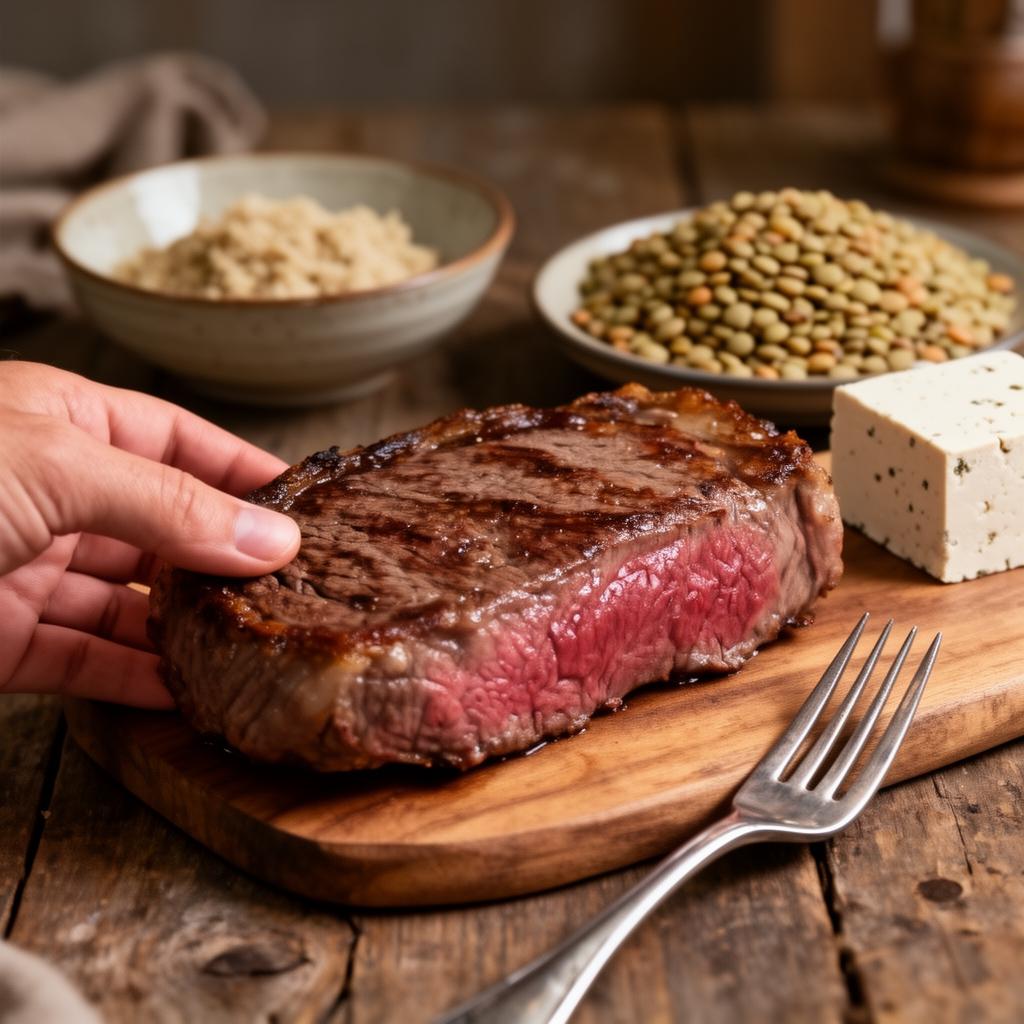 Hand holding beef steak with lentils and tofu blurred in background, symbolizing protein comparison.
Read next
The common questions
People also ask
Sources
- Proceedings of the National Academy of Sciences - Comparative life cycle assessment of beef production
- Hayek et al., Environmental Research Letters - Land use for grass-fed beef
- Global Change Biology - Review of grazing management and carbon sequestration
- Poore & Nemecek, Science - Reducing food's environmental impacts through producers and consumers
- EAT-Lancet Commission - Food in the Anthropocene
- FAO - Tackling Climate Change Through Livestock